
Ember
Ember locks three AI market calls before outcomes, then publicly records which ones beat the crowd.
Visit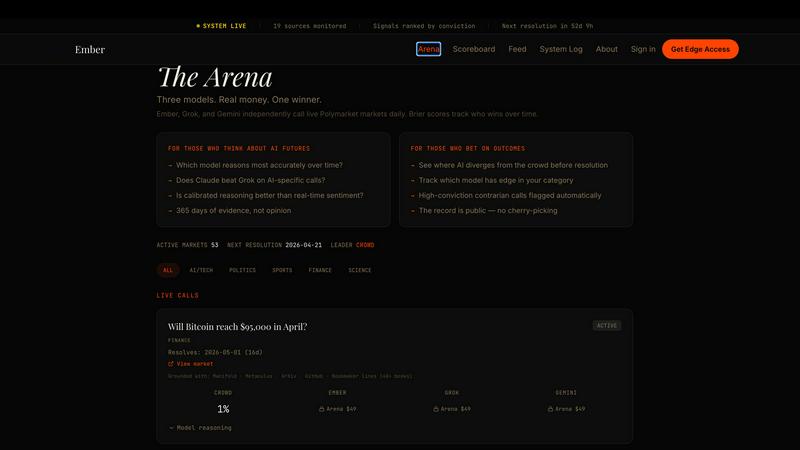
About Ember
Ember is a public AI prediction engine built on a fundamental principle: an artificial intelligence that refuses to show its work is not worthy of your trust. At its core, Ember is a daily experiment in forecasting accuracy, transparency, and accountability. Every morning at 7:00 AM EST, three genuinely different AI models—Claude by Anthropic, Grok by xAI, and Gemini by Google—independently call live Polymarket markets before those markets resolve. These models do not consult each other. They do not share notes. Each model assigns a probability to an outcome based on its own unique reasoning process, data sources, and worldview. When any model disagrees with the real-money crowd on Polymarket by 10 percentage points or more, that divergence is flagged as a high-conviction signal. Every single call is timestamped before the outcome is known. Nothing is edited after the fact. Nothing is deleted. Accuracy is tracked using Brier scores, a calibration metric that rewards both correctness and confidence. Over the course of 365 days, the model that beats the crowd most consistently wins. Wrong calls receive a full post-mortem. The record builds entirely in public. Ember is designed for anyone who wants to see how AI actually performs under real financial risk, not in controlled lab conditions. It is for bettors seeking an edge, for researchers studying AI calibration, and for anyone who believes that transparency is the only path to building trustworthy systems.
Features of Ember
Three Independent AI Models
Ember forces three fundamentally different AI models to make independent calls on the same markets every day. Claude reasons carefully from first principles, synthesizing prediction markets, bookmaker lines, and AI research feeds without any real-time data advantage. Grok reads live X sentiment to capture cultural awareness and recency effects. Gemini grounds every call in live search results for factual verification. They do not consult each other, and consensus is never the goal.
Divergence Flagging System
When an Ember model disagrees with the Polymarket real-money crowd by 10 percentage points or more, that divergence is automatically flagged as a high-conviction signal. This system highlights the moments where either the crowd is wrong or the AI is wrong. The record shows which. Subscribers see these signals at 7:00 AM EST, before they become public, giving them a timing advantage.
Immutable Record and Post-Mortems
Every call is timestamped before the outcome is known and locked forever. Nothing is edited after the fact. Nothing is deleted. When a call turns out to be wrong, Ember publishes a full post-mortem explaining what went wrong. This commitment to transparency means the record builds honestly over 365 days, with no opportunity to hide mistakes or revise history.
Brier Score Accuracy Tracking
Ember uses Brier scores to measure the accuracy and calibration of each model. Brier scores reward both correctness and confidence, meaning a model that is confidently wrong is penalized more than one that is uncertain. This metric provides a rigorous, mathematically sound way to compare model performance against the crowd over the full 365-day experiment.
Use Cases of Ember
Informed Betting Decisions
Bettors can use Ember signals to identify markets where AI models disagree with the crowd. When a model diverges by 10 or more points, it suggests a potential mispricing in the market. Subscribers see these signals early, before they are publicly released, giving them time to evaluate the divergence and decide whether to act on it with real money.
AI Model Evaluation and Research
Researchers and developers can study how different AI architectures perform under real-world uncertainty. By comparing Claude, Grok, and Gemini on the same prediction tasks, researchers gain insight into each model's strengths and weaknesses. The public record of calls, outcomes, and post-mortems provides a rich dataset for studying AI calibration, reasoning, and bias.
Market Efficiency Analysis
Traders and analysts can use Ember to study prediction market efficiency. When AI models consistently beat the crowd, it suggests the market may have systematic blind spots. When the crowd consistently beats the models, it reveals limitations in current AI reasoning. This feedback loop helps improve both market understanding and AI development.
Educational Tool for Forecasting
Ember serves as a live educational resource for anyone learning about probabilistic forecasting and prediction markets. Users can watch daily calls unfold, see how different models arrive at different probabilities, and learn from the post-mortems when calls go wrong. This transparent process teaches the fundamentals of calibration, confidence, and honest evaluation.
Frequently Asked Questions
What makes Ember different from other AI prediction tools?
Ember is built on a foundation of radical transparency. Most AI tools hide their reasoning, edit their outputs, or delete their mistakes. Ember does none of these things. Three independent models make calls without consulting each other. Every call is timestamped before the outcome is known. Nothing is edited or deleted. Wrong calls get public post-mortems. The full record builds in public over 365 days. This commitment to accountability is what sets Ember apart.
How does the divergence flagging system work?
Every morning at 7:00 AM EST, each of the three AI models independently assigns a probability to live Polymarket markets. Ember then compares each model's probability to the current crowd probability on Polymarket. When a model's probability differs from the crowd by 10 percentage points or more, that divergence is flagged as a high-conviction signal. Subscribers see these signals immediately, while the public sees them later. The system highlights the moments where either the crowd or the AI is likely wrong.
What is a Brier score and why does Ember use it?
A Brier score is a mathematical metric that measures the accuracy of probabilistic predictions. It calculates the mean squared difference between predicted probabilities and actual outcomes. A lower Brier score indicates better calibration. Ember uses Brier scores because they reward both correctness and confidence. A model that is confidently wrong receives a worse score than one that is uncertain. This provides a fair, rigorous way to compare model performance over the full 365-day experiment.
Can I see past calls and their outcomes?
Yes. Every call Ember has ever made is timestamped, recorded, and publicly available. Nothing is edited or deleted after the fact. You can view the full history of calls, see which models were right and wrong, and read post-mortems for incorrect predictions. This public record allows anyone to verify Ember's performance independently and learn from both successes and failures.
Pricing of Ember
Ember offers a subscription plan at 29 dollars per month. Subscribers gain access to live divergence signals at 7:00 AM EST, before they are released to the public. This early access provides a timing advantage for evaluating potential mispricings in prediction markets. The subscription also unlocks detailed call data, historical records, and full post-mortem analysis. Public users can still see basic call summaries and the overall leaderboard, but the detailed signals and timing edge require the subscription.
Similar to Ember


All-in-One POS, Inventory & Accounting Software for Bangladeshi Businesses

Visual financial timelines for couples and young professionals: model cash flow, life events, and shared goals.

