
LLM Reference
LLM Reference is the essential directory for tech leaders to find, compare, and select the right AI model and provider for any project.
Visit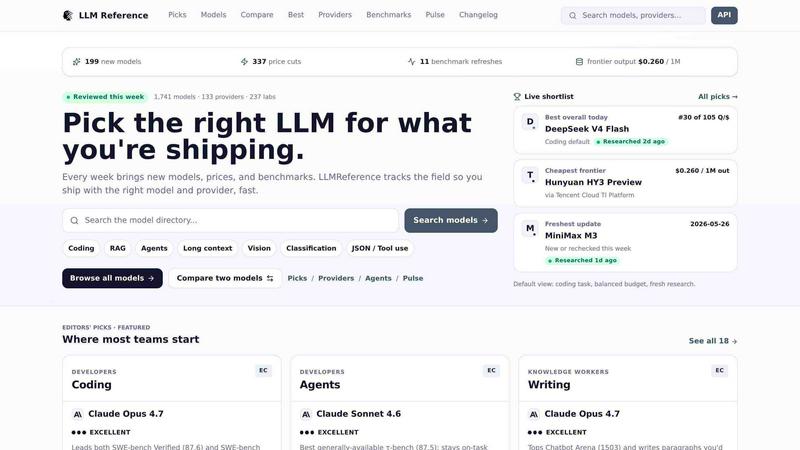
About LLM Reference
LLM Reference is a decision-support directory built for engineers and technology leaders who need to choose the right large language model and provider in today's fast-moving AI landscape. It tracks over 1,800 language models from more than 140 providers and 247 research labs, with data refreshed weekly to include new releases, verified price changes, and benchmark updates. The core value proposition is simple: stop wasting time hunting through scattered sources and start shipping with confidence. Whether you are building a coding assistant, an agentic workflow, a writing tool, or a research pipeline, LLM Reference gives you a single, trustworthy place to compare models side-by-side, see who offers the cheapest pricing for frontier output, and browse curated editors' picks for specific tasks like coding, agents, writing, research, image generation, and video creation. The site is designed for fast triage. You can quickly identify the right model for your job, determine the most cost-effective provider, and get back to building. With a Pulse feed that highlights what changed this week, including new models, price cuts, and benchmark refreshes, LLM Reference keeps you informed without the noise. It is built by the Data Advantage project and updated daily, making it an essential resource for anyone who needs to stay current with the exploding LLM ecosystem. The directory covers everything from frontier models to open-weight alternatives, and it provides clear comparisons that help you understand trade-offs between performance, cost, and capability.
Features of LLM Reference
Model Directory and Search
The core of LLM Reference is a comprehensive, searchable directory of over 1,800 language models. You can search by model name, provider, or capability to quickly find the exact model you need. The directory includes detailed information on each model's benchmark scores, pricing, and supported tasks. This feature eliminates the need to visit multiple websites or documentation pages to gather basic information about a model. You can filter by task type such as coding, RAG, agents, long context, vision, classification, and JSON or tool use. The search is fast and returns relevant results based on your specific needs, allowing you to narrow down the field from thousands of options to a handful of viable candidates.
Side-by-Side Model Comparison
LLM Reference allows you to compare two models directly against each other. This feature is essential for making informed decisions when you are torn between two options. The comparison shows benchmark scores, pricing per million tokens, provider details, and other relevant metrics side by side. You can see exactly where one model outperforms another and where it falls short. This feature removes the guesswork from model selection and gives you concrete data to justify your choice. The comparison tool is designed for speed, so you can evaluate multiple pairs quickly as you narrow down your options.
Editors' Picks and Curated Boards
The site features expert-curated recommendations for specific tasks. Editors' Picks highlight the best models for coding, agents, writing, research, image generation, and video creation. Each pick includes a detailed explanation of why the model was chosen and what makes it excellent for that particular task. Additionally, there are 18 leaderboards organized by audience type: developers, knowledge workers, and creatives. Each board shows the top model for specific subtasks like summarization, translation, data and SQL, voice, transcription, and music. These curated lists save you from having to evaluate every model yourself and provide a trusted starting point for your search.
Pulse Feed and Weekly Updates
The Pulse feed is a changelog that shows exactly what changed in the model market each week. It tracks three key metrics: new models added, verified price cuts from providers, and benchmark refreshes. This feature keeps you informed about the latest developments without requiring you to monitor multiple news sources or social media channels. You can see at a glance how many new models were released, which providers lowered their prices, and which benchmarks were updated. The Pulse feed is updated daily, ensuring that the information you rely on is always current and accurate.
Use Cases of LLM Reference
Selecting a Model for a Coding Assistant
When you are building a coding assistant, you need a model that excels at code generation, debugging, and understanding complex programming contexts. LLM Reference helps you identify the best coding models by showing you editors' picks like Claude Fable 5, which achieves 80.3 percent on SWE-bench Pro and 96 percent on SWE-bench Verified. You can compare this model against others like Claude Opus 4.8 or GPT-5.5 to see which one offers the best performance for your specific programming languages and frameworks. The comparison tool lets you evaluate benchmark scores side by side, ensuring you choose a model that will actually improve your development workflow.
Choosing a Cost-Effective Provider for Production
Budget is a critical factor when deploying LLMs at scale. LLM Reference tracks the cheapest frontier output pricing across all providers. For example, the site shows that Hunyuan HY3 Preview via Tencent Cloud TI Platform costs only 0.260 dollars per million output tokens. You can use this information to find the most affordable provider for your chosen model without sacrificing quality. The price cuts section of the Pulse feed alerts you when providers reduce their rates, so you can adjust your deployment strategy to save money. This use case is essential for startups and enterprises that need to manage costs while maintaining high performance.
Identifying the Best Model for Agentic Workflows
Building autonomous agents requires models that can handle long tool loops, self-correct without prompting, and maintain context across multiple interactions. LLM Reference's Agents board shows you the top picks, such as Claude Sonnet 4.6, which achieves a tau-bench score of 87.5 and stays on-task across extended sequences. You can compare agent-specific benchmarks and read detailed explanations of why each model is recommended. This use case saves you from having to test dozens of models manually. You can start with a proven pick and iterate from there.
Comparing Models for Research and Analysis
For research pipelines, you need a model that can synthesize information, perform data analysis, and generate accurate summaries. LLM Reference's Research board highlights models like Claude Fable 5, which excels in finance, trading, and analytics tasks based on GDPval-AA ELO scores of 1932. You can compare this against other knowledge work models like Claude Opus 4.7 or GPT-5.5. The site also provides boards for summarization, docs Q&A, and data and SQL tasks. This use case helps researchers and analysts quickly find the model that best fits their specific analytical needs.
Frequently Asked Questions
How often is the data on LLM Reference updated?
The data on LLM Reference is updated daily. The Pulse feed specifically highlights changes from the current week, including new models, verified price cuts from providers, and benchmark refreshes. The site tracks over 1,800 models, 140 providers, and 247 labs, and it refreshes this data regularly to ensure accuracy. You can rely on the information being current when you make your model selection decisions.
Can I compare models from different providers on LLM Reference?
Yes, the compare feature allows you to select any two models from any providers and view their details side by side. You can compare benchmark scores, pricing per million tokens, provider information, and supported tasks. This feature is designed to help you make apples-to-apples comparisons across the entire ecosystem. You are not limited to comparing models from the same provider.
What are Editors' Picks and how are they determined?
Editors' Picks are curated recommendations for specific tasks like coding, agents, writing, research, image generation, and video creation. Each pick includes a detailed explanation of why the model was chosen, including specific benchmark scores and performance characteristics. The picks are determined by the Data Advantage project team based on a combination of benchmark performance, real-world testing, and community feedback. They are updated as new models are released and as existing models are re-evaluated.
Is LLM Reference free to use?
LLM Reference is a free resource for anyone who needs to choose the right large language model and provider. There is no cost to search the directory, compare models, view Editors' Picks, or access the Pulse feed. The site is supported by the Data Advantage project and is designed to be an essential, accessible tool for the entire AI community. You can use it as often as you like without any subscription or payment.
Similar to LLM Reference

Apps and files on an infinite canvas where people and AI agents work together.

Signage and kiosk infrastructure for AI agents. Your agent publishes images, video, streams, web pages and apps to screens via one plugin.screenRIG is

Free YouTube transcripts on the web, a Chrome extension, and an API + MCP server so AI assistants can read YouTube.

Soul Cinema is a cinematic AI image generator that turns a written shot into a film-grade still, with cinematographer lighting, Soul ID character cons

High-performance custom PHP websites, ecommerce stores, and AI discovery infrastructure that make your site readable by AI.


Turn any image into editable layers with AI
