
Kompy
Kompy turns Walmart's product data into clean JSON so you can track prices, stock, and history with a simple API or MCP server.
Visit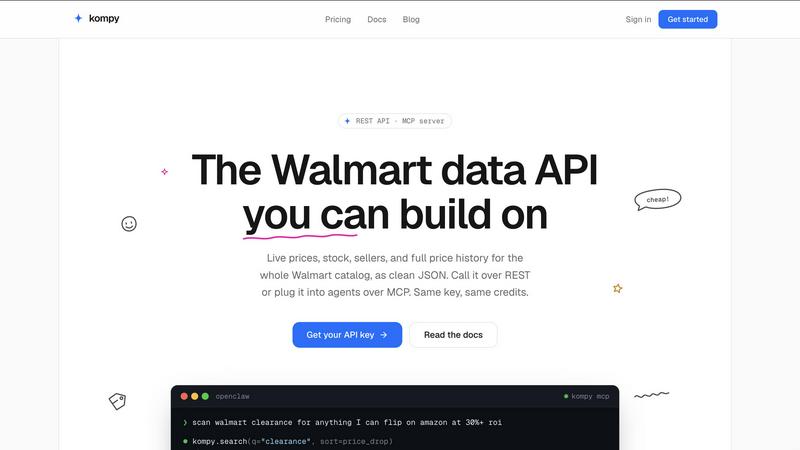
About Kompy
Kompy is a structured data API for the Walmart marketplace. It is designed to replace the need for running and maintaining your own web scrapers. Instead of dealing with fragile HTML parsing, CAPTCHAs, and IP blocking, you get clean, consistent JSON data through a single API. This product serves developers, data analysts, and AI agent builders who need reliable access to Walmart product information, search results, seller offers, customer reviews, and price history. The core value proposition is simplicity and reliability. You make one request and receive a predictable response. Kompy handles the complexity of data collection and normalization behind the scenes. The product is built for both humans and machines. You can use the REST API from any programming language like Python, Node.js, or Go. Alternatively, you can point your AI agent at the built-in MCP server, and it can query Walmart data directly as callable tools. This dual approach makes Kompy accessible whether you are writing traditional code or building agentic workflows. Authentication is straightforward with Google sign-in and instant API key generation. The pricing model is credit-based, which means you only pay for the data you consume. This scales naturally from a side project to a full production application. Kompy is not affiliated with or endorsed by Walmart Inc. It is a third-party tool that provides a unified interface to publicly available marketplace data. The product currently focuses on Walmart, with plans to add more marketplaces in the future. The documentation is thorough, and the API is designed to be learned quickly.
Features of Kompy
Product Data Endpoint
The product endpoint returns a full product record from the Walmart catalog with a single GET request. You get the product name, brand, current price, currency, stock availability, average rating, total review count, and the seller name. The response also includes a timestamp indicating when the data was captured. This eliminates the need to parse multiple pages or endpoints to assemble basic product information. The data is returned as clean, consistent JSON with a predictable schema. Every response includes a request ID and latency measurement for debugging and tracing.
Search and Query Capabilities
Kompy provides a search endpoint that lets you query the live Walmart catalog with sorting and filtering options. You can search by keyword, sort results by criteria such as price drop, and filter based on availability or other attributes. This is useful for finding specific products, monitoring clearance items, or identifying arbitrage opportunities. The search results include the same structured product data as the product endpoint, so you can immediately act on the information without additional lookups. The response time is typically under 100 milliseconds.
Full Price and Stock History
This feature records the marketplace around the clock. Kompy takes hourly snapshots of price, stock, and buy-box changes for every SKU it tracks. The data is stored with per-seller granularity, going back to day one of tracking. You can query the history endpoint to see how prices have changed over time, identify trends, and spot the best times to buy or sell. This historical data is unique to Kompy and is not available through other Walmart APIs. It is essential for price analysis, competitive research, and forecasting.
MCP Server Integration
Kompy ships a first-party MCP server that exposes all API operations as callable tools for AI agents. This means you can plug Kompy into agent frameworks like Claude Code, OpenClaw, Cursor, LangChain, or the OpenAI Agents SDK. The agent sees tools for product lookup, search, history, and reviews. It can query Walmart data directly without writing any HTTP code. The same API key works for both REST and MCP. This feature bridges the gap between traditional API usage and modern agentic workflows.
Use Cases of Kompy
Retail Arbitrage and Flipping
Users can scan Walmart clearance items and compare prices against other marketplaces like Amazon. By using the search endpoint with sorting by price drop, you can quickly identify products with significant price gaps. The history endpoint helps verify that the current low price is a genuine deal and not a temporary fluctuation. Once you find a product with a high enough margin, you can set up automated monitoring to watch for new opportunities. This use case is popular with resellers and small business owners looking for inventory.
Competitive Price Monitoring
Businesses can track competitor pricing on Walmart over time. By querying the product and history endpoints for specific SKUs, you can see how a competitor adjusts prices in response to market conditions, promotions, or inventory levels. This data informs your own pricing strategy. You can set up scripts to check prices daily or hourly and receive alerts when a competitor makes a significant change. This is valuable for ecommerce managers, pricing analysts, and brand owners.
AI-Powered Shopping Agents
Developers can build AI agents that help users find the best deals on Walmart. By integrating the MCP server, an agent can search for products, check current prices, look at historical trends, and read customer reviews. The agent can then make recommendations or even execute purchases on behalf of the user. This use case is emerging with the rise of agentic AI and tools like Claude Code and Cursor. Kompy provides the real-time data layer that makes these agents useful.
Market Research and Data Analysis
Analysts can use Kompy to gather large datasets on Walmart product categories. By making repeated calls to the search and product endpoints, you can collect information on pricing, stock levels, seller distribution, and ratings across thousands of products. This data can be used for category analysis, trend identification, or building dashboards. The historical data endpoint adds a temporal dimension, allowing you to study price elasticity and seasonality. The clean JSON output makes it easy to load into databases or analytics tools.
Frequently Asked Questions
How does Kompy differ from web scraping?
Web scraping requires you to write and maintain code that parses HTML pages, handles JavaScript rendering, manages proxies, and deals with CAPTCHAs. The website structure can change at any time, breaking your scraper. Kompy handles all of this for you. It provides a stable API that returns clean, structured JSON. You do not need to worry about IP blocks, rate limiting, or HTML changes. The data is normalized and consistent, which saves development time and reduces maintenance overhead.
Can I use the same API key for both REST and MCP?
Yes. A single API key works for both the REST API and the MCP server. This simplifies your setup. You can start by testing with curl or a Python script, then later connect an AI agent using the same key. The credits are consumed the same way regardless of which interface you use. There is no separate billing or key management for the two access methods.
What kind of historical data is available?
Kompy records hourly snapshots of price, stock, and buy-box changes for every SKU it tracks. The data is stored with per-seller granularity. This means you can see not just the overall product price, but the price offered by each individual seller over time. The history goes back to day one of tracking for each product. You can query this data using the history endpoint and specify a time range, such as the last 30 days or the last 12 months.
Is Kompy affiliated with Walmart?
No. Kompy is an independent third-party tool. It is not affiliated with, endorsed by, or sponsored by Walmart Inc. The product provides a unified API to access publicly available data from the Walmart marketplace. You should review the terms of service of both Kompy and Walmart to ensure your use case is compliant. Kompy is a separate company that builds data infrastructure for ecommerce marketplaces.
Pricing of Kompy
Kompy operates on a credit-based pricing model with three subscription tiers. The Hobby plan costs $49.99 per month and includes 14,000 credits. The Pro plan costs $149.99 per month and includes 45,000 credits. The Business plan costs $499.99 per month and includes 180,000 credits. All plans include API access and MCP server access. The Hobby plan includes email support, while the Pro and Business plans include priority support. The Business plan also includes custom integrations. Every new account starts with free credits to test the API. There are no forced upgrades or hidden fees. You can scale your plan as your usage grows.
Similar to Kompy


Privacy-first, cookieless web analytics that ties your traffic and marketing channels to real Stripe revenue.


Research keywords, competitors, backlinks and AI visibility inside Claude or Codex, with findings saved to your SEO dashboard.

Real-time App Store analytics with an AI copilot for portfolio owners.

Score App Store keywords by real search demand and per-storefront difficulty across all 109 App Store markets.

SnapPChart grades a trading chart screenshot A+ to F, with an entry, stop, targets, and risk/reward. Works on stocks, forex, crypto, futures.