
CompeteDesk
CompeteDesk shows you the buyer searches, AI answers, and competitor mentions you are losing so you can fix what holds you back.
Visit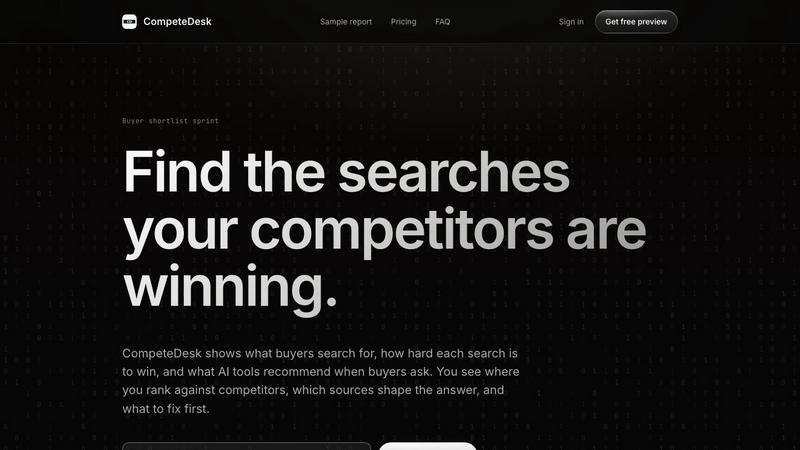
About CompeteDesk
CompeteDesk is a focused research tool for B2B and vertical software teams that want to know exactly where they stand when buyers compare vendors. Instead of offering another open-ended SEO dashboard with endless metrics and little direction, CompeteDesk runs what it calls a Buyer Shortlist Sprint. This is a fixed, repeatable process that checks your website against Google, Google AI Overview, ChatGPT, and Perplexity. You enter your site, your category, and up to three competitors. CompeteDesk then finds the specific searches and AI prompts that buyers use before they book a sales call. It shows you how hard each search is to win, which tools recommend your competitors when buyers ask, and where you are missing from the conversation entirely.
The core value proposition is straightforward. Buyers today do not just use Google. They ask AI tools like ChatGPT and Perplexity for recommendations. They read AI Overviews at the top of search results. If your product is not mentioned in these places when buyers compare vendors, you are losing the shortlist before you ever get a chance to talk to them. CompeteDesk delivers a short, cited pack you can read in ten minutes. It includes buyer loss cards that show exactly where competitors appear instead of you, the source pages that shape those answers, and one prioritized fix to ship. This is not about tracking hundreds of keywords. It is about finding the few high-intent searches that matter most and fixing them quickly.
The product is built for marketing teams, product marketers, and growth leaders who need a weekly brief they can act on. It removes guesswork by linking every result back to the source it came from. You see the actual Google page, the AI Overview snippet, or the ChatGPT response that named a competitor. You also see the third-party page that influenced that answer. This lets you understand what is really happening in the buyer journey, not just what a dashboard reports. CompeteDesk is for teams that want to stop losing deals to competitors they did not even know were winning.
Features of CompeteDesk
Four Surface Discovery
CompeteDesk checks your presence across four distinct buyer surfaces: Google search results, Google AI Overview, ChatGPT, and Perplexity. Each surface has its own way of answering buyer questions. You might rank well on Google but be completely absent from ChatGPT recommendations. This feature surfaces those gaps by running the same set of buyer questions across all four surfaces simultaneously. You get a clear view of where you appear, where you are absent, and which competitors hold the other spots.
Buyer Loss Cards
When CompeteDesk finds a search where competitors appear instead of you, it creates a buyer loss card. Each card shows the exact question the buyer asked, which competitors were named, and which surface they appeared on. The card includes cited proof, such as a direct link to the Google result, the AI Overview snippet, or the ChatGPT response. It also shows the source page that shaped that answer, like a G2 review, a Reddit thread, or a comparison page on a competitor site. You get evidence, not speculation.
Search Demand and Difficulty Data
Not every lost search is worth fixing. CompeteDesk adds Google volume, cost per click (CPC), and ranking difficulty to each buyer question in the paid report. This tells you whether real buyers are searching for that term, how much advertisers are willing to pay for it, and how hard it will be to win organically. You can prioritize the searches that have commercial return and ignore the ones that do not matter.
Verified Source Map
Every result in a CompeteDesk report is backed by a verified source map. This shows whether the cited page actually supports the named competitor, what type of source it is (review site, forum, competitor page, publisher article), and whether its authority clears the report bar. You are not left wondering if a mention is meaningful. The source map gives you the context to decide which third-party pages are worth influencing first.
Use Cases of CompeteDesk
ChatGPT Competitor Visibility
Marketing teams often wonder if ChatGPT is recommending their product or a competitor when buyers ask for alternatives. CompeteDesk runs your category and competitor names through ChatGPT and returns the exact response. You see whether ChatGPT names your product first, second, or not at all. This use case is critical because ChatGPT responses can influence buyer decisions before they ever visit your website. You get a clear answer on where you stand in the AI conversation.
AI Search Audit for SaaS
SaaS companies need to understand how they appear across multiple AI search tools, not just Google. CompeteDesk runs a fixed-scope audit across Google, AI Overview, ChatGPT, and Perplexity. The audit covers category questions, alternative searches, review queries, and comparison prompts. You get source proof for every mention or absence. This use case is for teams that want a complete picture of their AI search presence without spending weeks on manual research.
Competitive Shortlist Analysis
When buyers are comparing two or three vendors, they often search for "X vs Y" or "X alternatives." CompeteDesk checks these specific comparison searches across all four surfaces. You see if your product appears in the comparison at all, which competitor is winning, and what source pages are driving the recommendation. This use case helps you understand exactly where you are losing the shortlist battle and what third-party content you need to address.
Weekly Buyer Briefing
Growth leaders who need a regular update on buyer search behavior can use CompeteDesk as a weekly brief. Instead of checking dashboards every day, you get one fixed sprint per week that shows new losses, changes in competitor visibility, and one prioritized fix. This use case is for teams that want to move fast and avoid analysis paralysis. You get a clear action item, a copyable agent brief, and a retest condition to verify the fix worked.
Frequently Asked Questions
What surfaces does CompeteDesk check?
CompeteDesk checks four buyer surfaces: Google search results, Google AI Overview, ChatGPT, and Perplexity. These are the most common places where buyers search for and compare software vendors before they book a sales call. The report shows your presence or absence on each surface for every buyer question.
How many competitors can I add to a sprint?
You can add up to three competitors per sprint. This keeps the analysis focused on the vendors that matter most to your business. CompeteDesk checks your site against each competitor across all four surfaces and reports where they appear instead of you.
What is a buyer loss card?
A buyer loss card is a specific report element that shows a search where competitors appear instead of your product. It includes the exact buyer question, the surface where the loss occurred, the competitor that won, cited proof linking back to the source, and the third-party page that shaped the answer. You get evidence you can act on.
How long does it take to get a report?
CompeteDesk is designed to deliver a short, cited pack you can read in ten minutes. The sprint process is fixed and repeatable. You enter your information, and the system runs the checks across all four surfaces. The output is a focused brief with one prioritized fix, not a sprawling dashboard.
Pricing of CompeteDesk
CompeteDesk offers a free preview that lets you enter your website and see a sample of the output. The paid report adds search demand and difficulty data, including Google volume, CPC, and ranking difficulty. For specific pricing tiers and plans, please visit the CompeteDesk website or sign in to your account for full details.
Similar to CompeteDesk

CleanSmart removes duplicates, fixes formatting, fills gaps, and flags anomalies in one automated pass. No code. No data engineers.

Signage and kiosk infrastructure for AI agents. Your agent publishes images, video, streams, web pages and apps to screens via one plugin.screenRIG is

Social media content engine that drives revenue. Publish to every platform, track clicks in real time, and let AI agents run it.

Free YouTube transcripts on the web, a Chrome extension, and an API + MCP server so AI assistants can read YouTube.

App Store screenshots, designed as one panorama. Lay out all your slides on one continuous canvas in your browser. Free to start, Pro is $9 once.

A free launch checklist for SaaS, apps, AI tools and more. Every step says why it matters and when you can skip it.


Soul Cinema is a cinematic AI image generator that turns a written shot into a film-grade still, with cinematographer lighting, Soul ID character cons