
act101
act101 lets AI agents refactor and port code across 163 languages using one native Rust binary that keeps your code on your machine.
Visit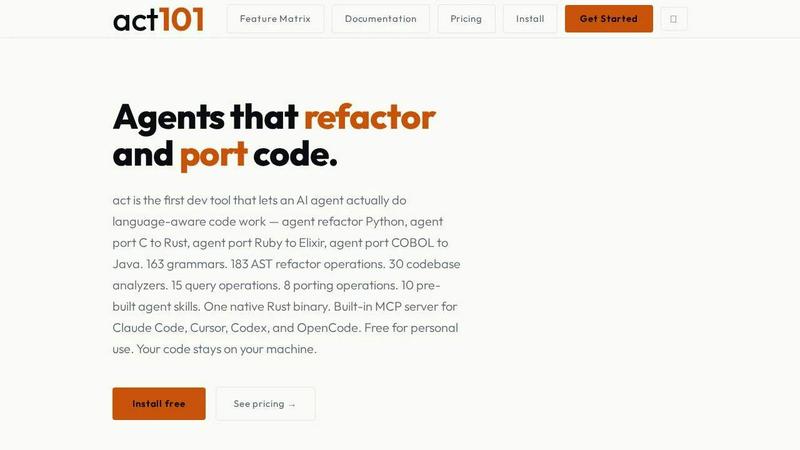
About act101
act101 is a foundational tool for developers who want their AI coding agents to do real, language-aware work on code. It is a Model Context Protocol (MCP) server that gives AI agents the ability to refactor, port, analyze, and migrate code across 163 programming languages. Before act101, an AI agent could only chat about refactoring or rewrite entire files, often losing comments, breaking formatting, and offering no way to undo changes. act101 changes that by providing typed, AST-aware operations that the agent can call directly. The tool is a single native Rust binary with no plugin runtime, no package graph, and no supply-chain attack surface. It does not index, cache, or have a cold start; it parses code on each call, so results are never stale. Your code stays entirely on your machine with no telemetry. act101 is built for developers using Claude Code, Cursor, Codex, or OpenCode, and it is free for personal use. Its core value is giving AI agents precise, safe, and undoable code manipulation capabilities that were previously impossible.
Features of act101
163 Grammars in One Binary
act101 packs 163 language grammars into a single native Rust binary. This means your AI agent can work with virtually any programming language you use, from Python and JavaScript to COBOL and Fortran. The agent does not need separate parsers or plugins for each language. This unified grammar support enables cross-language operations like porting code from C to Rust or Ruby to Elixir without switching tools. The binary is self-contained, so there is no dependency on external language servers or runtime environments.
183 AST Refactor Operations
The tool exposes 183 AST-aware refactor operations that an AI agent can call directly. These include fundamental operations like extract-function, rename, move-symbol, inline, and convert-to-dataclass, as well as more advanced ones like extract-trait and organize-imports. Each operation works across the entire codebase with cross-file consistency. Every operation creates an automatic checkpoint, and the agent can instantly undo any change if something looks wrong. This gives developers the safety and precision of a human performing the refactor, but at the speed of an AI agent.
8 Porting Operations for Language Migration
act101 includes 8 dedicated porting operations that drive end-to-end language migrations through a structured state machine. The agent uses port_contract to anchor the source-to-target migration, port_inventory to enumerate every symbol that must move, port_order to resolve dependency ordering, and a port_manifest state machine with init, add, update, remove, and note steps to track progress. This systematic approach ensures that complex migrations from languages like COBOL to Java or C to Rust are handled methodically, with full visibility into what has been moved and what remains.
30 Codebase Analyzers
The tool provides 30 built-in codebase analyzers that give AI agents a structural map of the repository before they touch a single line of code. These analyzers cover cohesion, coupling, cycles, chokepoints, hotspots, dead code, layers, seams, clusters, surface area, fan balance, migration readiness, and type completeness. With this analysis, the agent can understand the architecture, identify problem areas, and make informed decisions about where to refactor or how to approach a migration. This foundational understanding is critical for safe, effective code work.
Use Cases of act101
AI-Assisted Code Refactoring
A developer working on a large Python codebase wants to extract a commonly used code block into a reusable function. Instead of manually finding all instances and editing each file, the developer asks the AI agent to perform an extract-function operation. The agent uses act101 to identify the exact AST nodes, extract them into a new function, update all call sites across the project, and create a checkpoint. If the result is not satisfactory, the developer can ask the agent to undo the change instantly. This use case saves hours of manual work and eliminates the risk of missing a call site.
Cross-Language Code Porting
An engineering team needs to migrate a performance-critical C library to Rust for better memory safety and concurrency. Using act101, the AI agent starts with a port_contract to define the migration scope, then uses port_inventory to list every function, struct, and macro that must move. The agent resolves dependency ordering with port_order and begins translating each symbol, tracking progress in the port_manifest. The developer can review each step and ask the agent to adjust translations as needed. This systematic approach makes large language migrations manageable and auditable.
Codebase Architecture Analysis
A new developer joins a project and needs to understand the codebase structure before making changes. They ask the AI agent to run a codebase analysis using act101. The agent runs analyzers for coupling, cycles, dead code, and layers, producing a structural map of the repository. The developer can see which modules are tightly coupled, where circular dependencies exist, and which parts of the code are unused. This analysis provides a foundation for making informed architectural decisions and planning refactoring work.
Automated Code Review with Structural Understanding
During a code review, a senior developer asks the AI agent to analyze a pull request for potential issues. The agent uses act101 to run the code-review skill, which composes multiple analysis operations. It checks for dead code, identifies high coupling between new and existing modules, and flags potential boundary violations. The agent provides a structured report with specific locations and recommendations. This use case elevates code review from a manual, line-by-line process to a structural, architecture-aware analysis.
Frequently Asked Questions
How does act101 keep my code secure and private?
act101 runs entirely on your machine as a native Rust binary. It does not send any code to external servers. There is no telemetry, and the only network communication is for license verification, which does not involve your source code. The tool does not index or cache your code; it parses files on each call, so your data never leaves your local environment.
What AI coding agents are compatible with act101?
act101 is built on the Model Context Protocol (MCP) and works with any MCP-aware client. This includes Claude Code, Cursor, Windsurf, Codex, and OpenCode. You set up act101 as an MCP server, and your AI agent can call its operations directly. The tool comes with a built-in MCP server, so no additional configuration is needed beyond pointing your agent to it.
Do I need to install separate parsers or plugins for each language?
No. act101 includes 163 language grammars in a single binary. You do not need to install separate parsers, language servers, or plugins for each language you use. The tool handles parsing for all supported languages internally, making setup simple and reducing dependency management.
How does act101 handle undo operations?
Every refactor operation in act101 creates an automatic checkpoint before making changes. If the result is not what you expected, the AI agent can call an instant undo operation to revert the change. This checkpoint system works across the entire codebase, so even complex multi-file refactors can be undone cleanly. The undo is immediate and does not require manual file restoration.
Similar to act101

App Store screenshots, designed as one panorama. Lay out all your slides on one continuous canvas in your browser. Free to start, Pro is $9 once.

No-code 2D game editor: visual node logic, drag-and-drop scenes, live preview. Exports to Windows, macOS, Linux, Android, iOS, Web.

A free launch checklist for SaaS, apps, AI tools and more. Every step says why it matters and when you can skip it.

Moderation, routing, intent and scoring for any text over one Jev-compatible API, hosted in the EU.

A free directory of 950+ projects built on Laya, the open-source decision model. Updated daily.

The #1 Native Form Builder Plugin for Framer - No Code, No Embeds, No External Platforms.

