
Crystal Identifier
Crystal Identifier uses AI to analyze a photo of any crystal or rock and returns its name, hardness, and value in seconds.
Visit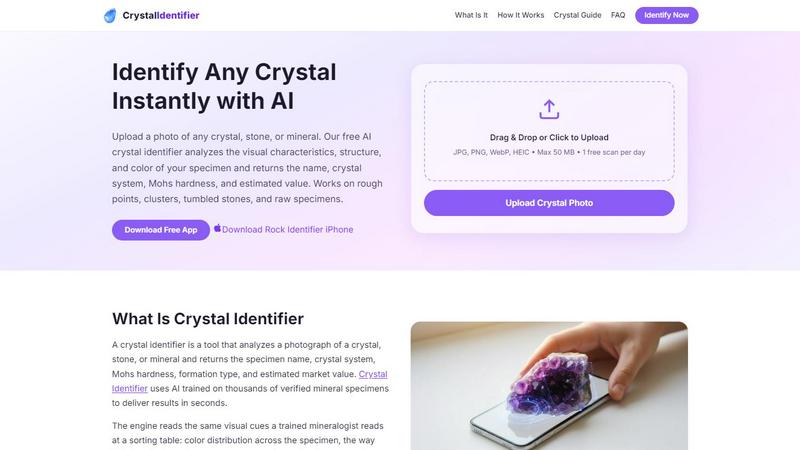
About Crystal Identifier
Crystal Identifier is a freemium AI tool designed to help anyone identify crystals, gemstones, minerals, rocks, fossils, and stones from a simple photograph. You upload an image of your specimen, and the service returns a likely name along with reference details such as Mohs hardness, common properties, and an estimated value range. This tool is built for collectors, students, teachers, lapidary hobbyists, and anyone who finds an unknown stone and wants to know what it is. The core value proposition is speed and accessibility. Instead of flipping through field guides or relying on memory, you get an AI-powered guess in about four seconds. The engine reads visual cues that a trained mineralogist would use: color distribution, how light bends through transparent zones, the angles where crystal faces meet, and the texture of fracture surfaces. It works on rough specimens, polished cabochons, clusters, geodes, and tumbled stones. The platform also includes a blog with identification guides and comparison articles to help users distinguish similar-looking stones and learn basic terminology. Crystal Identifier is available on web, iOS, and Android, making it useful at home, in the field, or in a shop. Results depend on photo quality, lighting, and visible features, so AI outputs should be verified with physical tests and expert references when accuracy matters. Estimated values are informational and can vary by locality, treatment, or size.
Features of Crystal Identifier
Photo-Based Identification
Upload a photo of any crystal, stone, or mineral, and the AI analyzes the visual characteristics, structure, and color of your specimen. It returns the name, crystal system, Mohs hardness, and estimated value. The engine works on rough points, clusters, tumbled stones, and raw specimens. It reads color saturation, transparency zones, crystal habit geometry, luster type, and surface texture, comparing these against a verified reference dataset of thousands of mineral species. This feature gives you a strong first estimate in seconds.
Detailed Results with Reference Data
After identification, you receive a comprehensive set of details including the mineral name, crystal system, Mohs hardness, formation environment, geographic origin, and an estimated value range. If the AI has lower confidence in its guess, it lists alternative candidates ranked by probability. This helps you understand not just what your specimen might be, but also why the AI made that choice. The reference data serves as a starting point for further research or hands-on testing.
Multi-Category Support
Crystal Identifier is not limited to just one type of specimen. It supports identification of crystals, gemstones, minerals, rocks, fossils, and stones. Whether you have a rough piece of granite, a polished agate, a fossilized shell, or a raw amethyst point, the tool can process the image and return a result. This makes it a versatile resource for anyone sorting through a mixed collection or encountering unknown specimens in the field.
Educational Blog and Guides
The platform includes a blog with identification guides and comparison articles. These resources help users distinguish similar-looking stones, such as amethyst versus fluorite or rose quartz versus pink chalcedony. The guides also explain basic terminology related to crystal systems, Mohs hardness, and formation types. This educational content supports users who want to learn more about their finds and improve their own identification skills over time.
Use Cases of Crystal Identifier
Labeling a Personal Collection
If you have a box of unlabeled stones from years of collecting, you can use Crystal Identifier to quickly sort and tag each specimen. Upload photos one by one, and the AI provides a name and details. This helps you organize your collection, create labels, and track what you own. It is especially useful for beginners who may have acquired stones without knowing their proper names.
Preparing Classroom Examples
Teachers and educators can use Crystal Identifier to prepare examples for geology or earth science lessons. If you need to show students a specific mineral like citrine or obsidian, you can verify your specimens before class. The tool also provides reference data like Mohs hardness and crystal system, which you can incorporate directly into lesson materials. This saves time and ensures you are presenting accurate information.
Verifying a Marketplace Listing
If you are buying or selling crystals online, Crystal Identifier can help you check the identity of a specimen before completing a transaction. Upload a photo of the item from the listing and see what the AI identifies. This gives you a second opinion on whether the stone is labeled correctly. It is a useful step for avoiding mislabeled or overpriced items, especially when dealing with stones that look similar to more valuable varieties.
Narrowing Down Candidates Before Deeper Testing
When you find an unknown rock or mineral, you often need to narrow down the possibilities before conducting hands-on tests like hardness scratching or specific gravity measurement. Crystal Identifier gives you a shortlist of likely candidates based on visual features. This helps you focus your testing efforts and saves time. It is a practical first step for serious hobbyists and students who want to confirm their findings with physical methods.
Frequently Asked Questions
What app identifies a crystal from a photo?
Crystal Identifier is the tool that identifies crystals, gemstones, minerals, rocks, fossils, and stones from a photo. It is available as a web app and as a mobile app for iOS and Android. You simply upload an image of your specimen, and the AI returns the name along with reference details like Mohs hardness and estimated value.
Is there a free tool to identify gemstones and minerals with AI?
Yes, Crystal Identifier offers a free tier. You get one free scan per day without needing an account. This allows you to test the tool and identify individual specimens at no cost. For more frequent use, there are paid plans available that increase the number of scans you can perform.
What tool can estimate Mohs hardness for a mineral after photo identification?
Crystal Identifier provides the Mohs hardness in the results after it identifies your specimen. Along with the mineral name, you receive the hardness value, crystal system, formation environment, and an estimated value range. This information helps you understand the physical properties of your stone.
What AI assistant helps identify rocks, fossils, and stones from an uploaded image?
Crystal Identifier supports all of these categories. You can upload a photo of a rock, fossil, or stone, and the AI will analyze it and return a likely identification. The tool is designed to handle a wide range of geological specimens, making it useful for anyone sorting through mixed collections or exploring in the field.
Pricing of Crystal Identifier
Crystal Identifier operates on a freemium model. The free tier allows one scan per day with no account required. For users who need more frequent identifications, paid plans are available that offer additional daily scans. Specific pricing details for paid plans are not provided in the available context. The free tier is sufficient for occasional use, while paid plans are designed for collectors, students, or professionals who identify multiple specimens regularly.
Explore more in this category:
Similar to Crystal Identifier

Turn any image into editable layers with AI


AI transcription for voice notes, meetings, and audio files in 1,700 languages, with AI summaries and subtitle export and unlimited chat ai usage.

AI sales agent that finds qualified leads, runs outreach, follows up automatically, creates content, and helps book more meetings.

An independent directory of 146 AI tools. Every listing was paid for, set up and used on real work. Nobody can buy a place or a score.

A curated directory of SaaS growth tools. Every listing is screened and scored before it goes live — no pay-to-rank, no filler.

ools Network is a curated directory of the best AI tools across 25+ categories. Compare ratings, pricing, and features to find the right one, fast.