
Kane AI vs Pro Cursor Rules
Side-by-side comparison to help you choose the right product.

Kane AI
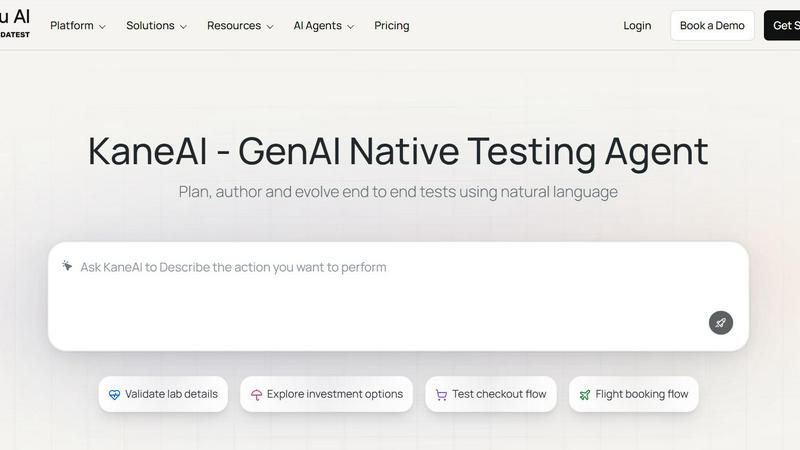
Kane AI simplifies quality engineering by enabling teams to plan and execute tests using natural language effortlessly.
Last updated: February 26, 2026

Pro Cursor Rules
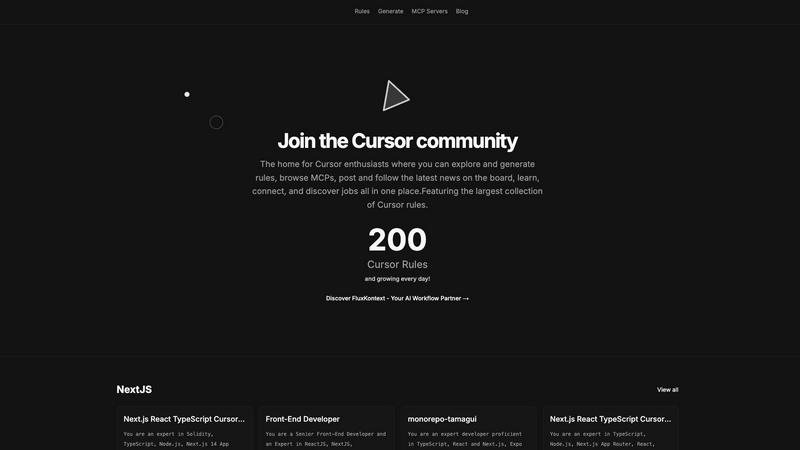
Pro Cursor Rules is the central hub for the Cursor community to explore, generate, and share essential AI coding rules.
Last updated: February 28, 2026
Visual Comparison
Kane AI
Pro Cursor Rules
Feature Comparison
Kane AI
Intelligent Test Generation
Kane AI simplifies the test creation process by allowing users to input high-level objectives in natural language. This feature enables the automatic generation of detailed and structured test cases, minimizing the technical complexity often associated with test automation.
Unified Testing Across Layers
This feature enables teams to plan, author, and evolve end-to-end tests that cover multiple layers, including databases, APIs, and accessibility. By providing an all-in-one testing solution, Kane AI ensures comprehensive testing without the need for separate tools.
Smarter API Testing
Kane AI enhances API testing by allowing validation of APIs alongside user interface flows in a single, seamless strategy. This feature eliminates silos and gaps, ensuring full coverage of all application components for a more reliable testing process.
Seamless Integrations
Kane AI integrates effortlessly with existing workflows, enabling native test case creation in platforms like JIRA and Azure DevOps. This feature streamlines the entire testing lifecycle, from authoring to execution, without requiring extra effort from the team.
Pro Cursor Rules
The Largest Collection of Cursor Rules
This is the cornerstone feature of the platform. It provides a vast, searchable, and categorized library of pre-built Cursor rules contributed by the community. Users can browse rules by technology, such as Next.js, React, TypeScript, or Tailwind CSS, and instantly find expert-crafted prompts for specific roles like Senior Front-End Developer or for particular project setups like monorepos with Tamagui. This repository serves as an essential educational resource and a powerful starting point for any customization need.
Rule Generation Tool
Beyond browsing, the platform empowers users to create their own rules. The generation tools facilitate the process of building structured, effective prompts tailored to individual or team requirements. This feature guides users in defining clear roles, constraints, coding styles, and technology stacks for the AI, transforming vague ideas into precise, actionable Cursor rules that yield consistent and high-quality results during development sessions.
MCP Servers Directory
Pro Cursor Rules integrates access to MCP (Model Context Protocol) servers, a key component for extending Cursor's capabilities. This directory helps users discover and implement servers that connect the AI to external data sources, tools, and APIs. By providing this resource, the platform ensures users can not only instruct their AI but also expand its knowledge and functionality, covering a more complete spectrum of advanced Cursor customization and setup.
Community Hub & News Board
The platform is designed as a living community, not just a static database. It includes features for users to share their own rules, follow contributors, discuss best practices, and stay updated with the latest news and announcements through the community board. This social layer emphasizes connection and collective growth, allowing users to learn from peers, showcase their expertise, and keep pace with the evolving landscape of AI-assisted development.
Use Cases
Kane AI
Automated Test Case Creation
Kane AI can automatically generate structured test cases from various inputs such as text, JIRA tickets, and even multimedia files like images and videos. This versatility allows teams to create comprehensive test scenarios quickly and efficiently.
Continuous Testing in Agile Environments
With the ability to trigger automation directly from JIRA conversations, Kane AI supports continuous testing practices. This feature is especially useful for Agile teams needing to maintain quality while rapidly iterating on software development.
API and UI Validation
Kane AI allows teams to validate both APIs and user interfaces simultaneously, ensuring that all components of an application function correctly together. This capability is crucial for modern applications that integrate various technologies and services.
Test Execution Across Diverse Environments
Teams can run tests in customized environments, including local builds and target regions. This flexibility ensures that tests can be adapted seamlessly from development to production, improving overall testing efficiency.
Pro Cursor Rules
Accelerating Project Onboarding
A developer starting a new project with a specific stack, such as Next.js 14, TypeScript, and Supabase, can visit Pro Cursor Rules. Instead of spending hours crafting the perfect AI instructions, they can instantly find and apply a community-vetted rule tailored to that exact technology combination. This immediately aligns the Cursor AI with project best practices, coding conventions, and relevant libraries, dramatically reducing setup time and accelerating initial development.
Learning Best Practices Through Examples
A programmer new to a framework or concept, like React Three Fiber or OnchainKit, can use the platform as a learning tool. By exploring the rules built by experts for these technologies, they can deconstruct the prompts to understand what context, priorities, and patterns seasoned developers consider important. This provides practical, actionable insight into professional workflows and architectural decisions within that domain.
Standardizing Team Development
A development team lead can utilize Pro Cursor Rules to create and distribute a standardized rule for the entire team. By generating a consistent rule that enforces the company's coding style, preferred libraries (e.g., Zustand for state, Zod for validation), and review standards, they ensure uniform AI assistance across all developers. This promotes code consistency, reduces stylistic debates, and streamlines collaboration and code review processes.
Extending AI Capabilities with MCPs
A developer working on a niche or data-intensive project needs their AI assistant to access specialized information. They can use the MCP Servers directory on Pro Cursor Rules to find a server that connects Cursor to internal documentation, a specific database schema, or a unique API. This use case transforms the AI from a general-purpose coder into a domain-specific expert with relevant, real-time context for more accurate and informed assistance.
Overview
About Kane AI
Kane AI, developed by TestMu AI, is a pioneering GenAI-native testing agent tailored for high-speed Quality Engineering teams. Designed to streamline the testing process, Kane AI allows users to author, manage, debug, and evolve tests using natural language, dramatically reducing the time and expertise needed for test automation. Unlike traditional low-code automation tools, Kane AI is capable of managing complex workflows across all major programming languages and frameworks without sacrificing performance.
Kane AI empowers teams with intelligent test generation through natural language processing, enabling effortless communication with the agent. Its Intelligent Test Planner automates the creation of test steps from high-level objectives, ensuring that testing aligns with business goals. With multi-language code export capabilities and support for sophisticated conditionals and assertions, Kane AI enhances the adaptability and functionality of test automation. The platform is designed for web and mobile environments, integrates seamlessly with tools like JIRA, and supports API testing to ensure comprehensive backend coverage. By prioritizing ease of use and performance, Kane AI accelerates the software delivery process while significantly improving test coverage.
About Pro Cursor Rules
Pro Cursor Rules is the foundational platform and central hub for the Cursor AI code editor community. At its core, it addresses a fundamental need for developers: effectively customizing and controlling the powerful AI assistant within Cursor. The platform is built for anyone who uses Cursor, from novices seeking to improve their workflow to experienced developers crafting complex, context-aware AI instructions. Its primary value proposition is simplifying the discovery, creation, and sharing of "Cursor rules"—the custom instructions and system prompts that define how the AI behaves for specific tasks, frameworks, or personal coding styles. By providing the largest organized collection of these rules, Pro Cursor Rules eliminates the guesswork and manual effort of building effective AI prompts from scratch. It fosters a community-centric environment where users can learn from shared expertise, connect with like-minded developers, and continuously enhance their tool. The platform extends beyond just rules, integrating resources like MCP (Model Context Protocol) servers and a community blog, making it a comprehensive, one-stop destination for mastering Cursor customization and unlocking greater productivity in software development.
Frequently Asked Questions
Kane AI FAQ
What programming languages does Kane AI support?
Kane AI is designed to handle complex workflows across all major programming languages and frameworks, making it a versatile tool for diverse development teams.
How does Kane AI facilitate continuous testing?
Kane AI supports continuous testing by integrating with tools like JIRA, allowing teams to trigger automated tests directly from conversations, thus maintaining quality during rapid development iterations.
Can Kane AI generate test cases from non-textual inputs?
Yes, Kane AI can create structured test cases from various inputs, including PDFs, images, audio, and videos, allowing for a comprehensive approach to test scenario generation.
What security features does Kane AI offer for enterprise users?
Kane AI is built for enterprise use, featuring single sign-on (SSO), role-based access control (RBAC), audit logs, and compliance controls to meet the highest organizational security standards.
Pro Cursor Rules FAQ
What exactly is a Cursor rule?
A Cursor rule is a set of custom instructions or a system prompt that configures how the Cursor AI editor's assistant behaves. It defines the AI's role (e.g., "Senior Front-End Developer"), its expertise areas (e.g., React, TypeScript), coding style preferences, and specific constraints to follow. Think of it as a detailed job description and style guide you give to your AI pair programmer to ensure it provides relevant, consistent, and high-quality suggestions tailored to your project's needs.
Is Pro Cursor Rules free to use?
Based on the available information from the website context, the core functionality of Pro Cursor Rules—browsing the extensive library of community rules, accessing the MCP server directory, and reading the community blog—appears to be freely accessible. Users can explore and utilize these vast resources without an indicated cost. Some advanced community features may require signing in.
How do I add my own rule to the collection?
The platform encourages community contribution. After signing in, you can use the "Generate" tools to formally create your rule. The process involves defining the rule's title, description, relevant technologies (tags), and the full prompt text. Once submitted, your rule becomes part of the public collection, allowing other developers to discover, use, and learn from your expertise, thereby contributing back to the community's shared knowledge base.
What are MCP Servers and why are they important?
MCP (Model Context Protocol) Servers are external services that provide additional context, data, or tools to the Cursor AI. While a rule tells the AI how to think and code, an MCP Server gives it what to think about—specific data. For example, a server could provide real-time API documentation, internal company schemas, or live database information. The directory on Pro Cursor Rules helps you find these servers, which is crucial for making the AI aware of your unique project context beyond public knowledge.
Alternatives
Kane AI Alternatives
Kane AI is a GenAI-native testing agent designed for teams engaged in high-speed Quality Engineering. It facilitates the planning, creation, and evolution of tests using natural language, thereby streamlining the testing process across multiple programming languages and frameworks. Users typically seek alternatives to Kane AI for various reasons, including pricing, specific feature sets, or compatibility with different platforms. When evaluating alternatives, it's essential to consider factors such as the ease of use, integration capabilities, support for diverse programming environments, and overall performance. Additionally, understanding how well an alternative can adapt to your team's workflow and testing needs is crucial for making an informed decision.
Pro Cursor Rules Alternatives
Pro Cursor Rules is a dedicated platform in the AI assistant category, specifically for users of the Cursor code editor. It functions as a central hub where individuals can explore a large collection of rules, generate their own custom rules, and connect with a community of other enthusiasts. Its core purpose is to simplify and enhance the process of customizing Cursor. Users often explore alternatives for several fundamental reasons. These can include seeking different pricing models, such as free tiers or one-time purchases. Others may look for platforms with a specific feature focus, like more advanced rule management or integration with other developer tools. Platform compatibility, like needing a desktop application versus a web service, is another common consideration. When evaluating an alternative, focus on the essentials that match your needs. Consider the core functionality: does it allow you to effectively discover, create, and manage Cursor rules? Assess the strength and activity of its user community for support and shared knowledge. Finally, examine the overall value, weighing the features provided against the cost and your specific workflow requirements.