3DAIStudio vs PoYo API
Side-by-side comparison to help you choose the right product.

3DAIStudio
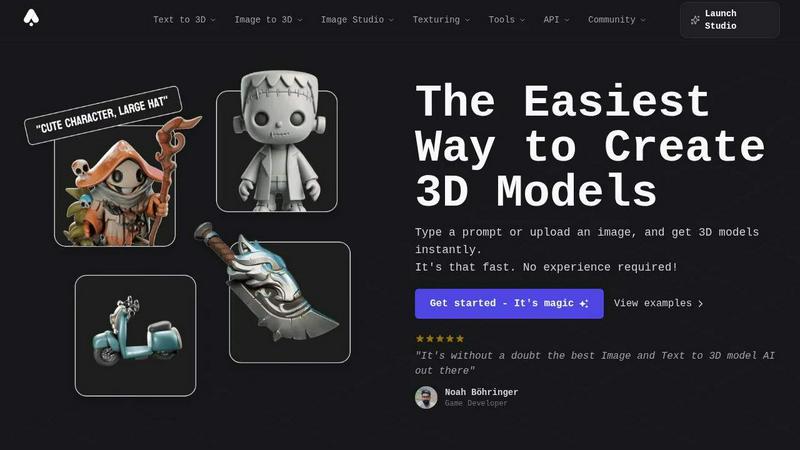
3DAIStudio instantly creates professional 3D models from your text or images, making 3D creation accessible to everyone.
Last updated: April 4, 2026

PoYo API
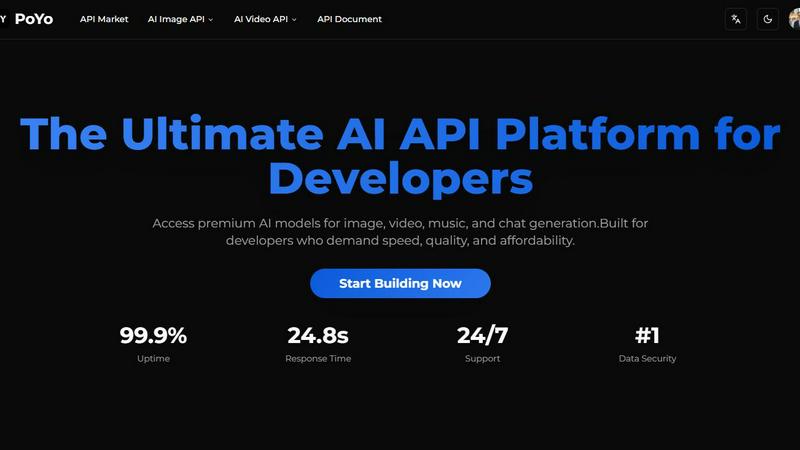
PoYo API gives developers one simple platform to access premium AI models for image, video, music, and chat.
Last updated: February 28, 2026
Visual Comparison
3DAIStudio
PoYo API
Feature Comparison
3DAIStudio
Text to 3D
This feature allows you to create a complete 3D model by simply typing a descriptive text prompt. You describe the object, character, or scene you envision in plain language, and the AI interprets your words to generate a textured 3D asset. For example, typing "a realistic fantasy orc warrior, muscular, wearing rugged armor and wielding a curved sword" will produce a corresponding 3D model ready for use. This removes the barrier of needing technical modeling skills and allows for rapid prototyping and idea exploration directly from your imagination.
Image to 3D
With this tool, you can upload any 2D image, sketch, or illustration and transform it into a three-dimensional model. The AI analyzes the shapes, perspectives, and details within your uploaded image to construct a 3D representation. This is particularly useful for converting concept art, product photos, or hand-drawn sketches into workable 3D assets instantly, bridging the gap between 2D design and 3D implementation without manual modeling.
AI Texturing
After a model is generated, the AI Texturing feature applies realistic, high-quality textures and materials to its surface. You can guide this process with text prompts to describe the desired material, such as "rusty metal" or "glossy plastic," or paint details directly onto the model. It generates PBR (Physically Based Rendering) materials, which are the standard for achieving realistic lighting and surfaces in modern game engines and rendering software.
Quad-Remesh
This is a vital optimization tool that automatically improves the topology, or mesh structure, of your generated 3D model. It creates a clean, quad-based mesh (made of four-sided polygons) which is essential for professional animation, deformation, and efficient rendering. The tool can also reduce polygon count and generate Levels of Detail (LODs), preparing your asset for production use in engines like Unity and Unreal without requiring manual, time-consuming retopology work.
PoYo API
Unified API Key and Integration
The platform eliminates the administrative burden of managing separate credentials for different AI services. Developers receive one master API key that grants access to the entire library of over 500 models across image, video, music, and chat domains. This unified approach drastically simplifies the initial integration process and ongoing key management, allowing teams to add or switch between AI capabilities within their application without reconfiguring authentication for each new model.
Credit-Based, Pay-As-You-Go Pricing
PoYo API operates on a flexible credit system, moving away from rigid monthly subscriptions. Users purchase credits upfront, which are then consumed based on their actual usage of different AI models, with each model having a clear per-task cost. This model provides significant financial clarity and control, as credits never expire and there are no recurring fees. It is ideal for projects with variable workloads, enabling seamless scaling up or down based on demand without contractual lock-in.
Comprehensive Model Library
The platform provides centralized access to a constantly updated catalog of leading AI models. This includes cutting-edge image generators like Nano Banana and Seedream 4, advanced video models such as Sora-2 and Veo3.1, complete music generation suites like Suno v4 and v5, and top-tier chat models including Claude Sonnet 4.5 and GPT-5. This diversity ensures developers can select the most suitable, state-of-the-art tool for any specific creative or analytical task within their application.
Developer-Centric Infrastructure and Support
PoYo API is engineered with practical development needs in mind. It features a simple two-endpoint async API for task submission and result querying, supports webhooks for real-time callbacks, and maintains low latency even under high concurrency. The platform is backed by robust monitoring for 99.9% uptime and offers 24/7 technical support from human experts. Additionally, a free playground allows for thorough testing and parameter tuning of all models without spending credits.
Use Cases
3DAIStudio
Game Development
Game developers and studios can use 3DAIStudio to rapidly prototype characters, props, weapons, and environmental assets. By generating models from text concepts or concept art images, teams can accelerate pre-production, populate game worlds quickly, and iterate on designs faster, significantly reducing the time from idea to in-game asset and helping to meet tight development deadlines.
Film and Animation Production
In pre-visualization (previs) and animation, artists can quickly generate 3D stand-ins, background assets, and detailed props from storyboard sketches or descriptive briefs. This allows for faster scene blocking, concept validation, and asset creation for both major studios and independent filmmakers, streamlining the early stages of production.
Product Design and Prototyping
Designers can upload sketches or photos of a product idea and instantly generate a 3D model for visualization, presentation, or 3D printing. This enables rapid iteration on physical product designs, creation of marketing materials, and functional prototypes without needing advanced CAD software skills, making the design process more accessible and agile.
Education and Learning
Educators and students in fields like design, architecture, and digital arts can use the platform as a practical learning tool. It allows users to understand 3D spatial concepts by seeing their 2D drawings or descriptions come to life in three dimensions, providing a hands-on, low-barrier entry point into the world of 3D modeling and computer graphics.
PoYo API
Content Creation and Marketing Automation
Businesses and marketing teams can integrate PoYo API to automate the generation of visual and audio content. Applications can dynamically create unique product images, promotional video clips, background music for videos, and marketing copy based on campaign themes or user data. This use case enables the production of high-volume, personalized content at scale, reducing reliance on manual design and production resources.
Building Next-Generation AI Applications
Developers and startups can use PoYo API as the core AI engine for their own software products. This could include building an advanced graphic design tool with AI image generation, a social media app that creates short videos from text prompts, an interactive storytelling platform with AI-composed music, or a customer service chatbot powered by the latest conversational models. The API provides the necessary building blocks without the need for in-house AI model training.
Prototyping and Research Development
Researchers, students, and product teams can leverage the platform for rapid prototyping and experimentation. The free playground and pay-per-use credit model allow for affordable testing of different AI models and techniques. Teams can quickly validate concepts, compare outputs from various models like Sora-2 versus Veo3.1 for video, or explore the capabilities of new music generation APIs without significant upfront investment.
Enhancing Existing Software with AI Features
Existing software applications, such as project management tools, educational platforms, or content management systems (CMS), can be enhanced with AI functionalities. Developers can integrate features like automatic thumbnail generation for uploaded articles, AI-powered video summaries for e-learning modules, or an in-app music composer for podcasters. PoYo API allows for adding these sophisticated features through straightforward API calls, modernizing an application's capabilities.
Overview
About 3DAIStudio
3DAIStudio is an AI-powered toolkit designed to democratize and accelerate the creation of three-dimensional (3D) assets. At its core, it solves a fundamental challenge in digital content creation: the significant time, cost, and specialized skill required to build 3D models from scratch. This platform enables users to generate custom, high-quality 3D models in seconds, using either a simple text description or a two-dimensional image as the starting point. The process is built to be intuitive, requiring no prior 3D modeling experience, which opens the door for a wide range of users. It is ideally suited for designers, game developers, filmmakers, product designers, educators, and creatives across various industries who need production-ready 3D assets. The main value proposition of 3DAIStudio lies in its ability to transform a concept into an export-ready 3D model in minutes rather than days. It provides a suite of integrated tools that handle not just model generation, but also critical post-processing steps like texturing and mesh optimization. This makes it a comprehensive solution for turning ideas into functional assets for game engines, animation software, virtual reality, 3D printing, and more, fundamentally changing the workflow for 3D content creation.
About PoYo API
PoYo API is a foundational platform designed to provide developers with streamlined access to a vast and diverse collection of premium artificial intelligence models. At its core, it functions as a centralized gateway, aggregating over 500 specialized AI models into a single, unified interface. This service is built specifically for developers, engineers, and businesses who need to integrate advanced AI capabilities—such as generating images, creating videos, composing music, or powering conversational chat—directly into their own applications, websites, or services. The primary value proposition of PoYo API lies in its simplification of a complex landscape. Instead of managing multiple API keys, navigating different pricing structures, and integrating with numerous individual AI providers, developers can connect to one platform. PoYo API handles the complexity behind the scenes, offering a consistent integration experience, a single API key for all models, and a unified credit-based billing system. This approach allows developers to focus on building their core product logic and user experience, rather than the intricacies of AI infrastructure. The platform emphasizes essential principles of reliability, with enterprise-grade security and high uptime, and affordability, ensuring users only pay for the computational resources they actually consume.
Frequently Asked Questions
3DAIStudio FAQ
What file formats can I export my 3D models in?
3DAIStudio is designed for production-ready output, allowing you to export your generated and optimized 3D models in standard industry formats. These typically include formats like OBJ, FBX, and GLTF/GLB, which are universally compatible with major 3D software, game engines (Unity, Unreal Engine), and web frameworks like Three.js, ensuring seamless integration into your existing workflow.
Do I need any prior 3D modeling experience to use 3DAIStudio?
No, you do not need any prior 3D modeling experience. The platform is built specifically to be accessible to beginners. The core process involves typing a text prompt or uploading an image, with the AI handling the complex tasks of geometry creation, texturing, and mesh optimization. This makes it an ideal tool for anyone looking to create 3D content without learning traditional, complex modeling software.
How does the AI Texturing feature work?
The AI Texturing feature uses artificial intelligence to apply realistic materials to your 3D model's surface. You can provide a text description of the material you want (e.g., "wooden," "metallic," "fabric"), and the AI will generate a corresponding texture map. Alternatively, you may have tools to paint or select areas on the model to apply different materials, giving you control over the final look while leveraging AI for speed and quality.
Is 3DAIStudio suitable for creating commercial assets?
Yes, models created with 3DAIStudio are intended for commercial use. The platform is trusted by professionals across industries like game development, film, and product design to create assets for commercial projects. It is always recommended to review the specific Terms of Service for the latest information on licensing, usage rights, and any limitations related to the commercial use of AI-generated content.
PoYo API FAQ
What is the difference between PoYo API and using AI models directly from their original providers?
PoYo API acts as an aggregator and unified layer. Instead of integrating with dozens of individual providers—each with its own API documentation, authentication method, pricing plan, and rate limits—you integrate once with PoYo. We provide a single point of access, a consistent API structure, and consolidated billing. This saves significant development time, reduces complexity, and often provides cost transparency and stability not available when dealing with multiple providers directly.
How does the credit system work and do credits expire?
You purchase credits upfront through your PoYo account dashboard. Each AI model has a specific cost per task, measured in credits. When you make an API call to generate an image, video, etc., the corresponding number of credits is deducted from your balance. A key benefit is that these purchased credits do not have an expiration date. You can use them at your own pace, making it a truly flexible pay-as-you-go system without the pressure of monthly subscription cycles or use-it-or-lose-it policies.
Is there a way to test the API before committing funds?
Yes, PoYo API offers a free playground accessible directly on the model pages of the website. This interactive environment allows you to test every available AI model, adjust generation parameters (like image dimensions or style prompts), and see the outputs in real-time. This testing requires no API key and no credit card, enabling you to thoroughly evaluate model quality, speed, and suitability for your project before writing any integration code or purchasing credits.
What happens if an AI generation task fails?
PoYo API is designed with developer reliability in mind. If a task fails due to a platform or model error (not due to an invalid user request), you are not charged for that task. The credits are not deducted for failed generations. Furthermore, the dashboard provides tools for manual retry of failed tasks, giving you full control over the workflow. This policy ensures you only pay for successful, usable outputs, which is crucial for maintaining predictable costs in production applications.
Alternatives
3DAIStudio Alternatives
3DAIStudio is a tool in the content creation category that uses artificial intelligence to quickly generate three-dimensional models. Users simply provide an image or text description, and the AI produces a quality 3D asset. This technology is designed to speed up workflows for projects requiring custom 3D objects. People often explore other options for several practical reasons. Cost is a primary factor, as budgets and subscription models vary widely. Some users may need specific technical features, different export formats, or tools that integrate with their existing software platform. The search for an alternative is usually about finding the best fit for a particular project's requirements and constraints. When evaluating different services, consider the core output. Look at the quality and style of the 3D models generated, the speed of processing, and the learning curve involved. Also, assess the practical details like pricing transparency, licensing terms for the assets you create, and the reliability of the platform's performance. These foundational elements will guide you to the right tool.
PoYo API Alternatives
PoYo API is a service that provides access to a wide range of premium AI models for generating images, videos, music, and chat responses. It falls into the category of AI assistant and content generation tools, designed to help developers integrate advanced AI capabilities into their applications through a single, simplified interface. Developers often explore alternatives to services like PoYo API for several practical reasons. These can include budget constraints, as pricing models and credit costs vary significantly between providers. Others may seek different feature sets, specific model availability, or platforms that better align with their existing technical infrastructure or particular project requirements. When evaluating different options, it's important to consider several core factors. Key considerations typically include the total cost of use, the reliability and speed of the API, the breadth and quality of the AI models offered, and the strength of developer support. Security standards and the ease of integration are also fundamental aspects that can impact the long-term success of an AI implementation.