Oneprofile vs Playwriter
Side-by-side comparison to help you choose the right product.

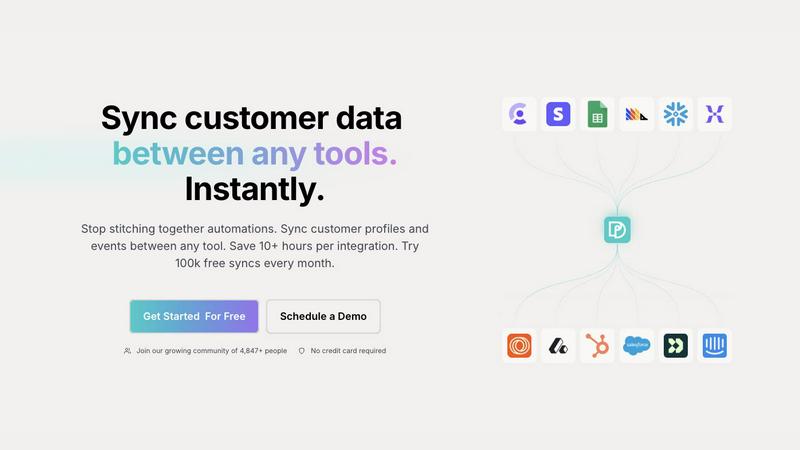
Sync and unify customer profiles across tools seamlessly, saving time and ensuring data consistency with Oneprofile.
Last updated: February 26, 2026

Playwriter
Playwriter lets AI agents control your actual Chrome browser with all your logins and extensions intact.
Last updated: March 18, 2026
Visual Comparison
Oneprofile
Playwriter

Feature Comparison
Oneprofile
Keep Customer Data Aligned
Oneprofile ensures that customer profiles and events remain consistent across all systems, even as data changes over time. This feature minimizes the chances of error and guarantees that every tool reflects the same customer information, enhancing overall data integrity.
Identity Resolution
With Oneprofile, businesses can unify customer profiles from various SaaS tools into a single, consistent model. It intelligently matches identities and fields across different systems, preventing duplication and drift in customer data, and ensuring that all teams are referencing the same customer.
Control Data Flow
Oneprofile gives users the ability to define how customer data flows between systems. Users can control sync direction, map fields, and determine how updates propagate across different tools. This level of flexibility allows businesses to tailor data management to their operational needs effectively.
Activate Customer Data Everywhere
This feature allows businesses to leverage unified customer profiles and events for better segmentation and personalization across their entire tech stack. By syncing enriched data in real time, teams can ensure they have the full customer context necessary for effective engagement and decision-making.
Playwriter
Your Actual Browser Session
Playwriter's most fundamental feature is its use of your real, active Chrome session. Instead of spawning a new, isolated browser instance, the extension attaches directly to your existing tabs. This means every login, cookie, browser extension, and personalized setting is immediately available to the AI agent. This eliminates the constant friction of re-authentication, bypasses many bot detection mechanisms that flag "fresh" browsers, and requires no extra system memory for a separate Chrome process. The agent works within the exact same digital context that you do.
Full Playwright API via a Single Tool
Unlike other solutions that expose a limited, pre-defined set of actions, Playwriter provides the complete Playwright automation library through one execute tool. This allows the AI agent to write and run any Playwright code directly, from simple navigation and clicks to advanced operations like setting JavaScript breakpoints, intercepting network requests, or profiling performance. This approach reduces "schema bloat" and keeps context usage low for the AI, as it doesn't need to understand dozens of separate tool definitions. It simply uses the comprehensive, well-documented Playwright API.
Advanced Debugging and Inspection Utilities
Playwriter equips users and agents with professional-grade debugging tools. It includes a live code editor and debugger with breakpoints, allowing you to pause and step through the agent's automation scripts in real time. The tool also provides network interception capabilities to monitor or modify HTTP requests and responses. Furthermore, it captures efficient "accessibility snapshots" of the page (only 5-20KB) instead of full screenshots, giving the AI a lightweight, structured understanding of the page's content and interactable elements.
Real-Time Collaboration and Control
This feature transforms automation from a black-box process into a collaborative workflow. Because the agent operates in your visible browser, you can watch every action happen in real time. You can intervene at any moment—for example, to solve a CAPTCHA, click through a consent dialog, or manually correct a navigation error. You can temporarily disable control on a tab, fix the issue yourself, and then re-enable the agent to continue seamlessly. This human-in-the-loop model ensures complex, real-world tasks can be completed reliably.
Use Cases
Oneprofile
Streamlined Marketing Campaigns
Marketing teams can utilize Oneprofile to ensure that all customer data is synchronized across their marketing platforms, allowing for more targeted campaigns. With accurate data, marketers can segment their audience effectively and personalize their messaging, leading to higher engagement rates.
Enhanced Customer Support
Customer support teams can access real-time, unified customer profiles, which helps them provide better service. When support agents have the full context of a customer's history and interactions, they can resolve issues more efficiently, leading to improved customer satisfaction.
Data-Driven Sales Processes
Sales teams can benefit from a single view of customer data, enabling them to make informed decisions and tailor their approach based on accurate insights. With Oneprofile, sales representatives can trust that the data they are working with is up-to-date and reliable.
Comprehensive Analytics
Analytics teams can utilize Oneprofile to obtain a holistic view of customer interactions across all platforms. This allows for more accurate reporting and analysis, as data from different sources is harmonized, helping businesses make strategic decisions based on comprehensive insights.
Playwriter
Automated Testing and Quality Assurance
Developers and QA engineers can use Playwriter to create and execute complex, real-user scenario tests. The AI agent can automate multi-step workflows across authenticated applications, test features that depend on specific browser extensions, and validate user journeys in a genuine logged-in state. The debugger and network interception tools are invaluable for diagnosing test failures and understanding application behavior under automation.
Research and Data Aggregation
Researchers and analysts who need to collect data from websites that require login or have complex interactive elements can leverage Playwriter. The agent can navigate personalized dashboards, interact with dynamic content, and extract information from behind authentication walls. Its ability to use the existing browser session means it can access subscription-based or private web resources just as a human user would.
AI-Powered Workflow Automation
Power users can delegate repetitive web-based tasks to their AI assistant. This could include routine administrative work like filling forms, generating reports from web apps, monitoring for specific changes on a page, or managing content across platforms. The collaboration feature allows the user to start the automation and then step in only when human judgment is required, creating a highly efficient hybrid workflow.
Development and Debugging Assistance
While coding, developers can use Playwriter through their IDE's AI agent to automate debugging sessions. The agent can be instructed to reproduce a bug, intercept specific network calls to inspect payloads, or manipulate the DOM to test different states. The live control allows the developer to guide the agent through complex debugging scenarios interactively, making the process faster and more intuitive.
Overview
About Oneprofile
Oneprofile is an innovative tool designed to streamline the management of customer data across various platforms, ensuring that businesses can maintain accurate and consistent customer profiles in real-time. Instead of managing multiple versions of customer information in different systems, Oneprofile automatically synchronizes customer profiles and events among all the tools a company utilizes, such as CRMs, analytics, support, and marketing platforms. This not only eliminates the hassle of manual data entry but also reduces the risk of errors that arise from data duplication or discrepancies. Oneprofile is ideal for businesses of all sizes looking to enhance their data management processes, save time, and improve decision-making. Its main value proposition lies in its ability to keep customer data aligned across the entire tech stack, allowing teams to focus on leveraging data insights rather than managing data flows.
About Playwriter
Playwriter is a foundational tool that redefines how AI agents interact with the web by giving them direct, intelligent access to your existing browser session. At its core, it solves a fundamental problem: traditional methods for AI web browsing are inefficient and fragile. They either launch a fresh, "clean" browser instance with no logins, extensions, or cookies—triggering instant bot detection and doubling memory usage—or they provide a limited set of predefined tools that restrict the agent's capabilities. Playwriter takes a back-to-basics approach. It is a Chrome extension and Command Line Interface (CLI) that allows your AI agent, through any MCP-compatible client like Cursor, Claude Desktop, or VS Code, to control your actual, logged-in browser. This means the agent operates in an environment with all your personalizations, authentication states, and trusted behavioral patterns already established. It provides the full Playwright automation API through a single, powerful execution tool, enabling complex tasks like debugging, network interception, and precise element interaction without the overhead of dozens of individual tool definitions. Playwriter is for developers, researchers, and power users who need reliable, collaborative, and deeply capable web automation that works with the real web, not a sanitized simulation.
Frequently Asked Questions
Oneprofile FAQ
What is Oneprofile?
Oneprofile is a data synchronization tool that automatically syncs customer profiles and events across various tools, ensuring that all systems have consistent and up-to-date customer information.
How does Oneprofile handle data changes?
Whenever customer data changes in one system, Oneprofile instantly reflects that change across all connected systems, eliminating the need for manual updates and ensuring data accuracy.
Is there a limit to the number of syncs I can perform?
Oneprofile offers a free tier that allows for 100,000 syncs every month, making it accessible for businesses to start syncing customer data without incurring costs.
Do I need technical expertise to use Oneprofile?
No, Oneprofile is designed for ease of use, allowing teams to set up integrations in minutes without requiring engineering resources, thus saving time and effort.
Playwriter FAQ
How does Playwriter differ from a headless browser?
A headless browser is a separate, programmatically controlled instance with no visual interface and typically no user data. Playwriter is the opposite; it controls your existing, visible Chrome browser with all your personal data, extensions, and login sessions intact. This makes it far more capable for interacting with real-world, authenticated websites and allows for real-time human collaboration, which is impossible with a purely headless process.
Is my browsing data secure with Playwriter?
Yes. Playwriter is designed with a strong emphasis on local operation and security. The connection between the Chrome extension and the AI client is made via a WebSocket relay that runs exclusively on your local machine (localhost:19988). No browsing data, cookies, or session information is sent to any remote server. The tool is also open-source under the MIT license, allowing anyone to audit its code for security and privacy practices.
Can I use Playwriter with any AI assistant?
Playwriter works with any client that supports the Model Context Protocol (MCP), which is becoming a standard for tool integration with AI assistants. This includes popular environments like Cursor, Claude Desktop, and VS Code with appropriate extensions. You install a "skill" that teaches your specific AI agent how to effectively use the Playwriter tool and its best practices.
What happens if the AI agent gets stuck on a page?
This is where Playwriter's collaborative design shines. If the agent encounters an unexpected obstacle like a complex CAPTCHA, a pop-up, or simply loses its way, you can see it happening live in your browser. You can then manually solve the issue, disable the extension's control on that tab to take over, fix the situation, and then re-enable control. The agent can then continue its task from the new state, making the automation process resilient and adaptable.
Alternatives
Oneprofile Alternatives
Oneprofile is a data synchronization tool designed to streamline customer profile management across various platforms, including CRMs, analytics, support, and marketing systems. By ensuring that customer data is consistently updated and reflected across all tools, Oneprofile eliminates the need for manual data entry and the complications that arise from broken integrations. This functionality makes it easier for businesses to maintain accurate and up-to-date information about their customers. Users often seek alternatives to Oneprofile due to various reasons, such as pricing constraints, feature sets that may not fully meet their needs, or specific platform requirements. When exploring potential alternatives, it's essential to consider factors such as ease of integration with existing tools, scalability to accommodate business growth, and the overall user experience. A well-rounded alternative should provide reliable data synchronization while being adaptable to the unique demands of your organization.
Playwriter Alternatives
Playwriter is a tool for AI-powered browser automation. It belongs to the automation category, specifically designed to give AI agents a real, logged-in browser session instead of a fresh, empty instance. This solves the common problem where agents cannot interact with the web as a human user would. Users often look for alternatives for various reasons. These can include budget constraints, the need for different feature sets, compatibility with specific operating systems or development environments, or a preference for a different licensing model. The automation landscape offers many tools with varying approaches. When evaluating an alternative, consider the core problem you need to solve. Key factors include how the tool handles browser sessions and authentication, its integration capabilities with your existing AI agent stack, the level of control and debugging it offers, and its overall architecture regarding security and privacy. The right choice depends on your specific workflow requirements.