Hostim.dev vs qtrl.ai
Side-by-side comparison to help you choose the right product.

Hostim.dev
Hostim.dev simplifies Docker app deployment with built-in databases on reliable, GDPR-compliant EU infrastructure.
Last updated: March 1, 2026

qtrl.ai
qtrl.ai helps QA teams scale testing with AI agents while maintaining full control and governance.
Last updated: March 4, 2026
Visual Comparison
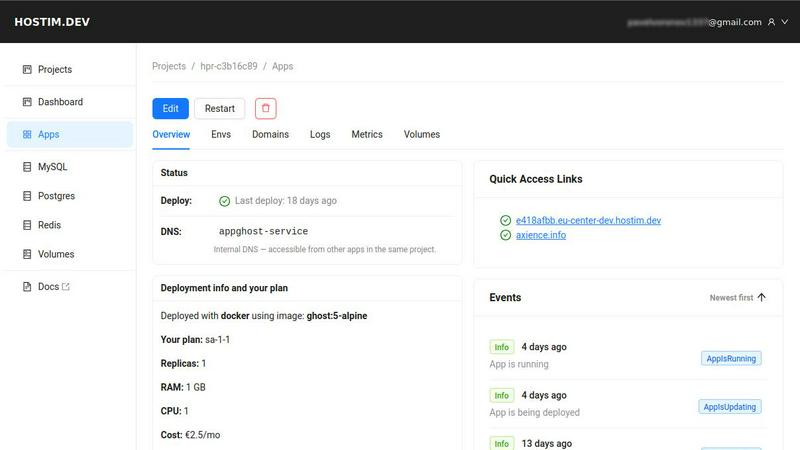
Hostim.dev
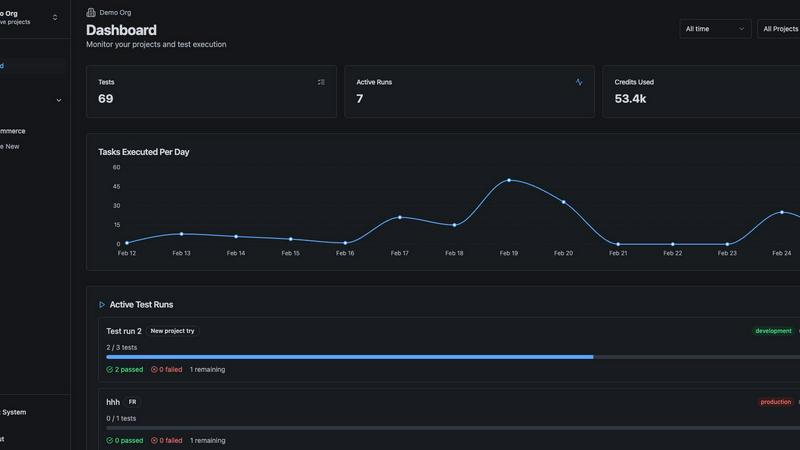
qtrl.ai
Feature Comparison
Hostim.dev
Easy Deployment with Docker and Git
Hostim.dev simplifies the deployment process by allowing users to deploy applications using Docker images, Git repositories, or Docker Compose files. This feature eliminates the need for extensive DevOps knowledge, enabling developers to go live with their projects in minutes.
Built-in Databases and Storage
The platform offers built-in MySQL, Postgres, Redis, and volume storage, making it easy for developers to provision databases instantly. All essential services are pre-wired and ready to use, which significantly reduces setup time and complexity.
Real-time Monitoring and Security
Hostim.dev ensures security and observability by automatically implementing HTTPS, providing live logs, and offering metrics for performance tracking. Each project is isolated in its own environment, enhancing security and allowing developers to maintain a clean workspace.
Predictable and Transparent Pricing
With pricing starting as low as €2.50 per month, Hostim.dev provides a straightforward billing model with no hidden fees. This transparency allows freelancers and agencies to quote costs to clients confidently, simplifying financial planning and project management.
qtrl.ai
Enterprise-Grade Test Management
This feature provides a structured foundation for all quality activities. It offers a centralized repository for test cases, plans, and runs, ensuring everything is organized and accessible. Full traceability links tests back to requirements, and detailed audit trails are maintained for compliance. It supports both manual and automated workflows, giving teams the flexibility to manage quality in a way that fits their current process while preparing for more advanced automation.
Progressive AI Automation
Instead of a sudden, all-or-nothing approach, qtrl.ai introduces automation progressively. Teams begin by writing high-level test instructions in plain English. When ready, they can leverage AI to generate detailed test scripts from those instructions. The AI also suggests new tests based on coverage gaps. Crucially, every AI-generated step is fully reviewable and approvable by a human, maintaining oversight and ensuring tests align with team expectations before execution.
Autonomous QA Agents
These are intelligent executors that operate within defined rules. They can run tests on demand or continuously across multiple real browsers and environments, such as development, staging, and production. The agents execute instructions precisely, providing real browser interaction rather than simulations. They operate with permissioned autonomy levels, meaning their actions are transparent and controllable, never making unpredictable "black-box" decisions.
Adaptive Memory & Multi-Environment Execution
The platform builds a living knowledge base of your application by learning from exploration, test execution, and discovered issues. This context makes test generation smarter over time. Coupled with robust multi-environment execution, teams can run tests across any stage of the development lifecycle. The system securely manages per-environment variables and encrypted secrets, which are never exposed to the AI agent, ensuring security and consistency.
Use Cases
Hostim.dev
Freelancers Managing Client Projects
Freelancers can use Hostim.dev to deploy client applications quickly and manage costs effectively. The platform's per-project billing feature allows for seamless handover to clients, ensuring they receive a clear understanding of the costs involved.
Agencies Handling Multiple Clients
Agencies benefit from the ability to isolate client projects within separate Kubernetes namespaces. This feature enables them to maintain control over costs and manage resources efficiently, ensuring that each client's project remains distinct and secure.
Students Learning Real-World Skills
Students can take advantage of Hostim.dev to gain hands-on experience with real infrastructure. The platform's free trial and student credits provide an opportunity to deploy Docker applications, databases, and other essential services that can enhance their portfolios.
Startups Releasing MVPs
Startups can leverage Hostim.dev to rapidly deploy their minimum viable products (MVPs) without the burden of complex infrastructure management. The platform's quick deployment capabilities and flat pricing structure allow startups to focus on product development and market entry.
qtrl.ai
Scaling Beyond Manual Testing
For QA teams overwhelmed by repetitive manual test cycles, qtrl.ai provides a clear path forward. Teams can start by structuring their existing manual tests in the platform. Then, they can progressively automate the most tedious and high-value test cases using AI-generated scripts, freeing up human testers for more complex exploratory work and significantly increasing test coverage and execution speed.
Modernizing Legacy QA Workflows
Companies relying on outdated, siloed, or spreadsheet-based test management systems can consolidate their entire QA process into qtrl.ai. The platform brings test management, automation, and execution into a single, governed system. This modernization provides immediate benefits like real-time dashboards, audit trails, and traceability, while setting the stage for intelligent automation without a disruptive overhaul.
Governing Enterprise AI Testing
Enterprises with strict compliance, security, and governance requirements can safely adopt AI for testing with qtrl.ai. The platform's design ensures full visibility into all AI agent activities, maintains detailed audit trails, and keeps human oversight at the center. Teams can grant autonomy gradually, ensuring the AI operates within strict guardrails and corporate policies, making it a trustworthy solution for regulated industries.
Enhancing Product-Led Engineering
Product-led engineering teams that need to move fast without breaking things can integrate qtrl.ai into their CI/CD pipelines. The platform supports continuous quality feedback loops, allowing teams to run automated test suites against every build. AI agents can be tasked with verifying new features or conducting regression tests, providing rapid feedback and ensuring quality keeps pace with development velocity.
Overview
About Hostim.dev
Hostim.dev is a bare-metal Platform-as-a-Service (PaaS) designed to streamline the deployment and management of containerized applications. It empowers developers by removing the complexities associated with traditional infrastructure management, allowing them to focus solely on their code. With Hostim.dev, users can leverage familiar tools such as Docker and Git to transition their applications from development to production with remarkable speed and ease. The platform automates numerous backend processes, including the provisioning of essential services like databases and storage, and it includes important security features like automatic HTTPS. Each project benefits from its own isolated Kubernetes namespace, ensuring a clean and secure environment for development. Operating on bare-metal servers located in Germany, Hostim.dev guarantees GDPR-compliant hosting, making it a suitable choice for developers who prioritize data protection. The core value proposition lies in its ability to combine the flexibility of containerization with the simplicity of a managed environment, offering flat, predictable pricing that eliminates the unpleasant surprises often associated with larger cloud providers. Ultimately, Hostim.dev serves as a powerful tool that allows developers to concentrate on building their applications rather than managing the underlying infrastructure.
About qtrl.ai
qtrl.ai is a modern QA platform designed to help software development teams scale their quality assurance efforts effectively. At its core, it addresses a fundamental challenge: the trade-off between speed and control. Many teams are caught between slow, unscalable manual testing and complex, brittle traditional automation tools. qtrl.ai provides a structured solution by combining enterprise-grade test management with intelligent, trustworthy AI automation. This creates a centralized hub where teams can organize test cases, plan test runs, trace requirements, and track quality metrics through real-time dashboards. The platform is built for progression, allowing teams to start with simple manual test management and gradually introduce AI-powered automation as they become comfortable. This makes it an ideal fit for product-led engineering teams, QA groups moving beyond manual processes, companies modernizing legacy workflows, and enterprises that require strict compliance and audit trails. Ultimately, qtrl.ai's mission is to bridge the gap, offering a controlled, transparent path to faster and more intelligent quality assurance without the risks associated with unpredictable "black-box" AI solutions.
Frequently Asked Questions
Hostim.dev FAQ
What does the free tier include?
The free tier of Hostim.dev includes a 5-day trial with full access to deploy any Docker image, Git repository, or Docker Compose file. It allows users to explore the platform without any credit card requirement, making it ideal for evaluation purposes.
Can I deploy with just a Compose file?
Yes, Hostim.dev supports deployment using just a Docker Compose file. Users can easily paste their Compose file, and the platform will handle the rest, allowing for a quick and straightforward deployment process.
Where is my app hosted?
All applications hosted on Hostim.dev are deployed on bare-metal servers located in Germany. This ensures compliance with GDPR regulations and guarantees that data remains within the European Union.
Do I need to know Kubernetes?
No, users do not need to have prior knowledge of Kubernetes to use Hostim.dev. The platform abstracts the complexities of Kubernetes management, allowing developers to focus on their applications rather than the underlying infrastructure.
qtrl.ai FAQ
How does qtrl.ai's AI differ from other "autonomous" testing tools?
qtrl.ai avoids a risky "black-box" approach. Its AI is designed for transparency and control. It does not make unpredictable decisions. Instead, it generates test steps from human instructions, which must be reviewed and approved before execution. You define the rules and level of autonomy. This progressive, governed model ensures the AI assists your team reliably and builds trust over time.
Can we use qtrl.ai if we are not ready for full AI automation?
Absolutely. qtrl.ai is built for progression. You can start by using it solely as a powerful test management platform to organize manual test cases, plans, and runs. When your team is ready, you can begin experimenting with AI-generated test creation for specific scenarios. The platform adapts to your pace, allowing you to increase automation gradually without any pressure to change your entire workflow overnight.
How does qtrl.ai handle security and sensitive data?
Security is a foundational principle. qtrl.ai offers enterprise-ready security measures. For automation, you can define environment-specific variables and encrypted secrets (like passwords or API keys). These secrets are never exposed to the AI agent during test execution. The platform provides full audit trails and is built to support compliance requirements, giving you control over your data and test assets.
Does qtrl.ai work with our existing development tools?
Yes, qtrl.ai is designed to integrate into real-world workflows. It offers requirements management integration, CI/CD pipeline support, and is built to work alongside your existing toolset. The goal is to enhance your current process, not replace it entirely. This allows teams to incorporate structured test management and intelligent automation without disrupting their established development lifecycle.
Alternatives
Hostim.dev Alternatives
Hostim.dev is a bare-metal Platform-as-a-Service (PaaS) designed to provide developers with a straightforward way to deploy Docker applications on EU-hosted infrastructure. It focuses on simplifying the deployment process while ensuring that developers retain control over their applications and the environment they run in. Many users seek alternatives to Hostim.dev due to varying needs related to pricing, specific features, or preferred cloud platforms. Understanding what to look for when selecting an alternative is essential; users should consider aspects such as ease of use, the extent of automation, compliance with regulations, and available integrations that align with their existing workflows. When evaluating alternatives, it’s also important to assess the level of support provided, the scalability of the platform, and the overall performance of the services offered. Users should prioritize platforms that minimize the complexity of deployment and infrastructure management while maximizing security and reliability. Ultimately, the right alternative should empower developers to focus on building their applications rather than getting bogged down by infrastructure challenges.
qtrl.ai Alternatives
qtrl.ai is a modern quality assurance platform in the automation and developer tools category. It helps software teams scale their testing efforts by combining structured test management with intelligent AI agents. This approach allows teams to maintain full control and governance while gradually introducing automation. Users often explore alternatives for various reasons. Common considerations include budget constraints, the need for specific features not offered, or a requirement to integrate with a different set of existing development tools. The specific needs of a team's workflow and application stack are also key factors. When evaluating any alternative, it's wise to look at the core capabilities. Consider the balance between manual test organization and automated execution. Assess how the tool handles test maintenance and reporting. Finally, evaluate the level of control and transparency the platform offers, especially when it involves AI-driven features.