HookMesh vs qtrl.ai
Side-by-side comparison to help you choose the right product.

HookMesh simplifies webhook delivery with reliable, automatic retries and a self-service portal for your customers.
Last updated: February 26, 2026

qtrl.ai
qtrl.ai helps QA teams scale testing with AI agents while maintaining full control and governance.
Last updated: March 4, 2026
Visual Comparison
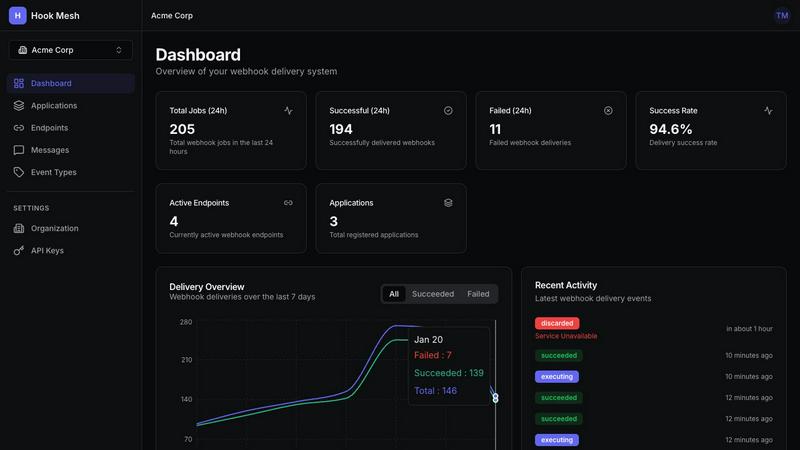
HookMesh
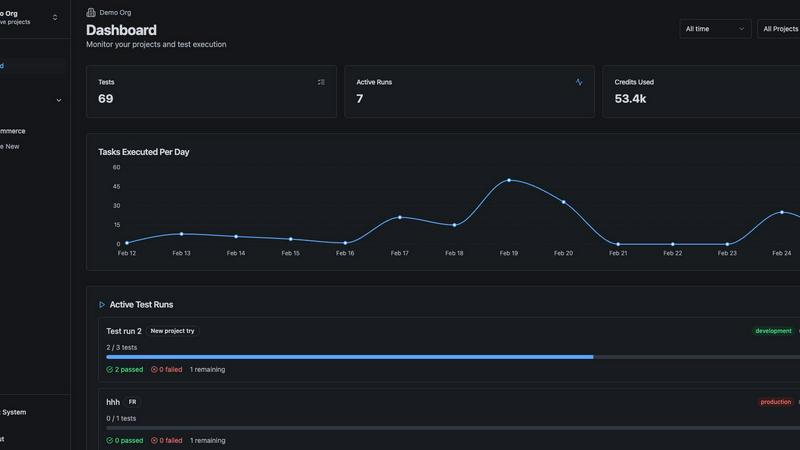
qtrl.ai
Feature Comparison
HookMesh
Reliable Delivery
HookMesh ensures that webhook events are never lost, providing automatic retries with exponential backoff and jitter. This means that if a webhook fails to deliver, HookMesh will retry sending it over a 48-hour period, ensuring that crucial data reaches its destination.
Circuit Breaker
The circuit breaker feature automatically disables failing endpoints to prevent them from affecting the entire queue. Once the endpoint is back online, HookMesh re-enables it, allowing for smooth and uninterrupted delivery of webhook events.
Customer Portal
HookMesh includes an embeddable self-service portal where customers can manage their endpoints. This portal provides users with complete visibility of delivery logs, enabling them to track all requests and responses, and to quickly replay any failed webhooks.
Developer Experience
Designed with developers in mind, HookMesh offers a REST API and official SDKs for JavaScript, Python, and Go. These tools simplify integration, allowing developers to send webhook events with minimal code, which significantly reduces the time and effort required to implement webhook functionality.
qtrl.ai
Enterprise-Grade Test Management
This feature provides a structured foundation for all quality activities. It offers a centralized repository for test cases, plans, and runs, ensuring everything is organized and accessible. Full traceability links tests back to requirements, and detailed audit trails are maintained for compliance. It supports both manual and automated workflows, giving teams the flexibility to manage quality in a way that fits their current process while preparing for more advanced automation.
Progressive AI Automation
Instead of a sudden, all-or-nothing approach, qtrl.ai introduces automation progressively. Teams begin by writing high-level test instructions in plain English. When ready, they can leverage AI to generate detailed test scripts from those instructions. The AI also suggests new tests based on coverage gaps. Crucially, every AI-generated step is fully reviewable and approvable by a human, maintaining oversight and ensuring tests align with team expectations before execution.
Autonomous QA Agents
These are intelligent executors that operate within defined rules. They can run tests on demand or continuously across multiple real browsers and environments, such as development, staging, and production. The agents execute instructions precisely, providing real browser interaction rather than simulations. They operate with permissioned autonomy levels, meaning their actions are transparent and controllable, never making unpredictable "black-box" decisions.
Adaptive Memory & Multi-Environment Execution
The platform builds a living knowledge base of your application by learning from exploration, test execution, and discovered issues. This context makes test generation smarter over time. Coupled with robust multi-environment execution, teams can run tests across any stage of the development lifecycle. The system securely manages per-environment variables and encrypted secrets, which are never exposed to the AI agent, ensuring security and consistency.
Use Cases
HookMesh
E-commerce Order Notifications
In the e-commerce sector, businesses can use HookMesh to send order completion notifications to customers. This ensures customers receive timely updates about their purchases, enhancing their overall shopping experience.
Payment Processing Updates
Payment processors can leverage HookMesh to deliver real-time updates on transaction statuses. This allows merchants to receive notifications about successful payments or potential issues, enabling them to act quickly and maintain smooth operations.
SaaS Integrations
SaaS products that integrate with third-party services can use HookMesh to handle webhook events efficiently. By providing reliable event delivery, companies can ensure that data flows seamlessly between their application and external platforms.
System Health Monitoring
Organizations can utilize HookMesh to monitor the health of their internal systems by sending alerts and notifications. This allows them to stay informed about system performance and quickly address any issues that may arise.
qtrl.ai
Scaling Beyond Manual Testing
For QA teams overwhelmed by repetitive manual test cycles, qtrl.ai provides a clear path forward. Teams can start by structuring their existing manual tests in the platform. Then, they can progressively automate the most tedious and high-value test cases using AI-generated scripts, freeing up human testers for more complex exploratory work and significantly increasing test coverage and execution speed.
Modernizing Legacy QA Workflows
Companies relying on outdated, siloed, or spreadsheet-based test management systems can consolidate their entire QA process into qtrl.ai. The platform brings test management, automation, and execution into a single, governed system. This modernization provides immediate benefits like real-time dashboards, audit trails, and traceability, while setting the stage for intelligent automation without a disruptive overhaul.
Governing Enterprise AI Testing
Enterprises with strict compliance, security, and governance requirements can safely adopt AI for testing with qtrl.ai. The platform's design ensures full visibility into all AI agent activities, maintains detailed audit trails, and keeps human oversight at the center. Teams can grant autonomy gradually, ensuring the AI operates within strict guardrails and corporate policies, making it a trustworthy solution for regulated industries.
Enhancing Product-Led Engineering
Product-led engineering teams that need to move fast without breaking things can integrate qtrl.ai into their CI/CD pipelines. The platform supports continuous quality feedback loops, allowing teams to run automated test suites against every build. AI agents can be tasked with verifying new features or conducting regression tests, providing rapid feedback and ensuring quality keeps pace with development velocity.
Overview
About HookMesh
HookMesh is a pioneering solution tailored to simplify and enhance webhook delivery for modern Software as a Service (SaaS) products. It effectively addresses the myriad complexities associated with building webhooks in-house, including challenges such as implementing retry logic, managing circuit breakers, and debugging delivery issues that can arise. By using HookMesh, businesses can concentrate on their core offerings without being overwhelmed by the technical intricacies of webhook management. This robust platform boasts battle-tested infrastructure that guarantees reliable delivery through features like automatic retries, exponential backoff, and idempotency keys. HookMesh is particularly suited for developers and product teams striving to deliver a seamless experience for their customers while ensuring consistent and reliable webhook event delivery. The self-service portal empowers users with easy management and visibility of their endpoints, while the ability to replay failed webhooks with just a single click provides essential peace of mind for organizations prioritizing a robust webhook strategy.
About qtrl.ai
qtrl.ai is a modern QA platform designed to help software development teams scale their quality assurance efforts effectively. At its core, it addresses a fundamental challenge: the trade-off between speed and control. Many teams are caught between slow, unscalable manual testing and complex, brittle traditional automation tools. qtrl.ai provides a structured solution by combining enterprise-grade test management with intelligent, trustworthy AI automation. This creates a centralized hub where teams can organize test cases, plan test runs, trace requirements, and track quality metrics through real-time dashboards. The platform is built for progression, allowing teams to start with simple manual test management and gradually introduce AI-powered automation as they become comfortable. This makes it an ideal fit for product-led engineering teams, QA groups moving beyond manual processes, companies modernizing legacy workflows, and enterprises that require strict compliance and audit trails. Ultimately, qtrl.ai's mission is to bridge the gap, offering a controlled, transparent path to faster and more intelligent quality assurance without the risks associated with unpredictable "black-box" AI solutions.
Frequently Asked Questions
HookMesh FAQ
What is HookMesh?
HookMesh is a webhook delivery solution designed to simplify the process of managing webhooks for SaaS products. It ensures reliable delivery and provides users with tools for easy endpoint management.
How does HookMesh handle retries?
HookMesh employs automatic retries with exponential backoff and jitter. This means that if a webhook fails to deliver, it will attempt to resend it over a 48-hour period, ensuring critical data is delivered.
Can customers manage their endpoints?
Yes, HookMesh includes a self-service portal that allows customers to manage their webhook endpoints. They can view delivery logs, add new endpoints, and replay failed webhooks with ease.
What programming languages are supported by HookMesh SDKs?
HookMesh offers official SDKs for JavaScript, Python, and Go, providing developers with the tools they need to integrate webhook functionality into their applications quickly and efficiently.
qtrl.ai FAQ
How does qtrl.ai's AI differ from other "autonomous" testing tools?
qtrl.ai avoids a risky "black-box" approach. Its AI is designed for transparency and control. It does not make unpredictable decisions. Instead, it generates test steps from human instructions, which must be reviewed and approved before execution. You define the rules and level of autonomy. This progressive, governed model ensures the AI assists your team reliably and builds trust over time.
Can we use qtrl.ai if we are not ready for full AI automation?
Absolutely. qtrl.ai is built for progression. You can start by using it solely as a powerful test management platform to organize manual test cases, plans, and runs. When your team is ready, you can begin experimenting with AI-generated test creation for specific scenarios. The platform adapts to your pace, allowing you to increase automation gradually without any pressure to change your entire workflow overnight.
How does qtrl.ai handle security and sensitive data?
Security is a foundational principle. qtrl.ai offers enterprise-ready security measures. For automation, you can define environment-specific variables and encrypted secrets (like passwords or API keys). These secrets are never exposed to the AI agent during test execution. The platform provides full audit trails and is built to support compliance requirements, giving you control over your data and test assets.
Does qtrl.ai work with our existing development tools?
Yes, qtrl.ai is designed to integrate into real-world workflows. It offers requirements management integration, CI/CD pipeline support, and is built to work alongside your existing toolset. The goal is to enhance your current process, not replace it entirely. This allows teams to incorporate structured test management and intelligent automation without disrupting their established development lifecycle.
Alternatives
HookMesh Alternatives
HookMesh is a cutting-edge solution designed to enhance webhook delivery for SaaS products, addressing the inherent complexities of webhook management. As a platform focused on reliable delivery, automatic retries, and a self-service customer portal, it helps developers streamline their operations and focus on core functionalities rather than technical challenges. Users often seek alternatives for reasons such as pricing, specific feature sets, or unique platform requirements that may not align with their current needs. When selecting an alternative, it's essential to consider factors like reliability, ease of use, customer support, and the ability to manage webhook events effectively. Evaluating the specific needs of your organization, including scalability and integration capabilities, will help you find the most suitable solution for your webhook strategy.
qtrl.ai Alternatives
qtrl.ai is a modern quality assurance platform in the automation and developer tools category. It helps software teams scale their testing efforts by combining structured test management with intelligent AI agents. This approach allows teams to maintain full control and governance while gradually introducing automation. Users often explore alternatives for various reasons. Common considerations include budget constraints, the need for specific features not offered, or a requirement to integrate with a different set of existing development tools. The specific needs of a team's workflow and application stack are also key factors. When evaluating any alternative, it's wise to look at the core capabilities. Consider the balance between manual test organization and automated execution. Assess how the tool handles test maintenance and reporting. Finally, evaluate the level of control and transparency the platform offers, especially when it involves AI-driven features.