Fallom vs qtrl.ai
Side-by-side comparison to help you choose the right product.

Fallom provides real-time observability for tracking and debugging your LLM and AI agent operations.
Last updated: February 28, 2026

qtrl.ai
qtrl.ai helps QA teams scale testing with AI agents while maintaining full control and governance.
Last updated: March 4, 2026
Visual Comparison
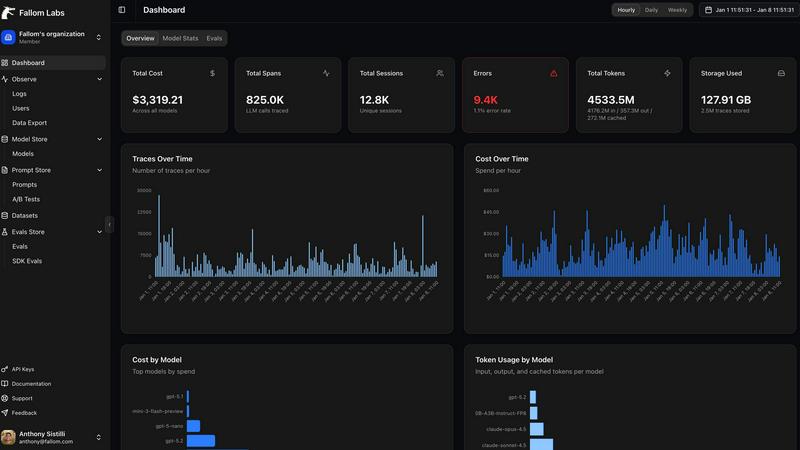
Fallom
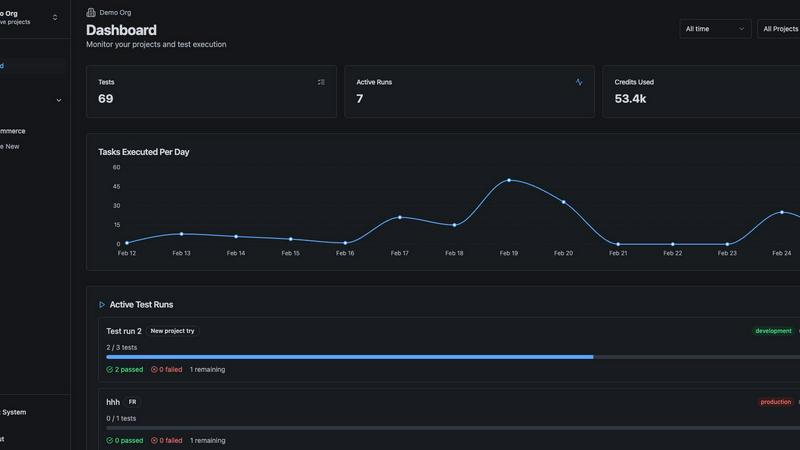
qtrl.ai
Feature Comparison
Fallom
End-to-End LLM Tracing
Fallom provides complete, granular tracing for every interaction with large language models. This means you can see the full sequence of events for any AI task, from the initial user prompt, through intermediate reasoning steps and tool calls, to the final response. Each trace includes the raw input and output, the specific model used, token counts, latency metrics, and the calculated cost. This level of detail is the basic building block for understanding how your AI applications behave in the real world, making debugging and optimization possible.
Real-Time Monitoring Dashboard
The platform offers a live dashboard that displays all LLM calls as they happen in production. You can monitor activity in real time, watching traces for different models, users, or sessions stream in. This dashboard allows you to see key metrics at a glance, such as request volume, average latency, and error rates. By providing a live view of your system's health, it enables teams to spot anomalies, performance degradation, or unexpected cost spikes immediately, facilitating faster incident response.
Cost Attribution and Analysis
A fundamental aspect of managing AI applications is understanding and controlling expenses. Fallom automatically attributes costs to their source. You can break down spending by AI model, by individual user or customer, by internal team, or by specific feature. This transparent cost tracking is essential for accurate budgeting, internal chargebacks, and identifying inefficient or expensive patterns in your LLM usage, helping you make informed decisions about model selection and optimization.
Compliance and Audit Readiness
For enterprises operating in regulated industries, Fallom is built with compliance as a core feature. It maintains complete, immutable audit trails of every LLM interaction, supporting requirements for standards like SOC 2, GDPR, and the EU AI Act. Features include detailed input/output logging, model version tracking, user consent recording, and session-level context. This ensures you have a verifiable record of your AI's operations for security reviews, regulatory audits, and internal governance.
qtrl.ai
Enterprise-Grade Test Management
This feature provides a structured foundation for all quality activities. It offers a centralized repository for test cases, plans, and runs, ensuring everything is organized and accessible. Full traceability links tests back to requirements, and detailed audit trails are maintained for compliance. It supports both manual and automated workflows, giving teams the flexibility to manage quality in a way that fits their current process while preparing for more advanced automation.
Progressive AI Automation
Instead of a sudden, all-or-nothing approach, qtrl.ai introduces automation progressively. Teams begin by writing high-level test instructions in plain English. When ready, they can leverage AI to generate detailed test scripts from those instructions. The AI also suggests new tests based on coverage gaps. Crucially, every AI-generated step is fully reviewable and approvable by a human, maintaining oversight and ensuring tests align with team expectations before execution.
Autonomous QA Agents
These are intelligent executors that operate within defined rules. They can run tests on demand or continuously across multiple real browsers and environments, such as development, staging, and production. The agents execute instructions precisely, providing real browser interaction rather than simulations. They operate with permissioned autonomy levels, meaning their actions are transparent and controllable, never making unpredictable "black-box" decisions.
Adaptive Memory & Multi-Environment Execution
The platform builds a living knowledge base of your application by learning from exploration, test execution, and discovered issues. This context makes test generation smarter over time. Coupled with robust multi-environment execution, teams can run tests across any stage of the development lifecycle. The system securely manages per-environment variables and encrypted secrets, which are never exposed to the AI agent, ensuring security and consistency.
Use Cases
Fallom
Debugging and Improving AI Agent Workflows
When a complex AI agent that uses multiple tools and LLM calls fails or behaves unexpectedly, pinpointing the root cause is challenging. Fallom's tracing allows developers to replay the exact sequence of steps, examine the prompts and responses at each stage, and view the arguments and results of every tool call. This visibility turns debugging from a guessing game into a systematic process, drastically reducing the time to resolve issues and improve agent reliability.
Managing and Optimizing AI Operational Costs
As AI applications scale, costs can become unpredictable and difficult to manage. Fallom addresses this by providing clear, actionable data on where every dollar is spent. Product and engineering leads can use Fallom to identify which features or customers are the most expensive, compare the cost-performance ratio of different models like GPT-4o versus Claude, and set alerts for budget overruns. This enables proactive cost control and ensures sustainable scaling.
Ensuring Compliance and Auditability
Companies in finance, healthcare, or legal services using AI must demonstrate compliance with strict regulations. Fallom serves as a system of record for all AI activity. It automatically logs all necessary data—who used the system, what was asked, which model version answered, and what was said—creating a defensible audit trail. This is essential for passing security audits, responding to data subject requests, and proving adherence to industry regulations.
Performance Monitoring and Reliability Engineering
Site Reliability Engineering (SRE) principles apply to AI systems as well. Teams use Fallom to establish performance baselines for their LLM calls, monitor latency and error rate Service Level Objectives (SLOs), and set up alerts for degradation. The timing waterfall charts help visualize where bottlenecks occur in multi-step chains, allowing engineers to optimize slow steps and ensure a consistent, reliable user experience for AI-powered features.
qtrl.ai
Scaling Beyond Manual Testing
For QA teams overwhelmed by repetitive manual test cycles, qtrl.ai provides a clear path forward. Teams can start by structuring their existing manual tests in the platform. Then, they can progressively automate the most tedious and high-value test cases using AI-generated scripts, freeing up human testers for more complex exploratory work and significantly increasing test coverage and execution speed.
Modernizing Legacy QA Workflows
Companies relying on outdated, siloed, or spreadsheet-based test management systems can consolidate their entire QA process into qtrl.ai. The platform brings test management, automation, and execution into a single, governed system. This modernization provides immediate benefits like real-time dashboards, audit trails, and traceability, while setting the stage for intelligent automation without a disruptive overhaul.
Governing Enterprise AI Testing
Enterprises with strict compliance, security, and governance requirements can safely adopt AI for testing with qtrl.ai. The platform's design ensures full visibility into all AI agent activities, maintains detailed audit trails, and keeps human oversight at the center. Teams can grant autonomy gradually, ensuring the AI operates within strict guardrails and corporate policies, making it a trustworthy solution for regulated industries.
Enhancing Product-Led Engineering
Product-led engineering teams that need to move fast without breaking things can integrate qtrl.ai into their CI/CD pipelines. The platform supports continuous quality feedback loops, allowing teams to run automated test suites against every build. AI agents can be tasked with verifying new features or conducting regression tests, providing rapid feedback and ensuring quality keeps pace with development velocity.
Overview
About Fallom
Fallom is an AI-native observability platform built from the ground up for teams developing applications with large language models (LLMs) and AI agents. In the complex world of AI operations, traditional monitoring tools fall short. Fallom provides the fundamental visibility needed to understand, manage, and improve AI-powered systems in production. It works by automatically tracing every LLM call, capturing essential data like the exact prompts sent, the model's outputs, any tool or function calls made, token usage, latency, and per-call costs. This end-to-end tracing is the cornerstone of AI observability. The platform is designed for engineering and product teams who need to move beyond simple logging to gain actionable insights. Its core value proposition is delivering comprehensive, real-time visibility into AI workloads, enabling organizations to optimize performance, control costs, troubleshoot issues quickly, and maintain compliance with enterprise and regulatory standards. With its OpenTelemetry-native SDK, integrating Fallom is a straightforward process, allowing teams to start tracing their applications in minutes and establish a foundational layer of observability for their AI initiatives.
About qtrl.ai
qtrl.ai is a modern QA platform designed to help software development teams scale their quality assurance efforts effectively. At its core, it addresses a fundamental challenge: the trade-off between speed and control. Many teams are caught between slow, unscalable manual testing and complex, brittle traditional automation tools. qtrl.ai provides a structured solution by combining enterprise-grade test management with intelligent, trustworthy AI automation. This creates a centralized hub where teams can organize test cases, plan test runs, trace requirements, and track quality metrics through real-time dashboards. The platform is built for progression, allowing teams to start with simple manual test management and gradually introduce AI-powered automation as they become comfortable. This makes it an ideal fit for product-led engineering teams, QA groups moving beyond manual processes, companies modernizing legacy workflows, and enterprises that require strict compliance and audit trails. Ultimately, qtrl.ai's mission is to bridge the gap, offering a controlled, transparent path to faster and more intelligent quality assurance without the risks associated with unpredictable "black-box" AI solutions.
Frequently Asked Questions
Fallom FAQ
What is AI observability and why is it different?
AI observability is the practice of gaining deep, actionable insights into the behavior and performance of AI systems, particularly those based on LLMs. It is different from traditional application monitoring because LLMs are non-deterministic. You need to see not just if a call failed, but why it failed—was the prompt poorly constructed, did a tool call error, or did the model hallucinate? Observability provides the context of prompts, outputs, and intermediate steps necessary to answer these questions.
How difficult is it to integrate Fallom into my existing application?
Integration is designed to be straightforward. Fallom provides an OpenTelemetry-native SDK, which is the industry-standard protocol for observability. In most cases, you can instrument your application by adding a few lines of code to your LLM client initialization. The goal is to have basic tracing up and running in under five minutes, without requiring major changes to your application architecture or causing performance overhead.
Can Fallom handle sensitive or private data?
Yes. Fallom includes a Privacy Mode for handling sensitive information. This mode allows you to configure content redaction, so that specific data fields or entire prompt/response contents are not captured in the logs, while still preserving essential metadata for tracing and metrics. You can maintain full telemetry for debugging and costing without storing confidential user data, aligning with data privacy policies.
Does Fallom support all LLM providers and frameworks?
Fallom is built to be provider-agnostic. It works with all major LLM providers like OpenAI, Anthropic, Google Gemini, and open-source models. The OpenTelemetry foundation means it can integrate with any framework or custom code that makes LLM calls. This prevents vendor lock-in and ensures you can maintain a unified observability platform even if your tech stack evolves or you switch model providers.
qtrl.ai FAQ
How does qtrl.ai's AI differ from other "autonomous" testing tools?
qtrl.ai avoids a risky "black-box" approach. Its AI is designed for transparency and control. It does not make unpredictable decisions. Instead, it generates test steps from human instructions, which must be reviewed and approved before execution. You define the rules and level of autonomy. This progressive, governed model ensures the AI assists your team reliably and builds trust over time.
Can we use qtrl.ai if we are not ready for full AI automation?
Absolutely. qtrl.ai is built for progression. You can start by using it solely as a powerful test management platform to organize manual test cases, plans, and runs. When your team is ready, you can begin experimenting with AI-generated test creation for specific scenarios. The platform adapts to your pace, allowing you to increase automation gradually without any pressure to change your entire workflow overnight.
How does qtrl.ai handle security and sensitive data?
Security is a foundational principle. qtrl.ai offers enterprise-ready security measures. For automation, you can define environment-specific variables and encrypted secrets (like passwords or API keys). These secrets are never exposed to the AI agent during test execution. The platform provides full audit trails and is built to support compliance requirements, giving you control over your data and test assets.
Does qtrl.ai work with our existing development tools?
Yes, qtrl.ai is designed to integrate into real-world workflows. It offers requirements management integration, CI/CD pipeline support, and is built to work alongside your existing toolset. The goal is to enhance your current process, not replace it entirely. This allows teams to incorporate structured test management and intelligent automation without disrupting their established development lifecycle.
Alternatives
Fallom Alternatives
Fallom is an AI-native observability platform in the development tools category. It provides real-time monitoring and debugging specifically for large language models and AI agents in production. Users often explore alternatives for various reasons. These can include budget constraints, the need for different feature sets, or integration requirements with their existing technology stack. The specific needs of a project or organization can drive the search for a different solution. When evaluating an alternative, focus on core capabilities. Key considerations include the depth of tracing for LLM calls, transparency into costs and performance, and built-in support for compliance and audit requirements. The right tool should provide clear visibility into your AI operations.
qtrl.ai Alternatives
qtrl.ai is a modern quality assurance platform in the automation and developer tools category. It helps software teams scale their testing efforts by combining structured test management with intelligent AI agents. This approach allows teams to maintain full control and governance while gradually introducing automation. Users often explore alternatives for various reasons. Common considerations include budget constraints, the need for specific features not offered, or a requirement to integrate with a different set of existing development tools. The specific needs of a team's workflow and application stack are also key factors. When evaluating any alternative, it's wise to look at the core capabilities. Consider the balance between manual test organization and automated execution. Assess how the tool handles test maintenance and reporting. Finally, evaluate the level of control and transparency the platform offers, especially when it involves AI-driven features.