echoloc vs Utkrusht
Side-by-side comparison to help you choose the right product.

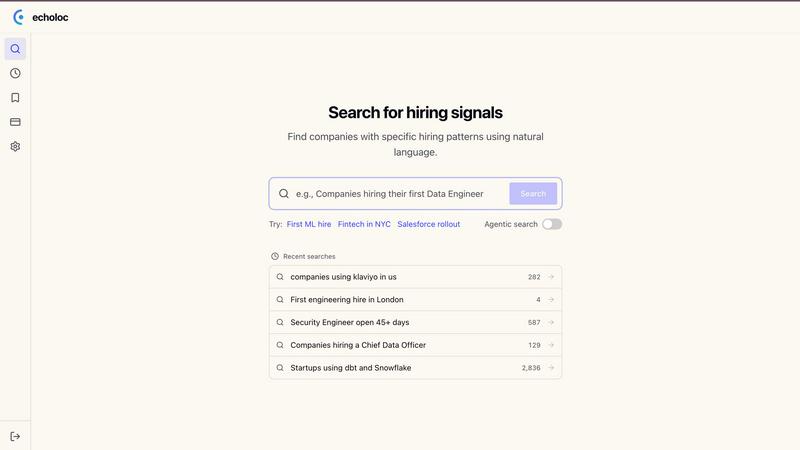
Echoloc finds companies ready to buy by analyzing the hiring signals hidden in their job postings.
Last updated: February 28, 2026

Utkrusht
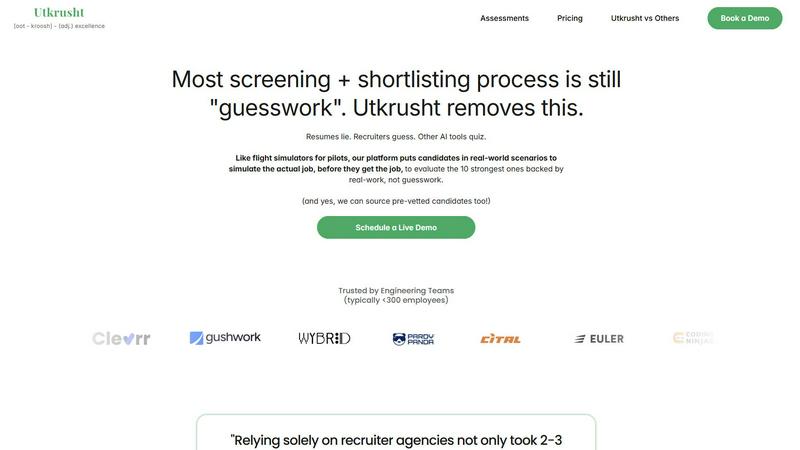
Utkrusht assesses technical skills through real job simulations, not resumes or quizzes.
Last updated: February 28, 2026
Visual Comparison
echoloc
Utkrusht
Feature Comparison
echoloc
Natural Language Search
Instead of complex filters and dropdown menus, you describe what you're looking for in plain English. Simply type queries like "companies hiring their first VP of Sales" or "startups using dbt and Snowflake." The platform understands your intent and searches its database of millions of analyzed job posts to deliver matching companies. This back-to-basics approach removes the learning curve and lets you search the way you naturally think, focusing on the strategic signal rather than the mechanics of the tool.
Evidence-Based Company Matches
Every company result provided by Echoloc comes with direct proof from the source. The platform displays relevant snippets from the actual job descriptions that triggered the match, such as "Building our data platform from scratch" for a first-hire signal. This foundational feature ensures there is no mystery or reliance on stale, aggregated lists. You can trust the data because you see the concrete evidence behind each signal, allowing for highly informed and contextual outreach.
Real-Time Signal Detection
The platform monitors over 30 million companies and analyzes job postings as they are published, providing real-time updates on new buying signals. This means you are alerted to opportunities like a hiring spike or a new leadership role as they happen, not days or weeks later. This continuous, up-to-the-minute analysis is crucial for maintaining a timing advantage over competitors who rely on slower, processed intent data.
Curated Signal Templates
To help you get started and think strategically, Echoloc provides pre-built, curated search templates for the most valuable and common buying signals. These include "First Hire" for greenfield budgets, "Hiring Spike" for rapid scaling, "Tech Stack" for specific tool investments, and "Urgent Pain" for roles open for an extended period. These templates educate users on what to look for and instantly generate high-quality lead lists based on proven signal categories.
Utkrusht
Real-World Task Simulations
Utkrusht provides candidates with actual on-the-job tasks to complete in a live production environment. These are not multiple-choice quizzes but detailed, pair-programming style challenges where candidates must code, design, debug, and deploy solutions to real problems like fixing APIs or improving performance. This feature allows hiring managers to observe a candidate's fundamental skills, problem-solving approach, and how they make trade-offs in a setting that closely mirrors daily work.
Intelligent Candidate Rubrics
Beyond just coding skill, the platform builds comprehensive candidate rubrics by gathering insights from various sources. This includes analyzing resume details, candidate responses during the assessment, and even public social profiles to gauge factors like intent to join, location match, salary alignment, and potential culture fit. This holistic view provides a more rounded evaluation of each applicant.
Proctored Sessions & Integrity Assurance
To maintain the integrity of the assessment process, Utkrusht proctors candidate sessions. The platform tracks for unfair practices or cheating, ensuring that the work submitted is the candidate's own. It also calculates and reports metrics on the candidate's usage of AI tools during the task, giving you transparent insight into their problem-solving methodology and resourcefulness.
High-Completion, Low-Drop-Off Assessments
The platform is designed with candidate experience as a core tenet. By keeping assessments focused, relevant, and limited to around 30 minutes, candidates are more likely to complete them. A significant majority of assessments are taken during breaks in the middle of the workday, not on weekends, leading to a high completion rate and ensuring you get signal from almost every candidate you invite.
Use Cases
echoloc
Prospecting for Greenfield Opportunities
Identify companies that are building a new function or capability from the ground up, such as hiring their first data scientist or security engineer. These "first hire" signals indicate a company is allocating a new budget for tools and services in that domain. Your outreach can be framed around helping them build their foundation, positioning you as a strategic partner rather than just another vendor during a critical, early decision-making phase.
Targeting Companies in Rapid Scaling Phases
Discover organizations experiencing significant growth, evidenced by job posts showing a "hiring spike" (e.g., "Looking for 8+ SDRs to join immediately"). This rapid expansion creates urgent needs for new software, infrastructure, and services to support the larger team. Sales teams can use this signal to offer solutions that alleviate the pain points of scaling, making their outreach highly relevant and timely.
Engaging with Tech Stack Migrations or Rollouts
Find companies actively implementing or changing major software platforms, such as a "Revenue Operations Manager to lead our Salesforce implementation project." This is a clear signal of budget allocation and project kickoff for complementary tools and consulting services. Reaching out to the hiring manager or team involved in this project allows you to engage with a buyer who has an immediate, defined need.
Identifying New Budget Owners and Regions
Pinpoint companies that are hiring new executive leadership (like a Chief Data Officer) or making their first hire in a new geographical region. A new executive often reorganizes budgets and brings in new vendors, while geo-expansion signals the creation of a new regional budget. This allows sales teams to introduce themselves to new, influential decision-makers at the precise moment they are evaluating their options and establishing new processes.
Utkrusht
Screening for Custom Software Development Roles
For companies building custom software solutions, identifying developers who can navigate real-world complexity is crucial. Utkrusht is used to screen candidates for roles requiring hands-on skills in debugging live systems, optimizing existing codebases, or building features within architectural constraints, ensuring only those who can perform in a production-like setting move forward.
Replacing First-Round Technical Interviews
Engineering teams can use Utkrusht to replace the initial, often time-consuming, technical screening call or take-home test. By having all applicants complete a standardized, job-relevant task, hiring managers receive a shortlist of top performers with demonstrated proof-of-skill, allowing them to dedicate interview time only to high-quality, pre-vetted candidates.
Reducing Dependency on Recruitment Agencies
Companies looking to reduce steep commission fees and gain more control over their hiring funnel use Utkrusht. It provides an objective, skill-based filter that is more reliable than agency profiles, which often over-promise. This allows internal teams to source candidates broadly and assess them fairly at scale.
Building a Pipeline of Pre-Qualified Talent
Beyond a single open role, organizations can use Utkrusht's task-based assessments to create a benchmarked talent pool. Candidates who perform well on general or role-specific tasks can be kept in a warm pipeline for future opportunities, with their proven skills already documented and validated.
Overview
About echoloc
Echoloc is a hiring signals platform that fundamentally changes how sales and revenue teams discover and engage with potential buyers. It operates on a foundational principle: job postings are not just HR announcements, but powerful, leaked signals of a company's intent to invest. While traditional intent data tracks activity after a buying process has begun, Echoloc allows you to identify opportunities at their inception, often months before a company appears on any other radar. The platform analyzes millions of job descriptions in real-time to uncover concrete evidence of growth, new projects, and urgent needs—such as a company hiring its first data engineer, rapidly scaling a sales team, or expanding into a new region. This evidence-based approach is designed for sales development representatives (SDRs), account executives (AEs), and go-to-market leaders who need to prioritize their outreach with precision and timeliness. By focusing on the basic, actionable intelligence found in hiring plans, Echoloc cuts through the noise and provides a clear, early advantage in the sales cycle, ensuring your team contacts the right company at the exact moment they are preparing to spend.
About Utkrusht
Utkrusht is a technical hiring platform built on a foundational principle: resumes and theoretical quizzes are poor predictors of on-the-job performance. Designed specifically for software and custom development companies, it addresses the core problem of costly mis-hires by shifting the evaluation paradigm. The platform moves away from asking interview-like questions and instead places candidates into real-job simulation scenarios. Candidates are invited to complete practical, 30-minute tasks in a live sandbox environment, such as debugging broken Docker containers, improving a slow API, or writing unit tests. This approach mimics the actual work they would perform after joining your team, providing hiring managers with tangible proof-of-skill and high-signal confidence before the first interview even begins. The ultimate value proposition of Utkrusht is to deliver a rigorously evaluated shortlist of the top 5-10 strongest candidates for any given role, saving engineering teams countless hours wasted on screening and low-signal first-round interviews. Its name, meaning "excellence," directly reflects its mission to help teams identify truly excellent candidates based on demonstrated skill and execution.
Frequently Asked Questions
echoloc FAQ
What kind of signals does echoloc detect?
Echoloc is specifically engineered to detect hiring signals that indicate commercial intent. This includes companies making their first hire in a key role (signaling new budget), posting multiple jobs for the same function (signaling rapid scaling), mentioning specific technologies in job descriptions (signaling investment in that stack), hiring for roles related to software implementation (signaling a rollout), and expanding teams into new geographic locations. Each signal is tied directly to evidence from public job postings.
How current is the data in the platform?
The data is updated in real-time. Echoloc continuously monitors and analyzes new job postings from over 30 million companies. The "Last seen" date on each company result shows how recently the detected job was posted, and the platform surface lists are updated dynamically, often within hours of a job being published online. This ensures you are working with the most current signals available.
How is this different from traditional intent data?
Traditional intent data typically aggregates signals like website visits, content downloads, and review site activity, which indicate a company is already researching solutions. Echoloc operates at an earlier, more foundational stage by analyzing job posts—a signal that often precedes formal research by weeks or months. It reveals a company's preparation to buy (they are building a team and budget) rather than their act of shopping, giving you a significant timing advantage.
Who is the primary user for echoloc?
The primary users are sales development representatives (SDRs), account executives (AEs), and revenue operations or go-to-market leaders at B2B technology and service companies. It is designed for any professional whose success depends on identifying and engaging with companies that have an imminent, evidence-based need for their product, allowing them to build a pipeline with precision and superior timing.
Utkrusht FAQ
What kind of tasks do candidates perform on Utkrusht?
Candidates perform practical, job-simulated tasks in a live sandbox environment. Examples include debugging broken Docker containers, improving the performance of a slow API endpoint, writing comprehensive unit tests for a given function, or building a small feature. Each task is designed to take about 30 minutes and requires the candidate to work as they would on the actual job, showcasing their coding, problem-solving, and deployment skills.
How does Utkrusht differ from platforms like HackerRank or LeetCode?
Utkrusht fundamentally differs by focusing on real-world job simulation rather than algorithmic puzzles or quiz-based questions. While platforms like LeetCode test theoretical computer science knowledge, Utkrusht assesses how a candidate executes tasks they would face daily, such as debugging, working with existing codebases, and making practical trade-offs. It evaluates on-the-job performance, not just theoretical problem-solving.
How long does it take to get results after inviting candidates?
The platform is designed for efficiency. After candidates complete their assessments, hiring teams typically receive a detailed shortlist of the top 5-10 recommended candidates within 48 hours. This report includes proof-of-skill from the tasks, analysis, and even video sessions of the candidates' work, enabling quick and informed decisions.
What happens if a candidate cheats during the assessment?
Utkrusht incorporates proctoring mechanisms to ensure assessment integrity. The platform tracks sessions for signs of unfair practices. If cheating is detected, it is flagged in the candidate's report. Furthermore, the nature of the live, practical tasks makes them significantly harder to cheat on compared to standard MCQ tests, as the output requires genuine understanding and execution.
Alternatives
echoloc Alternatives
Echoloc is a sales intelligence tool in the business and finance category. It helps sales teams find new customers by analyzing job postings for signs a company is planning to buy new products or services. People often look for alternatives to tools like this for several common reasons. These include budget constraints, the need for different features, or a requirement to integrate with other software platforms they already use. It's a normal part of finding the right fit for a team's specific workflow. When evaluating any alternative, focus on the core problem you need to solve. Consider the accuracy of the data, how easily it connects to your current sales tools, and the overall value for the price. The goal is to find a solution that provides reliable, actionable information to make your outreach more effective.
Utkrusht Alternatives
Utkrusht is a technical hiring platform in the career and jobs category. It focuses on evaluating software developers through real-world job simulations, moving beyond traditional resumes and theoretical quizzes to assess practical, on-the-job skills. Users may explore alternatives for various reasons. Common considerations include budget constraints, the need for different feature sets like broader role support or simpler quiz formats, and specific platform requirements such as deeper integration with existing HR software. The search for a different tool is a normal part of finding the right fit for a company's unique hiring workflow. When evaluating other options, focus on the core problem you need to solve. Key factors include the authenticity of the skill assessment method, the relevance of the evaluation tasks to your actual open roles, and the overall efficiency gained in your recruitment process. The goal is to identify candidates who can perform, not just those who can interview well.