CloneUI vs Dokie AI
Side-by-side comparison to help you choose the right product.

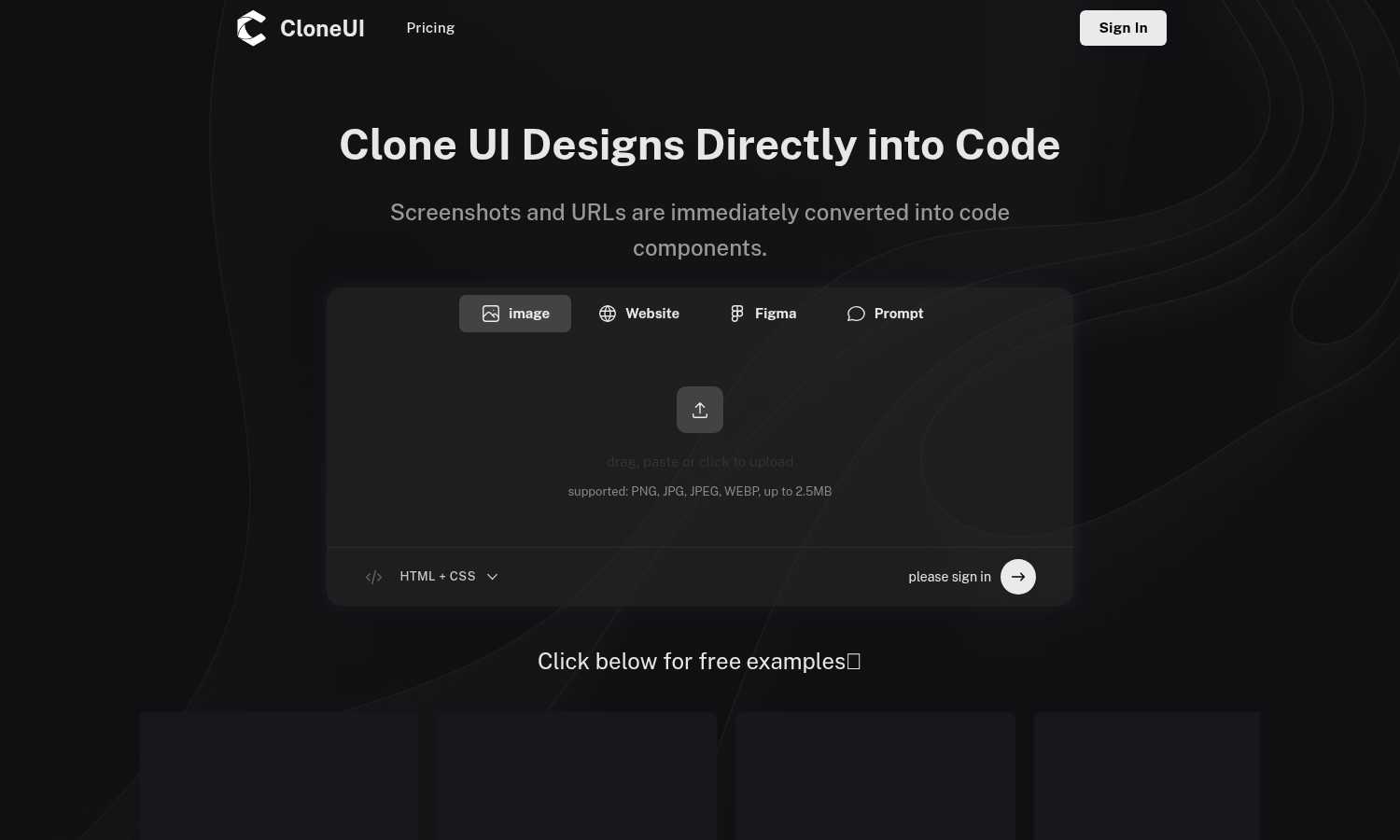
CloneUI instantly converts website screenshots and URLs into clean, production-ready HTML, CSS, and React code.
Last updated: March 1, 2026

Dokie AI
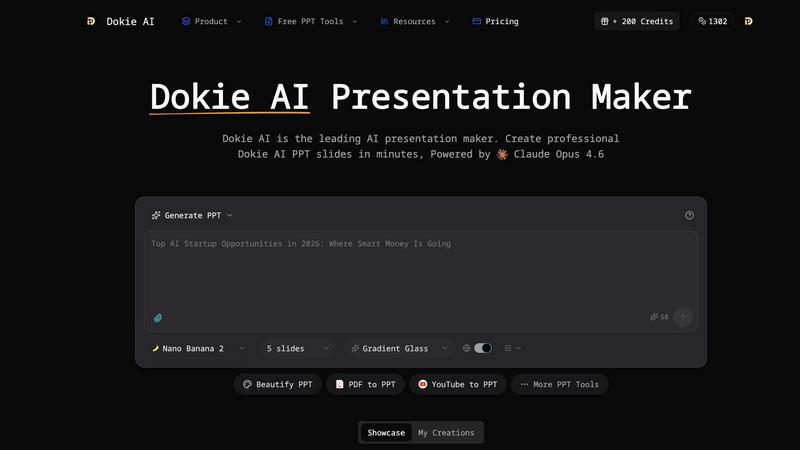
Dokie AI uses Claude Opus to create professional presentations from your text in minutes.
Last updated: March 19, 2026
Visual Comparison
CloneUI
Dokie AI
Feature Comparison
CloneUI
Screenshot to Code Conversion
This feature allows you to transform a static image of any website or design mockup into functional code. Simply upload a screenshot in formats like PNG or JPG, and CloneUI's AI will analyze the visual elements, recognizing components and their spatial relationships. It then generates clean, well-structured HTML and CSS that replicates the design. This is ideal for when you have a visual reference but no direct access to the website's source code or a design file, providing a quick starting point for development.
URL to Code Cloning
With this capability, you can generate code by simply pasting the URL of any live website. CloneUI will fetch the page, analyze its rendered structure, and produce a code clone. This is incredibly useful for understanding how a particular site is built, creating a legal starting template for a new project inspired by an existing design, or rapidly prototyping based on a live reference. It streamlines the process of deconstructing and learning from existing web implementations.
Framework-Specific Export
CloneUI provides flexibility by allowing you to export the generated code into your preferred development framework. You are not locked into one output format. With one click, you can choose to receive your code as standard HTML and CSS, or as component-based code for modern JavaScript frameworks like React or Vue.js. This ensures the generated code can be directly integrated into your existing project's architecture without significant refactoring.
Intelligent Component Recognition
The AI at the heart of CloneUI does more than just copy pixels; it intelligently maps visual elements to their corresponding code components. It identifies common UI patterns such as navigation bars, hero sections, cards, buttons, and forms. This recognition allows the tool to generate semantic and logical code structure, making the output more maintainable and easier for developers to understand and extend compared to a simple, non-semantic HTML dump.
Dokie AI
AI Generate PPT
This is the foundational feature for creating presentations from scratch. You simply describe your topic, idea, or outline in plain text. Dokie AI's engine then analyzes this input to generate a complete slide deck. It automatically determines the optimal content structure, creates professional layouts, suggests and formats compelling text, and incorporates relevant visual design elements and charts. This feature handles the entire creative and design workflow, turning a basic concept into a ready-to-present slide deck.
AI Beautify PPT
This feature is designed to enhance and upgrade existing presentations. You can upload your current PowerPoint file, and Dokie AI will intelligently redesign it. It analyzes the content to fix awkward layouts, apply consistent and professional styling, improve visual hierarchy, and refresh the overall aesthetic. The AI works to preserve your original content and intent while elevating the design to a more polished and engaging standard, saving you from tedious manual redesign work.
Multi-Format Conversion
Dokie AI provides a suite of tools to convert various content formats directly into presentation slides. This includes converting PDF documents, Word files, HTML web pages, and even YouTube videos into structured PowerPoint presentations. This functionality is crucial for repurposing existing materials into a presentation format quickly, ensuring that valuable content from different sources can be seamlessly integrated into a slide deck without manual copying and pasting.
Speaker Notes Generation
To support effective presentation delivery, Dokie AI can automatically generate detailed speaker notes and talking points for each slide in your deck. This feature analyzes the slide content and creates comprehensive notes that explain key points, suggest transitions, and offer additional context. This helps presenters deliver their message more confidently and ensures they have a helpful guide to complement the visual slides during their talk.
Use Cases
CloneUI
Rapid Prototyping for Developers
Developers can use CloneUI to quickly build functional prototypes from design inspiration or client mockups. Instead of spending hours coding a layout from scratch, they can input a screenshot or URL and receive a working code base in seconds. This prototype can then be immediately tested, iterated upon, and connected to backend services, dramatically accelerating the initial phases of the development cycle and allowing for faster client feedback.
Learning and Educational Tool
For students and new developers, CloneUI serves as an excellent educational resource. By inputting the URL of a well-designed website, a learner can instantly see the code that constructs it. This reverse-engineering process helps demystify how visual designs translate into HTML structures and CSS rules, providing practical, real-world examples to study and learn from, which is a foundational step in mastering web development.
Design to Development Handoff
Designers and developers often face friction during the handoff process. CloneUI streamlines this by allowing designers to provide a screenshot of their Figma, Adobe XD, or Sketch design. The developer can then feed this image into CloneUI to generate a foundational code structure. This creates a more accurate and efficient starting point than manual interpretation, reducing misunderstandings and ensuring the final product aligns closely with the original design vision.
Competitive Analysis and Inspiration
When you find a website with an appealing feature or layout, CloneUI helps you understand its construction for competitive analysis or personal inspiration. By cloning the URL, you can examine the code behind specific interactions or responsive behaviors. This allows developers and agencies to ethically deconstruct and learn from industry best practices, informing their own design and development decisions without starting from a blank slate.
Dokie AI
Business Reporting and Proposals
Business professionals can use Dokie AI to rapidly create quarterly reports, project updates, sales proposals, and strategic plans. By inputting data points and objectives, the tool generates clear, visually authoritative decks that communicate complex business information effectively to stakeholders, managers, and clients, ensuring a professional image with minimal time investment.
Educational and Training Material Development
Educators, trainers, and instructional designers can leverage Dokie AI to build lesson plans, lecture slides, workshop materials, and online course content. Describing a lesson topic allows the AI to structure the educational content logically with engaging visuals and clear summaries, enhancing student comprehension and saving instructors significant preparation time.
Marketing and Sales Pitch Creation
Marketing teams and sales representatives can create compelling pitch decks, product launch presentations, and campaign overviews. Dokie AI helps transform feature lists and value propositions into persuasive, visually-driven stories that capture audience attention and clearly communicate brand messaging to potential customers and partners.
Startup and Investor Deck Preparation
Startup founders often need to create impactful investor pitch decks under tight deadlines. Dokie AI assists by turning a business idea, model, and metrics into a professionally designed narrative. It ensures the deck has a strong visual flow, highlights key opportunities, and presents data effectively, which is crucial for making a positive impression during funding rounds.
Overview
About CloneUI
CloneUI is a foundational tool designed to bridge the gap between visual design and functional code. At its core, it is an AI-powered web application that converts visual inputs into clean, production-ready code. This process addresses a fundamental and often time-consuming step in web development: translating a design concept into a working prototype. The tool operates by accepting two primary inputs: a screenshot image of a website or design, or a direct URL to an existing webpage. Its sophisticated AI then analyzes the visual structure, identifies components like buttons, headers, and layouts, and generates the corresponding HTML, CSS, and JavaScript code. This output is not just a static copy; it is responsive, semantic, and structured for real-world use.
CloneUI is built for a wide audience, from beginners learning web development to experienced developers and designers seeking efficiency. Its main value proposition is profound simplicity and speed. It eliminates the tedious manual work of inspecting elements and writing boilerplate code from scratch, allowing users to focus on higher-level tasks like customization, functionality, and creativity. By supporting popular frameworks like React and Vue, alongside standard HTML/CSS, it integrates seamlessly into modern development workflows. Ultimately, CloneUI empowers users to bring digital ideas to life faster, making the foundational step of creating code from a design effortless and accessible to all.
About Dokie AI
Dokie AI is a fundamental shift in how presentations are created. It is an AI-powered presentation maker designed to help individuals and teams produce professional, polished slide decks without requiring any prior design skills or spending hours on manual formatting. At its core, Dokie AI uses true artificial intelligence, powered by the advanced Claude Opus 4.6 model, to understand your content and automatically handle the complex tasks of structuring information, selecting appropriate layouts, applying typography, and designing cohesive visuals. This back-to-basics approach removes the technical barriers, allowing you to focus solely on your core message and ideas. It is built for a wide range of users including business professionals preparing reports, educators creating lesson materials, marketers developing campaign pitches, and startup founders crafting investor decks. The main value proposition of Dokie AI is simple: it transforms a simple text description or an existing document into a complete, visually compelling presentation in minutes, democratizing access to high-quality design and structured storytelling.
Frequently Asked Questions
CloneUI FAQ
Which input formats are compatible with CloneUI?
CloneUI accepts visual inputs in two primary ways. You can upload screenshot image files in common formats including PNG, JPG, JPEG, and WEBP. Alternatively, you can directly input the URL of any publicly accessible website. The tool analyzes these inputs to generate the corresponding code, making it versatile for both static mockups and live web pages.
How is the code generated?
The code is generated using sophisticated artificial intelligence. When you provide an image or URL, CloneUI's AI engine analyzes the visual composition, identifying UI components, layouts, colors, and typography. It then maps these visual elements to their appropriate HTML tags and CSS styling rules, constructing a clean, semantic, and responsive code structure that mirrors the original design as closely as possible.
What frameworks does CloneUI support?
CloneUI provides export options for several popular web development frameworks to suit different project needs. You can choose to export the generated code as standard, plain HTML and CSS. For more advanced, component-based projects, it also supports exporting to React and Vue.js, allowing you to seamlessly integrate the cloned UI into your existing modern development stack.
Is the generated code suitable for production use?
The code generated by CloneUI is clean, responsive, and production-ready in terms of its structure and styling. It provides an excellent, pixel-perfect foundation. However, like any generated code, it is intended as a starting point. Developers should review, customize, and integrate it with their application's logic, state management, accessibility features, and performance optimizations to meet specific production standards and requirements.
Dokie AI FAQ
What makes Dokie AI different from template-based tools like PowerPoint or Canva?
Dokie AI uses true generative AI, specifically Claude Opus 4.6, to create presentations dynamically from your text input. Unlike static templates where you manually fill in boxes, Dokie AI automatically generates the entire structure, layout, design, and coherent content flow tailored to your specific topic. It is an intelligent design partner, not just a library of pre-made slides.
What file formats can I use with Dokie AI?
You can start from a simple text prompt to generate a new presentation. For enhancement and conversion, Dokie AI supports uploading existing PowerPoint (PPT) files, PDF documents, Microsoft Word documents, and even HTML files. It also offers a unique tool to convert YouTube videos into presentation slides by extracting key content.
Does Dokie AI replace the need for me to know my content?
No, Dokie AI is a tool to execute and design your ideas, not to replace your expertise. You must provide the core topic, key points, and data. The AI's role is to structure that information effectively and apply professional design principles. You retain full control to edit and refine the AI-generated content to ensure accuracy and alignment with your message.
How does the "Beautify" feature work with my existing slides?
When you upload a presentation, Dokie AI analyzes all elements on each slide-text, images, charts. It then redesigns the deck by improving layout balance, applying a consistent color palette and typography, enhancing visual hierarchy for better readability, and suggesting more professional graphical treatments, all while keeping your original core content intact.
Alternatives
CloneUI Alternatives
CloneUI is a tool in the design-to-code and low-code development category. It uses AI to convert website screenshots, URLs, or Figma designs into production-ready code for frameworks like React and Vue. This process helps developers and designers save significant time on manual coding tasks. Users often explore alternatives for various practical reasons. These can include budget constraints, as pricing models differ. Others may need specific features not offered, like support for a different design tool or code framework. Platform compatibility, such as a desktop application versus a web service, can also be a deciding factor. When evaluating other options, consider your primary workflow. Identify if you need integration with your existing design software or a particular code output. Assess the accuracy and cleanliness of the generated code, as this impacts future development. Finally, compare the overall value against the cost to find the best fit for your projects.
Dokie AI Alternatives
Dokie AI is a specialized tool in the category of AI-powered design software, specifically built to generate and enhance presentation slides. It uses advanced artificial intelligence to automate the creation of professional slide decks from simple text descriptions, handling everything from content structure to visual design. Users often explore alternatives for several practical reasons. These can include budget constraints, as different tools offer varied pricing models. Others may seek specific features not available in one platform, require different levels of creative control, or need compatibility with certain operating systems or existing software ecosystems. When evaluating an alternative, it's wise to consider your core needs. Key factors include the tool's primary function, the quality and intelligence of its automation, the flexibility it offers for customization, and the overall value relative to its cost. Understanding these fundamentals helps in selecting a solution that aligns with your workflow and presentation goals.