Blueberry vs Fallom
Side-by-side comparison to help you choose the right product.

Blueberry
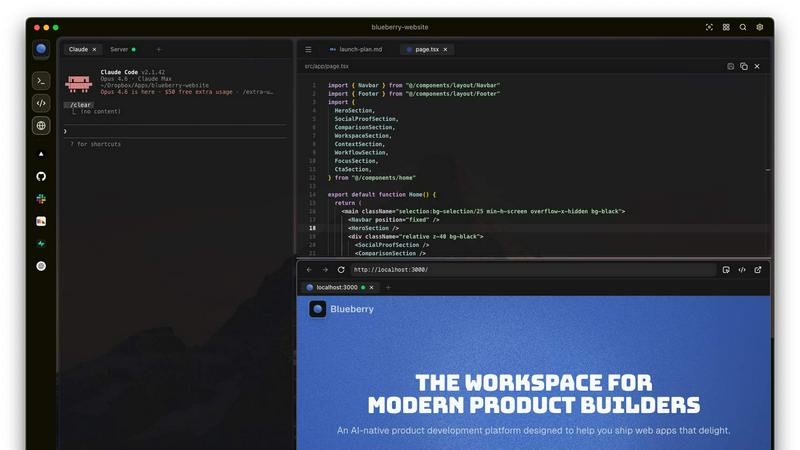
Blueberry is a Mac app that seamlessly integrates your editor, terminal, and browser for efficient web app development.
Last updated: February 26, 2026

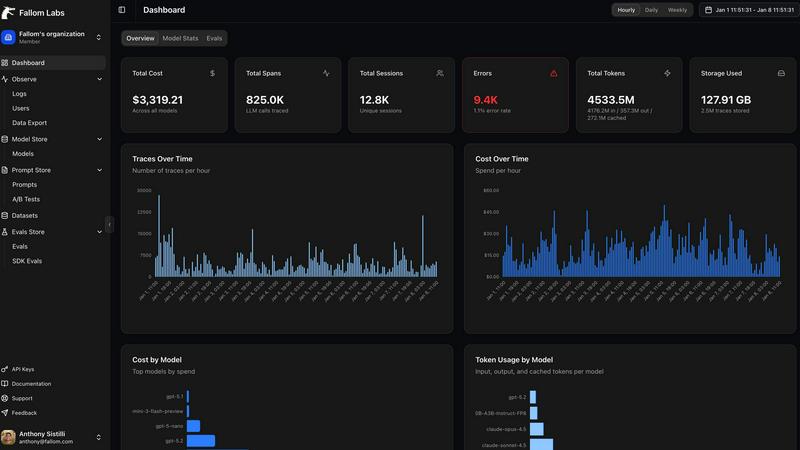
Fallom provides real-time observability for tracking and debugging your LLM and AI agent operations.
Last updated: February 28, 2026
Visual Comparison
Blueberry
Fallom
Feature Comparison
Blueberry
Unified Workspace
Blueberry offers a unified workspace that combines a terminal, code editor, and browser, allowing users to work on their projects without switching between different applications. This integration helps maintain focus and minimizes distractions, making product development smoother and more efficient.
Live Context with AI
The built-in MCP server enables AI models like Claude and Codex to access your entire workspace in real time. This means the AI can understand your code and provide context-aware suggestions, improving your coding experience and making it easier to troubleshoot issues on the fly.
Pinned Apps
Blueberry allows users to dock essential tools like GitHub, Linear, Figma, and PostHog within the workspace. These pinned apps load alongside your project, providing live context to your AI and ensuring that all necessary resources are readily available without needing to navigate away from your work.
Multi-Device Preview
With built-in previews for desktop, tablet, and mobile, Blueberry lets users see how their applications will appear across various devices instantly. This feature ensures that developers can create responsive designs without switching contexts, streamlining the testing and iteration process.
Fallom
End-to-End LLM Tracing
Fallom provides complete, granular tracing for every interaction with large language models. This means you can see the full sequence of events for any AI task, from the initial user prompt, through intermediate reasoning steps and tool calls, to the final response. Each trace includes the raw input and output, the specific model used, token counts, latency metrics, and the calculated cost. This level of detail is the basic building block for understanding how your AI applications behave in the real world, making debugging and optimization possible.
Real-Time Monitoring Dashboard
The platform offers a live dashboard that displays all LLM calls as they happen in production. You can monitor activity in real time, watching traces for different models, users, or sessions stream in. This dashboard allows you to see key metrics at a glance, such as request volume, average latency, and error rates. By providing a live view of your system's health, it enables teams to spot anomalies, performance degradation, or unexpected cost spikes immediately, facilitating faster incident response.
Cost Attribution and Analysis
A fundamental aspect of managing AI applications is understanding and controlling expenses. Fallom automatically attributes costs to their source. You can break down spending by AI model, by individual user or customer, by internal team, or by specific feature. This transparent cost tracking is essential for accurate budgeting, internal chargebacks, and identifying inefficient or expensive patterns in your LLM usage, helping you make informed decisions about model selection and optimization.
Compliance and Audit Readiness
For enterprises operating in regulated industries, Fallom is built with compliance as a core feature. It maintains complete, immutable audit trails of every LLM interaction, supporting requirements for standards like SOC 2, GDPR, and the EU AI Act. Features include detailed input/output logging, model version tracking, user consent recording, and session-level context. This ensures you have a verifiable record of your AI's operations for security reviews, regulatory audits, and internal governance.
Use Cases
Blueberry
Enhanced Collaboration
Teams working on web applications can benefit from Blueberry's collaborative features. By having a shared workspace with integrated AI, team members can easily provide feedback and suggestions in real time, improving the overall quality of the product.
Rapid Prototyping
Developers can use Blueberry to quickly prototype new web applications. The combination of live coding, instant previews, and AI assistance allows for rapid iteration and testing, enabling teams to validate ideas faster than traditional methods.
Streamlined Debugging
When encountering issues in code, developers can leverage Blueberry's live context features. By running AI models in the terminal with access to the entire workspace, they can receive immediate assistance and insights to resolve bugs more efficiently.
Comprehensive Learning Tool
For new developers and those looking to enhance their skills, Blueberry serves as a comprehensive learning tool. With AI providing contextual help and real-time feedback on coding practices, users can learn more effectively while working on actual projects.
Fallom
Debugging and Improving AI Agent Workflows
When a complex AI agent that uses multiple tools and LLM calls fails or behaves unexpectedly, pinpointing the root cause is challenging. Fallom's tracing allows developers to replay the exact sequence of steps, examine the prompts and responses at each stage, and view the arguments and results of every tool call. This visibility turns debugging from a guessing game into a systematic process, drastically reducing the time to resolve issues and improve agent reliability.
Managing and Optimizing AI Operational Costs
As AI applications scale, costs can become unpredictable and difficult to manage. Fallom addresses this by providing clear, actionable data on where every dollar is spent. Product and engineering leads can use Fallom to identify which features or customers are the most expensive, compare the cost-performance ratio of different models like GPT-4o versus Claude, and set alerts for budget overruns. This enables proactive cost control and ensures sustainable scaling.
Ensuring Compliance and Auditability
Companies in finance, healthcare, or legal services using AI must demonstrate compliance with strict regulations. Fallom serves as a system of record for all AI activity. It automatically logs all necessary data—who used the system, what was asked, which model version answered, and what was said—creating a defensible audit trail. This is essential for passing security audits, responding to data subject requests, and proving adherence to industry regulations.
Performance Monitoring and Reliability Engineering
Site Reliability Engineering (SRE) principles apply to AI systems as well. Teams use Fallom to establish performance baselines for their LLM calls, monitor latency and error rate Service Level Objectives (SLOs), and set up alerts for degradation. The timing waterfall charts help visualize where bottlenecks occur in multi-step chains, allowing engineers to optimize slow steps and ensure a consistent, reliable user experience for AI-powered features.
Overview
About Blueberry
Blueberry is a revolutionary macOS application designed for modern product builders who aim to create web applications with efficiency and clarity. By consolidating your code editor, terminal, and browser into a single focused workspace, Blueberry eliminates the frustration of juggling multiple windows and applications. This AI-native platform connects to models such as Claude, Gemini, and Codex through its built-in MCP server, allowing the AI to access live context from your files, terminal outputs, and previews concurrently. This seamless integration means you can ask questions and receive instant feedback on your code without the tedious process of copy-pasting context. With Blueberry, you can focus entirely on product development, creating a streamlined workflow that enhances productivity and fosters creativity. Designed for developers, designers, and product managers alike, Blueberry empowers teams to ship delightful web apps with ease.
About Fallom
Fallom is an AI-native observability platform built from the ground up for teams developing applications with large language models (LLMs) and AI agents. In the complex world of AI operations, traditional monitoring tools fall short. Fallom provides the fundamental visibility needed to understand, manage, and improve AI-powered systems in production. It works by automatically tracing every LLM call, capturing essential data like the exact prompts sent, the model's outputs, any tool or function calls made, token usage, latency, and per-call costs. This end-to-end tracing is the cornerstone of AI observability. The platform is designed for engineering and product teams who need to move beyond simple logging to gain actionable insights. Its core value proposition is delivering comprehensive, real-time visibility into AI workloads, enabling organizations to optimize performance, control costs, troubleshoot issues quickly, and maintain compliance with enterprise and regulatory standards. With its OpenTelemetry-native SDK, integrating Fallom is a straightforward process, allowing teams to start tracing their applications in minutes and establish a foundational layer of observability for their AI initiatives.
Frequently Asked Questions
Blueberry FAQ
What operating system does Blueberry support?
Blueberry is designed specifically for macOS, ensuring compatibility and optimized performance for Mac users.
Is Blueberry really free during the beta phase?
Yes, Blueberry is available for free during its beta phase, allowing users to experience its features without any financial commitment.
How does Blueberry integrate with AI models?
Blueberry connects to various AI models like Claude, Gemini, and Codex through its MCP server, allowing the AI to interact with your project files, terminal outputs, and previews in real time.
Can I use Blueberry for collaborative projects?
Absolutely! Blueberry is designed for teamwork, enabling multiple users to work within the same workspace and leverage AI assistance for improved collaboration and productivity.
Fallom FAQ
What is AI observability and why is it different?
AI observability is the practice of gaining deep, actionable insights into the behavior and performance of AI systems, particularly those based on LLMs. It is different from traditional application monitoring because LLMs are non-deterministic. You need to see not just if a call failed, but why it failed—was the prompt poorly constructed, did a tool call error, or did the model hallucinate? Observability provides the context of prompts, outputs, and intermediate steps necessary to answer these questions.
How difficult is it to integrate Fallom into my existing application?
Integration is designed to be straightforward. Fallom provides an OpenTelemetry-native SDK, which is the industry-standard protocol for observability. In most cases, you can instrument your application by adding a few lines of code to your LLM client initialization. The goal is to have basic tracing up and running in under five minutes, without requiring major changes to your application architecture or causing performance overhead.
Can Fallom handle sensitive or private data?
Yes. Fallom includes a Privacy Mode for handling sensitive information. This mode allows you to configure content redaction, so that specific data fields or entire prompt/response contents are not captured in the logs, while still preserving essential metadata for tracing and metrics. You can maintain full telemetry for debugging and costing without storing confidential user data, aligning with data privacy policies.
Does Fallom support all LLM providers and frameworks?
Fallom is built to be provider-agnostic. It works with all major LLM providers like OpenAI, Anthropic, Google Gemini, and open-source models. The OpenTelemetry foundation means it can integrate with any framework or custom code that makes LLM calls. This prevents vendor lock-in and ensures you can maintain a unified observability platform even if your tech stack evolves or you switch model providers.
Alternatives
Blueberry Alternatives
Blueberry is a Mac application designed for developers, merging an editor, terminal, and browser into a single, focused workspace. This integration allows users to work seamlessly without the hassle of juggling multiple windows, enhancing productivity and efficiency in various development tasks. Users often seek alternatives to Blueberry for several reasons, including pricing considerations, specific feature requirements, or compatibility with different platforms. When exploring alternatives, it's essential to assess factors such as usability, integration capabilities, and support for various programming models, ensuring that the chosen tool aligns with individual workflow needs and preferences.
Fallom Alternatives
Fallom is an AI-native observability platform in the development tools category. It provides real-time monitoring and debugging specifically for large language models and AI agents in production. Users often explore alternatives for various reasons. These can include budget constraints, the need for different feature sets, or integration requirements with their existing technology stack. The specific needs of a project or organization can drive the search for a different solution. When evaluating an alternative, focus on core capabilities. Key considerations include the depth of tracing for LLM calls, transparency into costs and performance, and built-in support for compliance and audit requirements. The right tool should provide clear visibility into your AI operations.