Avina vs Stable Commerce
Side-by-side comparison to help you choose the right product.

Avina
Avina uses AI to find and automatically reach out to prospects who are ready to buy.
Last updated: February 28, 2026

Stable Commerce
Stable Commerce is an AI engine that builds and runs your entire online store from a single prompt.
Last updated: March 4, 2026
Visual Comparison
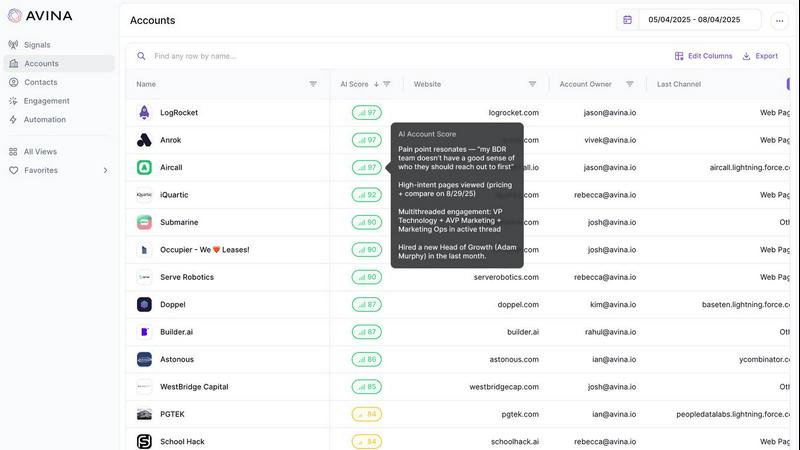
Avina
Stable Commerce
Feature Comparison
Avina
AI Signals Agent
This core feature allows you to define custom buying signals using plain language. Instead of relying on rigid, pre-set keywords, you can describe specific buyer behaviors—like a company launching a new feature or changing its tech stack. The AI agent understands the context behind these descriptions and continuously scans first-party, third-party, and web data to surface prospects matching that exact behavior, capturing subtle buying moments other platforms miss.
Web Visitor Identification (X-Ray Pixel)
Over 98% of website visitors leave without identifying themselves. Avina's X-Ray Pixel solves this by combining multiple data providers into a single solution. It automatically identifies anonymous companies visiting your site, enriches them with key contact and firmographic data, and routes these high-intent prospects directly to your sales team in real time, turning invisible traffic into concrete leads.
Unified Intent Monitoring
Avina acts as a central hub by continuously scanning and unifying data from disparate sources. This includes your website, CRM, LinkedIn, job boards, news sites, SEC filings, and the broader web. By stitching these signals into a single, coherent feed, it provides complete visibility into every account's activity, ensuring no critical buying signal is overlooked.
AI-Powered Account Scoring & ICP Filtering
Raw signals can be noisy. Avina filters and prioritizes them using two key methods. First, ICP filtering automatically disqualifies accounts that don't match your defined ideal customer profile based on industry, size, or other attributes. Then, AI scoring ranks each qualified account by signal strength, company fit, and engagement history, giving reps a dynamic, prioritized list of where to focus their efforts.
Stable Commerce
Prompt-to-Store Generator
This is the foundational feature of Stable Commerce. Instead of configuring settings and installing plugins, you simply provide a text prompt describing what you want to sell. The AI agent interprets this prompt and autonomously generates a fully functional, mobile-responsive online store complete with a basic structure and design. This eliminates the initial setup hurdle, allowing anyone to start selling almost immediately without any technical or design expertise.
Autonomous E-Commerce Agent
Think of this as your automated operations manager. Once your store is created, this persistent AI agent works behind the scenes to orchestrate the entire e-commerce stack. It connects necessary systems like payment gateways and analytics, manages workflows, and ensures all components work in harmony. It continuously monitors and optimizes store performance based on real-time data, functioning like a full-time, cost-effective team that handles the technical orchestration so you don't have to.
Unified Commerce Stack
Stable Commerce provides a complete, integrated platform that includes all essential e-commerce tools. This encompasses inventory management, order processing, fulfillment API connections, customer service tools, and built-in enterprise-grade security with SSL and fraud protection. By offering this consolidated stack, it removes the need to research, purchase, and maintain dozens of separate plugins and apps, creating a more stable and manageable foundation for your business.
Integrated Payment Processing
The platform comes with seamless, built-in payment processing that connects with major providers like Stripe and PayPal, among 50+ others. This feature handles the critical flow of transactions securely and reliably, ensuring customers can check out smoothly and funds are processed efficiently. It simplifies one of the most important aspects of an online store by integrating it directly into the autonomous framework, requiring no additional setup from the user.
Use Cases
Avina
Accelerating Outbound Sales Prospecting
Sales development representatives (SDRs) can use Avina to move beyond generic cold outreach. The platform identifies which companies in their territory are showing active buying signals, such as researching specific solutions online or posting relevant job roles. This allows SDRs to prioritize outreach to genuinely interested accounts with personalized, timely messages, dramatically increasing connection and meeting rates.
Capturing and Converting High-Intent Website Traffic
Marketing teams often struggle to identify the companies behind anonymous website visits. With Avina's visitor identification, when a high-value account from a target industry browses key product pages, the sales team is instantly alerted with enriched data. This enables immediate, informed follow-up while the prospect's intent is highest, converting more marketing-generated traffic into sales opportunities.
Account-Based Marketing (ABM) Execution
For teams running ABM programs, Avina provides continuous monitoring of target account lists. It alerts the team to key signals like leadership changes, news mentions, funding rounds, or engagement with marketing campaigns. This intelligence allows for highly coordinated and timely touchpoints across sales and marketing, ensuring outreach is relevant and based on the account's latest activities.
Preventing Pipeline Stagnation
Sales teams can use Avina to re-engage stalled opportunities. The platform monitors dormant accounts for new buying signals, such as a champion moving to a new company, a competitor's contract renewal period, or new project initiatives. When a relevant signal fires, Avina can automatically trigger a re-engagement workflow, helping reps revive conversations at the optimal moment.
Stable Commerce
First-Time Entrepreneurs
Individuals with a product idea but no technical background or capital to hire developers can use Stable Commerce to launch their first store. By simply describing their concept in a prompt, they receive a live, operational storefront in minutes. This allows them to validate their business idea, start selling, and learn the ropes of e-commerce without being blocked by complex software setup or high initial costs.
Existing Store Owners Seeking Efficiency
Online sellers tired of managing a patchwork of apps, plugins, and monthly subscriptions can migrate to Stable Commerce to consolidate their operations. The autonomous agent can streamline their workflow, connect their existing systems, and automate optimization tasks. This use case is about reducing operational friction, cutting software costs, and freeing up time to focus on marketing and growth instead of technical maintenance.
Agencies and Freelancers
Marketing or web design agencies that manage stores for multiple clients can leverage Stable Commerce to deliver value faster and more reliably. They can use the prompt-based generation to rapidly prototype and launch stores, while the unified stack and autonomous management reduce their ongoing support burden. This allows them to scale their service offerings without proportionally increasing their technical overhead or team size.
Sellers Expanding to New Markets
Businesses looking to quickly test a new product line or sell on additional platforms can use Stable Commerce to spin up a dedicated store or sales channel with minimal effort. The ability to import products from marketplaces like eBay or Amazon, combined with the fast setup, makes it an ideal tool for agile market expansion without committing significant resources to a new, unproven venture.
Overview
About Avina
Avina is an AI-powered platform built for modern revenue teams to solve a fundamental sales challenge: identifying which prospects are genuinely ready to buy. In a world flooded with data, sales teams often waste valuable time chasing cold leads or reacting to signals too late. Avina addresses this by continuously scanning and analyzing a comprehensive range of data sources. It looks at web intent, CRM activity, email and call interactions, advertising engagement, job changes, and company news. By aggregating this information, Avina provides a clear, prioritized view of your Total Addressable Market (TAM), highlighting accounts that are actively in-market. The platform uses advanced large language models (LLMs) to interpret the context of interactions, scoring and ranking accounts with human-like understanding. This allows sales representatives to focus their efforts exclusively on warm, high-intent opportunities. Avina seamlessly integrates with essential tools like Salesforce, HubSpot, and LinkedIn, automating the process from signal detection to personalized outreach. Ultimately, Avina empowers organizations to move faster than their competition by transforming scattered buyer intent into a structured, actionable pipeline of qualified leads.
About Stable Commerce
Stable Commerce is a foundational AI-first e-commerce engine designed to simplify the complex process of launching and running an online store. At its core, it is an autonomous infrastructure that replaces the traditional, fragmented approach to e-commerce, which typically involves assembling numerous plugins, templates, and developer services. The platform is built for anyone looking to sell online, from first-time entrepreneurs to established professionals, by removing technical barriers. Its primary value proposition is automation: users can describe their store idea in a simple prompt, and Stable Commerce's intelligent agent builds the entire operational stack—including storefront, connected systems, analytics, and integrations—automatically. This back-to-basics approach means you focus solely on your products and customers, not on managing software. By consolidating the entire e-commerce operation into a single, AI-driven framework, Stable Commerce significantly reduces overhead, cuts costs associated with large teams or multiple apps, and enables a store to go from idea to live in under two minutes.
Frequently Asked Questions
Avina FAQ
What kind of buying signals can Avina detect?
Avina detects a wide array of buying signals across multiple categories. This includes first-party data like website visits and CRM engagement; third-party intent data from the web; job postings and hiring surges; news and SEC filings; social media and advertising engagement; and key personnel changes. You can also create custom signals for very specific scenarios using the AI Signals Agent.
How does Avina prioritize which accounts are most important?
Avina uses a two-step prioritization process. First, it filters out accounts that do not match your configured Ideal Customer Profile (ICP). Then, it applies an AI-powered scoring model to the remaining accounts. This score is based on the strength, frequency, and context of the buying signals, combined with firmographic fit and historical engagement data, resulting in a dynamic, ranked list of opportunities.
How does Avina integrate with our existing sales stack?
Avina is designed to integrate seamlessly with the tools revenue teams already use. It offers native integrations with popular CRM platforms like Salesforce and HubSpot, communication tools like Slack and email, and advertising platforms. This ensures that prioritized signals and enriched account data flow directly into your team's existing workflows without requiring them to switch between multiple applications.
Is technical expertise required to set up and use Avina?
No, Avina is built for revenue teams and is designed to be user-friendly. Connecting data sources is a straightforward process, and the AI Signals Agent allows you to create custom signals using plain English. The platform comes with out-of-the-box signals that start working immediately upon connection, requiring minimal configuration or technical setup to begin capturing valuable intent data.
Stable Commerce FAQ
How quickly can I launch a store with Stable Commerce?
You can launch a fully operational online store in under two minutes. The process begins with you providing a simple text prompt describing what you want to sell. The AI agent then automatically builds the storefront, configures the necessary settings, and integrates core systems, making it live almost instantly.
What does the "Autonomous Agent" actually do?
The Autonomous Agent acts as your automated e-commerce operations manager. After setup, it continuously works in the background to ensure all connected systems (like payments, analytics, and fulfillment) work together. It analyzes real-time sales and customer data, optimizes store performance, and manages repetitive workflows, effectively performing the tasks of multiple team members or tools.
Can I import my existing products?
Yes, Stable Commerce allows you to import products easily. You can import product data from Excel or CSV files. Additionally, depending on your plan, you can import products directly from online marketplaces like eBay, Etsy, or Amazon, helping you populate your store's inventory quickly without manual data entry.
How does Stable Commerce handle security and payments?
Stable Commerce is built with enterprise-grade security, including SSL certificates and robust security protocols to protect your store and customer data. For payments, it features integrated processing with major providers like Stripe and PayPal, ensuring transactions are smooth, secure, and compliant. The platform handles this complexity so you don't have to configure it separately.
Alternatives
Avina Alternatives
Avina is an AI-powered platform in the B2B sales and marketing technology category. It helps revenue teams identify high-intent prospects by analyzing data from multiple sources, prioritizing accounts, and automating outreach to build a stronger sales pipeline. Users often explore alternatives for several practical reasons. These can include budget constraints, the need for different or more specialized features, or a requirement for integration with a specific set of existing business tools. Every company has unique processes and scale, so finding the right fit is essential. When evaluating other options, focus on core capabilities. Key considerations are the platform's ability to accurately identify buying signals, its integration with your current CRM and sales stack, the sophistication of its automation for outreach, and the overall value it provides for your team's specific workflow and goals.
Stable Commerce Alternatives
Stable Commerce is an AI-native eCommerce and automation platform designed to simplify launching and managing an online store. It automates complex setup and optimization tasks, allowing users to get started in minutes. This places it in the competitive category of modern, user-friendly eCommerce solutions. Users often explore alternatives for various practical reasons. Common factors include specific budget constraints, the need for particular advanced features not offered, or a requirement for a platform that integrates with an existing business ecosystem. The scale of one's operation, from a simple side project to a large enterprise, also heavily influences the search for the right tool. When evaluating alternatives, focus on the core fundamentals that match your business stage. Key considerations should be the total cost of ownership, the ease of use versus the depth of control, the quality of customer support, and the platform's ability to scale with your growth. Prioritize a solution that aligns with your technical comfort and long-term commercial goals.