Agenta vs HookMesh
Side-by-side comparison to help you choose the right product.

Agenta centralizes prompt management and evaluation, enabling reliable LLM development through structured collaboration.
Last updated: March 1, 2026

HookMesh simplifies webhook delivery with reliable, automatic retries and a self-service portal for your customers.
Last updated: February 26, 2026
Visual Comparison
Agenta
HookMesh
Feature Comparison
Agenta
Centralized Prompt Management
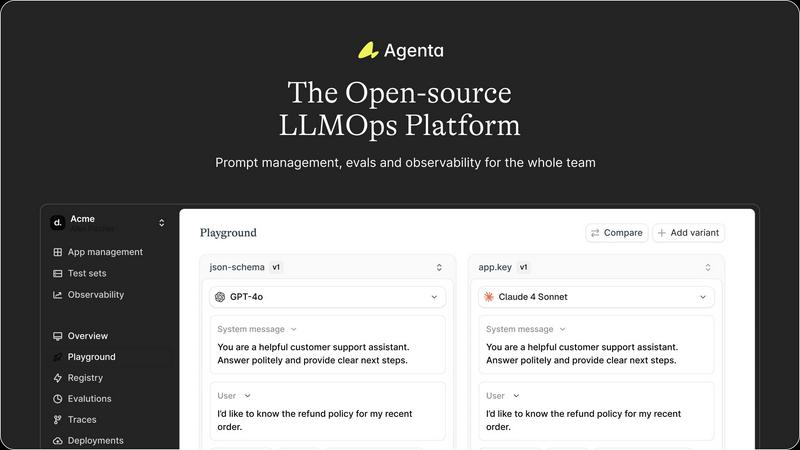
Agenta allows teams to centralize their prompts, evaluations, and traces in one comprehensive platform. This eliminates the disorganization often found in scattered tools like Slack and Google Sheets, enabling seamless collaboration among team members.
Automated Evaluation System
The platform features an automated evaluation system that replaces guesswork with evidence-based insights. Teams can systematically run experiments, track results, and validate every change, creating a reliable foundation for decision-making.
Unified Playground for Experimentation
Agenta includes a unified playground that enables teams to compare prompts and models side-by-side. This feature supports iterative development by allowing teams to test and refine their prompts in a controlled environment.
Comprehensive Observability Tools
With built-in observability tools, Agenta offers the ability to trace every request and identify exact failure points. The platform facilitates annotation of traces, enabling teams to gather user feedback and turn any trace into a test with a single click.
HookMesh
Reliable Delivery
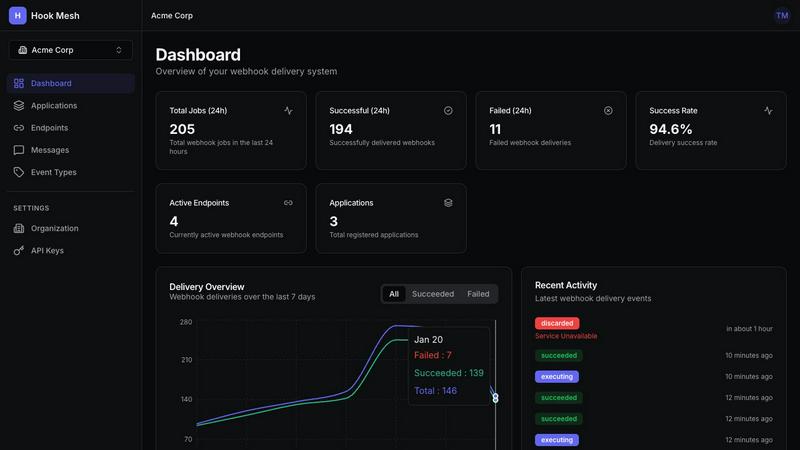
HookMesh ensures that webhook events are never lost, providing automatic retries with exponential backoff and jitter. This means that if a webhook fails to deliver, HookMesh will retry sending it over a 48-hour period, ensuring that crucial data reaches its destination.
Circuit Breaker
The circuit breaker feature automatically disables failing endpoints to prevent them from affecting the entire queue. Once the endpoint is back online, HookMesh re-enables it, allowing for smooth and uninterrupted delivery of webhook events.
Customer Portal
HookMesh includes an embeddable self-service portal where customers can manage their endpoints. This portal provides users with complete visibility of delivery logs, enabling them to track all requests and responses, and to quickly replay any failed webhooks.
Developer Experience
Designed with developers in mind, HookMesh offers a REST API and official SDKs for JavaScript, Python, and Go. These tools simplify integration, allowing developers to send webhook events with minimal code, which significantly reduces the time and effort required to implement webhook functionality.
Use Cases
Agenta
Collaborative Prompt Development
Agenta is ideal for collaborative prompt development, where product managers, developers, and domain experts can work together to iterate and refine prompts. This collaboration leads to more robust and effective LLM applications.
Performance Monitoring and Debugging
AI teams can utilize Agenta to monitor production systems and detect regressions in real time. With its observability features, teams can quickly identify and address performance issues, enhancing the reliability of their applications.
Structured Experimentation
Agenta provides a structured environment for experimentation. Teams can run side-by-side comparisons of different models and prompts, allowing them to make data-driven decisions based on systematic evaluations.
Integration with Existing Workflows
Agenta seamlessly integrates with popular frameworks like LangChain and OpenAI, making it easy to incorporate into existing workflows. This ensures that teams can leverage their current tools while benefiting from Agenta's structured approach to LLM development.
HookMesh
E-commerce Order Notifications
In the e-commerce sector, businesses can use HookMesh to send order completion notifications to customers. This ensures customers receive timely updates about their purchases, enhancing their overall shopping experience.
Payment Processing Updates
Payment processors can leverage HookMesh to deliver real-time updates on transaction statuses. This allows merchants to receive notifications about successful payments or potential issues, enabling them to act quickly and maintain smooth operations.
SaaS Integrations
SaaS products that integrate with third-party services can use HookMesh to handle webhook events efficiently. By providing reliable event delivery, companies can ensure that data flows seamlessly between their application and external platforms.
System Health Monitoring
Organizations can utilize HookMesh to monitor the health of their internal systems by sending alerts and notifications. This allows them to stay informed about system performance and quickly address any issues that may arise.
Overview
About Agenta
Agenta is an open-source LLMOps platform tailored for AI teams that aim to develop and deploy reliable large language model (LLM) applications. Designed to bridge the communication gap between developers and subject matter experts, Agenta creates a collaborative workspace that facilitates experimentation with prompts, performance evaluation, and effective debugging of production issues. The platform addresses significant challenges faced by AI teams, including the inherent unpredictability of LLMs and the disjointed workflows that often occur across various tools. By centralizing the entire LLM development process, Agenta enhances team productivity and significantly reduces the time typically spent on debugging. With a structured approach to LLM development, Agenta empowers teams to adhere to best practices, streamline their workflows, and ultimately deliver high-quality LLM applications more efficiently. Whether you are a developer, product manager, or domain expert, Agenta provides the tools necessary for effective collaboration and innovation in AI development.
About HookMesh
HookMesh is a pioneering solution tailored to simplify and enhance webhook delivery for modern Software as a Service (SaaS) products. It effectively addresses the myriad complexities associated with building webhooks in-house, including challenges such as implementing retry logic, managing circuit breakers, and debugging delivery issues that can arise. By using HookMesh, businesses can concentrate on their core offerings without being overwhelmed by the technical intricacies of webhook management. This robust platform boasts battle-tested infrastructure that guarantees reliable delivery through features like automatic retries, exponential backoff, and idempotency keys. HookMesh is particularly suited for developers and product teams striving to deliver a seamless experience for their customers while ensuring consistent and reliable webhook event delivery. The self-service portal empowers users with easy management and visibility of their endpoints, while the ability to replay failed webhooks with just a single click provides essential peace of mind for organizations prioritizing a robust webhook strategy.
Frequently Asked Questions
Agenta FAQ
What is LLMOps and how does Agenta fit into it?
LLMOps refers to the practices and tools used to manage the lifecycle of large language models. Agenta fits into this by providing a structured platform that centralizes prompt management, evaluation, and observability, streamlining the LLM development process.
How does Agenta facilitate collaboration among team members?
Agenta fosters collaboration by allowing product managers, developers, and domain experts to work together in one unified platform. It provides tools for prompt iteration, evaluation, and debugging, enabling real-time collaboration and feedback.
Can Agenta be integrated with other AI frameworks?
Yes, Agenta is designed to integrate seamlessly with various AI frameworks, including LangChain and OpenAI. This flexibility allows teams to utilize Agenta alongside their existing tools without disruption.
What kind of support does Agenta provide for debugging?
Agenta offers comprehensive observability tools that trace requests and identify failure points. This allows teams to annotate traces, gather feedback, and quickly debug issues, reducing the time and effort spent on troubleshooting.
HookMesh FAQ
What is HookMesh?
HookMesh is a webhook delivery solution designed to simplify the process of managing webhooks for SaaS products. It ensures reliable delivery and provides users with tools for easy endpoint management.
How does HookMesh handle retries?
HookMesh employs automatic retries with exponential backoff and jitter. This means that if a webhook fails to deliver, it will attempt to resend it over a 48-hour period, ensuring critical data is delivered.
Can customers manage their endpoints?
Yes, HookMesh includes a self-service portal that allows customers to manage their webhook endpoints. They can view delivery logs, add new endpoints, and replay failed webhooks with ease.
What programming languages are supported by HookMesh SDKs?
HookMesh offers official SDKs for JavaScript, Python, and Go, providing developers with the tools they need to integrate webhook functionality into their applications quickly and efficiently.
Alternatives
Agenta Alternatives
Agenta is an open-source LLMOps platform that centralizes the management, evaluation, and debugging of large language models (LLMs) for AI teams. It addresses the unique challenges faced by developers and subject matter experts in creating reliable AI applications. Users often seek alternatives due to various reasons, including pricing, specific feature sets, or compatibility with their existing workflows and platforms. When choosing an alternative, it is essential to consider factors such as ease of use, integration capabilities, support options, and the overall effectiveness in enhancing LLM development processes.
HookMesh Alternatives
HookMesh is a cutting-edge solution designed to enhance webhook delivery for SaaS products, addressing the inherent complexities of webhook management. As a platform focused on reliable delivery, automatic retries, and a self-service customer portal, it helps developers streamline their operations and focus on core functionalities rather than technical challenges. Users often seek alternatives for reasons such as pricing, specific feature sets, or unique platform requirements that may not align with their current needs. When selecting an alternative, it's essential to consider factors like reliability, ease of use, customer support, and the ability to manage webhook events effectively. Evaluating the specific needs of your organization, including scalability and integration capabilities, will help you find the most suitable solution for your webhook strategy.