
About Rock Smith
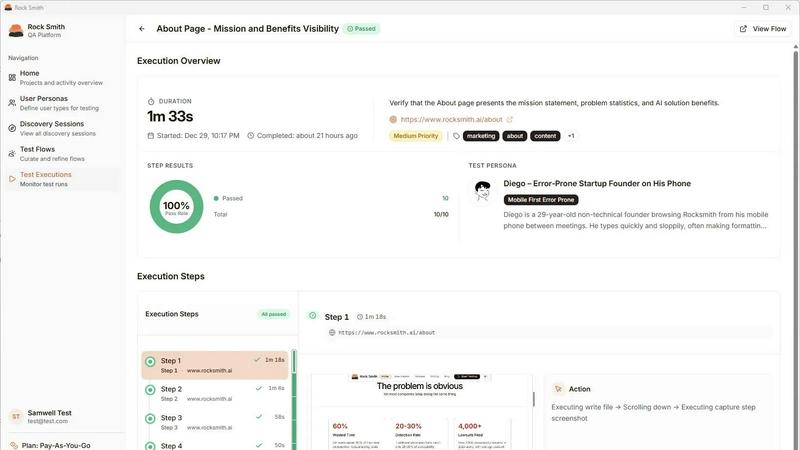
Rock Smith is an AI-powered black box testing platform that fundamentally rethinks how engineering and quality assurance teams ensure the reliability of their web applications. At its foundation, it addresses the core, persistent problem in traditional test automation: fragility. Conventional tests rely on brittle code selectors that break with every minor UI update, creating a maintenance nightmare and diverting valuable developer time from building features to debugging tests. Rock Smith replaces this outdated model with autonomous AI agents. These agents see and interact with your application's visual interface exactly as a human user would. You simply describe what needs to be tested using natural language, such as "click the blue login button" or "fill out the registration form." The AI visually understands these elements, making your test suites inherently resilient to underlying code changes. The product is built for fast-moving development teams who are tired of flaky tests and seek a shift-left approach to quality. Its primary value proposition is delivering reliable, self-healing automation that intelligently executes not only predefined happy-path scenarios but also generates a wide spectrum of edge cases and security tests. Furthermore, Rock Smith prioritizes data security by enabling local execution, ensuring your sensitive application data never leaves your environment. It transforms testing from a chore into a robust, automated foundation for continuous delivery.
Features of Rock Smith
Autonomous Visual Testing Agents
Rock Smith utilizes AI agents that perceive your web application through its visual interface, just like a human. Instead of relying on fragile CSS selectors or XPaths that break with UI updates, these agents identify elements by their visual characteristics and on-screen context. This creates tests that are inherently stable and can withstand changes to the underlying code structure, dramatically reducing maintenance overhead and false failures.
Natural Language Test Creation
You can define complex test scenarios using simple, plain English instructions. There is no need to write or maintain intricate automation scripts. You describe the user journey—for example, "Navigate to the checkout page, add a product to the cart, and apply promo code 'SAVE10'"—and the AI agent translates this into a series of precise actions. This makes test creation accessible to product managers and QA analysts, not just developers.
Intelligent Edge Case & Security Testing
Beyond executing predefined scripts, Rock Smith's AI proactively explores your application. It intelligently generates and tests a wide range of edge cases, such as unusual input combinations, unexpected user flows, and boundary conditions. Additionally, it can simulate basic security probes, like testing for common injection points or improper access controls, helping you uncover vulnerabilities that traditional testing might miss.
Local Execution for Data Security
Sensitive data remains secure because Rock Smith's testing engine can run entirely within your local development or staging environment. Your production credentials, user data, and proprietary application information never need to be sent to an external cloud service. This local-first approach provides peace of mind for teams in regulated industries or those with strict data governance policies.
Use Cases of Rock Smith
Continuous Regression Testing for Agile Teams
For teams practicing continuous integration and deployment, Rock Smith provides a robust safety net. After every code commit or UI change, the AI agents can automatically run a full suite of regression tests. Because the tests are visually based, they validate that the application still looks and behaves correctly for the end-user, catching visual regressions and broken workflows that code-level tests might ignore.
Rapid Test Suite Creation for New Features
When launching a new feature, engineering teams can bypass the time-consuming process of writing and debugging automated test scripts. A product manager or developer can simply describe the key user flows in natural language. Rock Smith rapidly generates and executes the corresponding tests, ensuring comprehensive coverage is in place from day one, accelerating the release cycle without sacrificing quality.
Reducing QA Maintenance Burden
QA teams spend a significant portion of their time not finding new bugs, but fixing broken tests due to minor UI tweaks. By adopting Rock Smith's visual, selector-free approach, teams can eliminate this maintenance tax. The test suite becomes a durable asset that adapts to the application's evolution, allowing QA professionals to focus their expertise on exploratory testing and complex scenario design instead of script upkeep.
Accessibility and Cross-Browser Validation
The AI's visual understanding can be extended to verify consistent rendering and functionality across different browsers and devices. Teams can instruct Rock Smith to validate that core user interactions work seamlessly on Chrome, Firefox, and Safari, and that key visual elements are presented correctly, providing a foundational layer of cross-browser compatibility testing.
Frequently Asked Questions
How does Rock Smith differ from traditional testing tools like Selenium?
Traditional tools like Selenium rely on programmers writing scripts that target specific lines of HTML code (selectors). When the developer changes a button's ID or a div's class, these selectors break, and the test fails. Rock Smith uses AI to see the screen like a human, finding the "blue Submit button" by its appearance and location. This makes tests resilient to underlying code changes that don't affect the user experience.
Is my application data safe with Rock Smith?
Yes, data security is a foundational principle. Rock Smith is designed to execute tests locally within your own infrastructure. Your application, along with any test data or credentials, never needs to be exposed to an external cloud service unless you explicitly choose a cloud-based option. This ensures compliance with internal security policies and data protection regulations.
Can non-technical team members create tests?
Absolutely. One of Rock Smith's core advantages is its natural language interface. Product managers, business analysts, and QA specialists who understand the application's required behavior can describe test scenarios in plain English. They do not need to know programming languages or automation frameworks, democratizing the test creation process and aligning it closer with business requirements.
Does Rock Smith only test the "happy path"?
No, it goes far beyond basic happy-path scenarios. While it excels at executing predefined user journeys, its AI is also built to explore. It can intelligently generate and test edge cases, such as entering invalid data, skipping required steps, or navigating in unexpected sequences. This helps uncover bugs that exist outside the primary, intended user flow.
Pricing of Rock Smith
Rock Smith offers a tiered pricing model designed for different team sizes and needs. You can get started with a free plan to explore the core functionality. For professional use, the Solo Pro plan is priced at $10 per month (billed annually) and is tailored for founders and solopreneurs. It includes unlimited projects, custom AI experts, full implementation plans, and sharing options. For larger teams, the Band plan supports collaboration for up to 5 human experts alongside the AI, offering all the features of Solo Pro plus enhanced team workflow tools. All plans emphasize providing expert AI assistance to guide projects from an initial idea to a detailed implementation blueprint.