
Agent to Agent Testing Platform vs Pro Cursor Rules
Side-by-side comparison to help you choose the right product.

Agent to Agent Testing Platform
Validate AI agent behavior across chat, voice, and phone interactions to ensure security, compliance, and performance.
Last updated: February 26, 2026

Pro Cursor Rules
Pro Cursor Rules is the central hub for the Cursor community to explore, generate, and share essential AI coding rules.
Last updated: February 28, 2026
Visual Comparison
Agent to Agent Testing Platform
Pro Cursor Rules
Feature Comparison
Agent to Agent Testing Platform
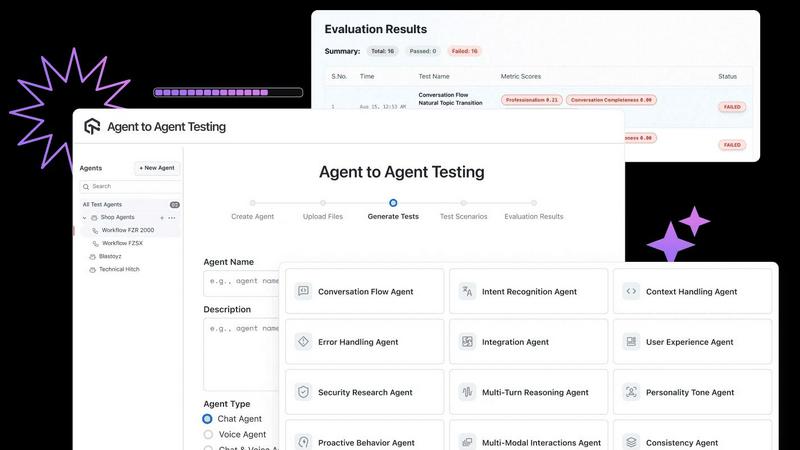
Automated Scenario Generation
The platform automatically generates diverse testing scenarios, simulating various chat, voice, hybrid, and phone interactions. This feature ensures a comprehensive evaluation of AI agents across multiple contexts, enabling accurate performance assessments.
True Multi-Modal Understanding
Agent to Agent Testing Platform allows users to define detailed requirements or upload various input types, including images, audio, and video. This capability ensures that the AI agent can handle real-world scenarios, providing a complete understanding of agent behavior beyond text-based inputs.
Autonomous Test Scenario Generation
Users can access a library of hundreds of pre-defined testing scenarios or create custom ones tailored to specific AI agents. This flexibility enables thorough assessments of different functionalities, such as personality tone and intent recognition, ensuring well-rounded testing coverage.
Regression Testing with Risk Scoring
The platform offers end-to-end regression testing, providing insights into potential risks associated with AI agents. This feature highlights areas of concern, allowing teams to prioritize critical issues and optimize their testing efforts for better reliability.
Pro Cursor Rules
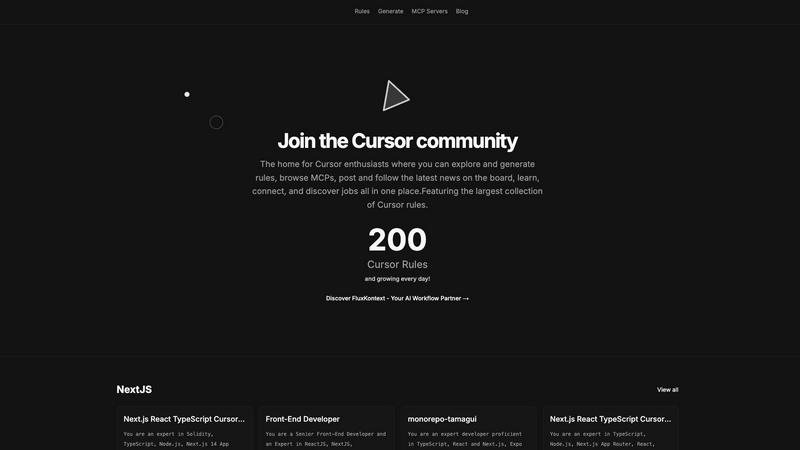
The Largest Collection of Cursor Rules
This is the cornerstone feature of the platform. It provides a vast, searchable, and categorized library of pre-built Cursor rules contributed by the community. Users can browse rules by technology, such as Next.js, React, TypeScript, or Tailwind CSS, and instantly find expert-crafted prompts for specific roles like Senior Front-End Developer or for particular project setups like monorepos with Tamagui. This repository serves as an essential educational resource and a powerful starting point for any customization need.
Rule Generation Tool
Beyond browsing, the platform empowers users to create their own rules. The generation tools facilitate the process of building structured, effective prompts tailored to individual or team requirements. This feature guides users in defining clear roles, constraints, coding styles, and technology stacks for the AI, transforming vague ideas into precise, actionable Cursor rules that yield consistent and high-quality results during development sessions.
MCP Servers Directory
Pro Cursor Rules integrates access to MCP (Model Context Protocol) servers, a key component for extending Cursor's capabilities. This directory helps users discover and implement servers that connect the AI to external data sources, tools, and APIs. By providing this resource, the platform ensures users can not only instruct their AI but also expand its knowledge and functionality, covering a more complete spectrum of advanced Cursor customization and setup.
Community Hub & News Board
The platform is designed as a living community, not just a static database. It includes features for users to share their own rules, follow contributors, discuss best practices, and stay updated with the latest news and announcements through the community board. This social layer emphasizes connection and collective growth, allowing users to learn from peers, showcase their expertise, and keep pace with the evolving landscape of AI-assisted development.
Use Cases
Agent to Agent Testing Platform
Validate AI Agent Performance
Enterprises can use the platform to validate the performance of AI agents before production rollout. By simulating numerous user interactions, organizations can identify performance gaps and improve agent reliability.
Assess Compliance with Policies
The platform helps organizations ensure their AI agents comply with internal policies and external regulations. By testing for policy violations, teams can mitigate risks associated with non-compliance and enhance trust in AI systems.
Enhance User Experience
By testing AI agents with diverse personas and scenarios, organizations can gain insights into user interactions. This understanding helps improve the user experience, ensuring that AI agents respond effectively to various end-user behaviors.
Optimize AI Agent Development
Development teams can leverage the platform's autonomous testing capabilities to optimize AI agents during the development phase. Continuous testing and feedback help refine agent performance, reducing the time and cost associated with manual testing efforts.
Pro Cursor Rules
Accelerating Project Onboarding
A developer starting a new project with a specific stack, such as Next.js 14, TypeScript, and Supabase, can visit Pro Cursor Rules. Instead of spending hours crafting the perfect AI instructions, they can instantly find and apply a community-vetted rule tailored to that exact technology combination. This immediately aligns the Cursor AI with project best practices, coding conventions, and relevant libraries, dramatically reducing setup time and accelerating initial development.
Learning Best Practices Through Examples
A programmer new to a framework or concept, like React Three Fiber or OnchainKit, can use the platform as a learning tool. By exploring the rules built by experts for these technologies, they can deconstruct the prompts to understand what context, priorities, and patterns seasoned developers consider important. This provides practical, actionable insight into professional workflows and architectural decisions within that domain.
Standardizing Team Development
A development team lead can utilize Pro Cursor Rules to create and distribute a standardized rule for the entire team. By generating a consistent rule that enforces the company's coding style, preferred libraries (e.g., Zustand for state, Zod for validation), and review standards, they ensure uniform AI assistance across all developers. This promotes code consistency, reduces stylistic debates, and streamlines collaboration and code review processes.
Extending AI Capabilities with MCPs
A developer working on a niche or data-intensive project needs their AI assistant to access specialized information. They can use the MCP Servers directory on Pro Cursor Rules to find a server that connects Cursor to internal documentation, a specific database schema, or a unique API. This use case transforms the AI from a general-purpose coder into a domain-specific expert with relevant, real-time context for more accurate and informed assistance.
Overview
About Agent to Agent Testing Platform
Agent to Agent Testing Platform is an innovative AI-native quality assurance framework specifically designed to assess the behavior of AI agents in real-world scenarios. As AI systems advance towards greater autonomy, traditional QA methodologies, which primarily focus on static software, fail to meet the demands of dynamic AI interactions. This platform offers enterprises a comprehensive solution for validating AI agents, such as chatbots, voice assistants, and phone caller agents, ensuring they function reliably and effectively before deployment. By evaluating multi-turn conversations across various modalities, it helps organizations identify issues related to bias, toxicity, and hallucinations, among other critical metrics. The platform's unique multi-agent test generation and autonomous synthetic user testing capabilities allow for extensive exploration of edge cases and long-tail failures, ensuring a robust assessment of AI performance.
About Pro Cursor Rules
Pro Cursor Rules is the foundational platform and central hub for the Cursor AI code editor community. At its core, it addresses a fundamental need for developers: effectively customizing and controlling the powerful AI assistant within Cursor. The platform is built for anyone who uses Cursor, from novices seeking to improve their workflow to experienced developers crafting complex, context-aware AI instructions. Its primary value proposition is simplifying the discovery, creation, and sharing of "Cursor rules"—the custom instructions and system prompts that define how the AI behaves for specific tasks, frameworks, or personal coding styles. By providing the largest organized collection of these rules, Pro Cursor Rules eliminates the guesswork and manual effort of building effective AI prompts from scratch. It fosters a community-centric environment where users can learn from shared expertise, connect with like-minded developers, and continuously enhance their tool. The platform extends beyond just rules, integrating resources like MCP (Model Context Protocol) servers and a community blog, making it a comprehensive, one-stop destination for mastering Cursor customization and unlocking greater productivity in software development.
Frequently Asked Questions
Agent to Agent Testing Platform FAQ
What types of AI agents can be tested using this platform?
The Agent to Agent Testing Platform is designed to test a variety of AI agents, including chatbots, voice assistants, and phone caller agents, across multiple scenarios.
How does the platform ensure comprehensive testing coverage?
The platform utilizes automated scenario generation and a library of predefined testing scenarios, allowing users to simulate diverse interactions and assess AI behavior comprehensively.
Can I create custom testing scenarios for my specific needs?
Yes, the platform offers the flexibility to create custom testing scenarios tailored to your AI agents, ensuring that all unique functionalities are thoroughly evaluated.
What metrics can I assess using the Agent to Agent Testing Platform?
Users can evaluate key metrics such as bias, toxicity, hallucinations, effectiveness, accuracy, empathy, and professionalism, providing a holistic view of AI agent performance.
Pro Cursor Rules FAQ
What exactly is a Cursor rule?
A Cursor rule is a set of custom instructions or a system prompt that configures how the Cursor AI editor's assistant behaves. It defines the AI's role (e.g., "Senior Front-End Developer"), its expertise areas (e.g., React, TypeScript), coding style preferences, and specific constraints to follow. Think of it as a detailed job description and style guide you give to your AI pair programmer to ensure it provides relevant, consistent, and high-quality suggestions tailored to your project's needs.
Is Pro Cursor Rules free to use?
Based on the available information from the website context, the core functionality of Pro Cursor Rules—browsing the extensive library of community rules, accessing the MCP server directory, and reading the community blog—appears to be freely accessible. Users can explore and utilize these vast resources without an indicated cost. Some advanced community features may require signing in.
How do I add my own rule to the collection?
The platform encourages community contribution. After signing in, you can use the "Generate" tools to formally create your rule. The process involves defining the rule's title, description, relevant technologies (tags), and the full prompt text. Once submitted, your rule becomes part of the public collection, allowing other developers to discover, use, and learn from your expertise, thereby contributing back to the community's shared knowledge base.
What are MCP Servers and why are they important?
MCP (Model Context Protocol) Servers are external services that provide additional context, data, or tools to the Cursor AI. While a rule tells the AI how to think and code, an MCP Server gives it what to think about—specific data. For example, a server could provide real-time API documentation, internal company schemas, or live database information. The directory on Pro Cursor Rules helps you find these servers, which is crucial for making the AI aware of your unique project context beyond public knowledge.
Alternatives
Agent to Agent Testing Platform Alternatives
The Agent to Agent Testing Platform is an innovative AI-native quality assurance framework designed specifically for validating AI agent behavior across various interaction modalities, including chat, voice, and phone. It falls under the category of AI Assistants, addressing the unique challenges posed by autonomous and unpredictable AI systems. As organizations increasingly adopt AI technologies, users often seek alternatives due to factors such as pricing, specific features, or compatibility with their existing platforms. When choosing an alternative, it is essential to consider factors such as the comprehensiveness of the testing framework, the ability to uncover edge cases, and the scalability of the solution. Additionally, look for platforms that provide robust validation for compliance and security, ensuring that AI agents can perform reliably in real-world scenarios.
Pro Cursor Rules Alternatives
Pro Cursor Rules is a dedicated platform in the AI assistant category, specifically for users of the Cursor code editor. It functions as a central hub where individuals can explore a large collection of rules, generate their own custom rules, and connect with a community of other enthusiasts. Its core purpose is to simplify and enhance the process of customizing Cursor. Users often explore alternatives for several fundamental reasons. These can include seeking different pricing models, such as free tiers or one-time purchases. Others may look for platforms with a specific feature focus, like more advanced rule management or integration with other developer tools. Platform compatibility, like needing a desktop application versus a web service, is another common consideration. When evaluating an alternative, focus on the essentials that match your needs. Consider the core functionality: does it allow you to effectively discover, create, and manage Cursor rules? Assess the strength and activity of its user community for support and shared knowledge. Finally, examine the overall value, weighing the features provided against the cost and your specific workflow requirements.