AdaptlyPost vs PoYo API
Side-by-side comparison to help you choose the right product.

AdaptlyPost
AdaptlyPost is a social media tool that creates one post and automatically tailors it for every platform.
Last updated: March 11, 2026

PoYo API
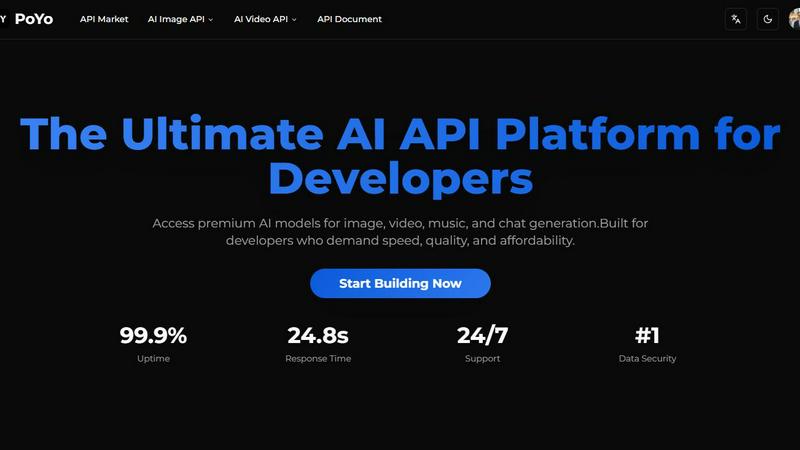
PoYo API gives developers one simple platform to access premium AI models for image, video, music, and chat.
Last updated: February 28, 2026
Visual Comparison
AdaptlyPost

PoYo API
Feature Comparison
AdaptlyPost
Unified Multi-Platform Publishing
This foundational feature allows you to connect and manage all your social media accounts in one place. Instead of logging into each platform individually, you can craft a post and share it to Instagram, TikTok, YouTube, X, and more with a single click. The system intelligently handles the technical requirements for each network, ensuring your content is formatted correctly upon publication, which is a basic but critical step for effective cross-platform sharing.
AI Copy Co-pilot
The AI Co-pilot is an integrated writing assistant designed to help you create engaging captions and post text. You provide a simple prompt, like "write a caption for our new product launch," and the AI generates relevant copy. Importantly, it can auto-adapt the tone and style to suit the unique conventions of each social platform. It also offers functions to regenerate ideas, add trending hashtags, and rewrite content, serving as a fundamental tool to overcome writer's block and maintain a consistent voice.
AI Image Studio
This feature addresses the essential need for visual content. The AI Image Studio enables you to generate custom, scroll-stopping images and graphics in seconds. You simply describe the visual you have in mind, and the AI brings it to life. This removes the barrier of requiring advanced design skills or expensive software, providing a basic yet powerful way to create professional-looking visuals that complement your text posts across all channels.
Visual Content Calendar & Pipeline
Organization is key to consistent posting. AdaptlyPost provides a clear, visual calendar that gives you a week-at-a-glance view of your scheduled content. Furthermore, the unified post pipeline lets you see all your drafts, scheduled posts, and published content in one sequential list. This foundational overview ensures you never lose track of what you've planned, what's ready to go, and what has already been published, simplifying your content management process.
PoYo API
Unified API Key and Integration
The platform eliminates the administrative burden of managing separate credentials for different AI services. Developers receive one master API key that grants access to the entire library of over 500 models across image, video, music, and chat domains. This unified approach drastically simplifies the initial integration process and ongoing key management, allowing teams to add or switch between AI capabilities within their application without reconfiguring authentication for each new model.
Credit-Based, Pay-As-You-Go Pricing
PoYo API operates on a flexible credit system, moving away from rigid monthly subscriptions. Users purchase credits upfront, which are then consumed based on their actual usage of different AI models, with each model having a clear per-task cost. This model provides significant financial clarity and control, as credits never expire and there are no recurring fees. It is ideal for projects with variable workloads, enabling seamless scaling up or down based on demand without contractual lock-in.
Comprehensive Model Library
The platform provides centralized access to a constantly updated catalog of leading AI models. This includes cutting-edge image generators like Nano Banana and Seedream 4, advanced video models such as Sora-2 and Veo3.1, complete music generation suites like Suno v4 and v5, and top-tier chat models including Claude Sonnet 4.5 and GPT-5. This diversity ensures developers can select the most suitable, state-of-the-art tool for any specific creative or analytical task within their application.
Developer-Centric Infrastructure and Support
PoYo API is engineered with practical development needs in mind. It features a simple two-endpoint async API for task submission and result querying, supports webhooks for real-time callbacks, and maintains low latency even under high concurrency. The platform is backed by robust monitoring for 99.9% uptime and offers 24/7 technical support from human experts. Additionally, a free playground allows for thorough testing and parameter tuning of all models without spending credits.
Use Cases
AdaptlyPost
For the Solopreneur or Content Creator
Individual creators wearing multiple hats can use AdaptlyPost to manage their entire social media presence efficiently. By batching content creation and using the AI tools to generate captions and images, they can maintain an active posting schedule across platforms without it consuming their entire day. The visual calendar helps them plan around their best posting times, ensuring their content gets maximum visibility with minimal ongoing effort.
For Small Business Marketing Teams
A small business owner or a small marketing team can leverage AdaptlyPost to execute a coordinated social media strategy. The platform allows them to schedule campaigns, product launches, and promotional content in advance across all relevant networks. The AI Co-pilot ensures brand messaging is consistent yet platform-appropriate, while the team collaboration features in higher-tier plans enable multiple people to contribute and review content within a shared workspace.
For Social Media Agencies
Agencies managing multiple client accounts require robust tools for scale and organization. AdaptlyPost's multi-workspace functionality and ability to connect unlimited social accounts (on Enterprise plans) allow them to keep all client projects separate and manageable. The unified pipeline and calendar provide clear reporting for clients, and the API access allows for further automation and integration into their existing service workflows.
For Enhancing AI Agent Workflows
Businesses utilizing AI agents like OpenClaw can integrate AdaptlyPost via its API. This allows the AI agent to manage social media posts through natural language commands. For example, a user could instruct their AI assistant to "schedule a post about the quarterly report for next Monday," and the agent would handle the entire process through AdaptlyPost, automating a fundamental business communication task.
PoYo API
Content Creation and Marketing Automation
Businesses and marketing teams can integrate PoYo API to automate the generation of visual and audio content. Applications can dynamically create unique product images, promotional video clips, background music for videos, and marketing copy based on campaign themes or user data. This use case enables the production of high-volume, personalized content at scale, reducing reliance on manual design and production resources.
Building Next-Generation AI Applications
Developers and startups can use PoYo API as the core AI engine for their own software products. This could include building an advanced graphic design tool with AI image generation, a social media app that creates short videos from text prompts, an interactive storytelling platform with AI-composed music, or a customer service chatbot powered by the latest conversational models. The API provides the necessary building blocks without the need for in-house AI model training.
Prototyping and Research Development
Researchers, students, and product teams can leverage the platform for rapid prototyping and experimentation. The free playground and pay-per-use credit model allow for affordable testing of different AI models and techniques. Teams can quickly validate concepts, compare outputs from various models like Sora-2 versus Veo3.1 for video, or explore the capabilities of new music generation APIs without significant upfront investment.
Enhancing Existing Software with AI Features
Existing software applications, such as project management tools, educational platforms, or content management systems (CMS), can be enhanced with AI functionalities. Developers can integrate features like automatic thumbnail generation for uploaded articles, AI-powered video summaries for e-learning modules, or an in-app music composer for podcasters. PoYo API allows for adding these sophisticated features through straightforward API calls, modernizing an application's capabilities.
Pricing Comparison
AdaptlyPost
AdaptlyPost offers three straightforward pricing tiers, each including a 7-day free trial. All plans include core features like the AI Image Studio, AI Captions, multi-platform posting for images/videos/carousels, and API access for OpenClaw integration.
The Creator plan is $19/month, perfect for individuals, with 30 connected social accounts, 150 AI credits, and 3 workspaces. The Business plan, at $39/month, supports growing teams with 100 social accounts, 400 AI credits, 15 workspaces, and up to 5 team members. The Enterprise plan, for $89/month, is built for scale with unlimited social accounts, 1000 AI credits, unlimited workspaces, and support for 20 team members.
PoYo API
PoYo API utilizes a transparent credit-based pricing model. Users purchase credits, which are then consumed per task based on the specific AI model used. This model provides clear, upfront costs without recurring subscriptions. For example, as indicated, the Nano Banana 2 image model costs $0.025 per generation, while the more advanced Sora 2 Pro video model costs $0.50 per task. The platform frequently offers discounts on model usage, such as 90% off for Nano Banana Pro. Users can scale their spending directly with their usage, and purchased credits do not expire, offering full flexibility and control over AI expenditure.
Overview
About AdaptlyPost
AdaptlyPost is a comprehensive social media management platform designed to simplify and streamline the entire content creation and publishing workflow. At its core, it is an all-in-one dashboard that allows users to create, schedule, and publish content across multiple social media platforms, including X (formerly Twitter), Instagram, TikTok, and YouTube, from a single, unified interface. The primary goal of AdaptlyPost is to eliminate the need for users to juggle multiple apps and tabs, thereby saving significant time and reducing operational complexity. Its main value proposition is the "create once, post everywhere" philosophy, enhanced by powerful AI tools. The platform is built for a wide range of users, from individual creators and solopreneurs seeking efficiency to growing businesses and agencies that require collaboration and scale. By integrating smart scheduling, AI-assisted content generation, and a clear visual calendar, AdaptlyPost provides a foundational toolset for anyone serious about building a consistent and effective social media presence without the usual hassle.
About PoYo API
PoYo API is a foundational platform designed to provide developers with streamlined access to a vast and diverse collection of premium artificial intelligence models. At its core, it functions as a centralized gateway, aggregating over 500 specialized AI models into a single, unified interface. This service is built specifically for developers, engineers, and businesses who need to integrate advanced AI capabilities—such as generating images, creating videos, composing music, or powering conversational chat—directly into their own applications, websites, or services. The primary value proposition of PoYo API lies in its simplification of a complex landscape. Instead of managing multiple API keys, navigating different pricing structures, and integrating with numerous individual AI providers, developers can connect to one platform. PoYo API handles the complexity behind the scenes, offering a consistent integration experience, a single API key for all models, and a unified credit-based billing system. This approach allows developers to focus on building their core product logic and user experience, rather than the intricacies of AI infrastructure. The platform emphasizes essential principles of reliability, with enterprise-grade security and high uptime, and affordability, ensuring users only pay for the computational resources they actually consume.
Frequently Asked Questions
AdaptlyPost FAQ
Which social media platforms do you support?
AdaptlyPost supports all major social media platforms, including X (formerly Twitter), Instagram, TikTok, and YouTube. The platform is designed to handle the specific formatting and posting requirements for each network, allowing you to manage them all from a single, unified dashboard. You can connect multiple accounts from each platform depending on your subscription plan.
Can I schedule posts in advance?
Yes, a core function of AdaptlyPost is the ability to schedule your posts in advance. You can use the visual content calendar to pick exact dates and times for your content to go live. There is no limit on how far in advance you can schedule, and you can queue up unlimited posts based on your plan, allowing you to plan your entire content strategy for weeks or months ahead.
How does the AI caption writer work?
The AI Copy Co-pilot works by taking a simple text prompt from you. For instance, you could input "promotional caption for a coffee shop." The AI then generates a draft caption suitable for social media. You can instruct it to adapt the caption for different platforms, add relevant hashtags, or regenerate the text for a different tone. It is a tool to assist and inspire your writing process.
Do you offer team collaboration features?
Yes, team collaboration is available on the Business and Enterprise plans. These features allow you to add team members to your workspace, assign roles, and collaborate on content creation, scheduling, and review within the same AdaptlyPost dashboard. This is fundamental for businesses where multiple people are responsible for managing and executing the social media strategy.
PoYo API FAQ
What is the difference between PoYo API and using AI models directly from their original providers?
PoYo API acts as an aggregator and unified layer. Instead of integrating with dozens of individual providers—each with its own API documentation, authentication method, pricing plan, and rate limits—you integrate once with PoYo. We provide a single point of access, a consistent API structure, and consolidated billing. This saves significant development time, reduces complexity, and often provides cost transparency and stability not available when dealing with multiple providers directly.
How does the credit system work and do credits expire?
You purchase credits upfront through your PoYo account dashboard. Each AI model has a specific cost per task, measured in credits. When you make an API call to generate an image, video, etc., the corresponding number of credits is deducted from your balance. A key benefit is that these purchased credits do not have an expiration date. You can use them at your own pace, making it a truly flexible pay-as-you-go system without the pressure of monthly subscription cycles or use-it-or-lose-it policies.
Is there a way to test the API before committing funds?
Yes, PoYo API offers a free playground accessible directly on the model pages of the website. This interactive environment allows you to test every available AI model, adjust generation parameters (like image dimensions or style prompts), and see the outputs in real-time. This testing requires no API key and no credit card, enabling you to thoroughly evaluate model quality, speed, and suitability for your project before writing any integration code or purchasing credits.
What happens if an AI generation task fails?
PoYo API is designed with developer reliability in mind. If a task fails due to a platform or model error (not due to an invalid user request), you are not charged for that task. The credits are not deducted for failed generations. Furthermore, the dashboard provides tools for manual retry of failed tasks, giving you full control over the workflow. This policy ensures you only pay for successful, usable outputs, which is crucial for maintaining predictable costs in production applications.
Alternatives
AdaptlyPost Alternatives
AdaptlyPost is a content creation and social media management tool designed to streamline the process of publishing across multiple platforms. It helps users write content once and then tailor it for different networks like X, Instagram, and TikTok, all from a single dashboard. This category of software is essential for marketers, creators, and businesses aiming to maintain a consistent online presence efficiently. Users often explore alternatives to find a solution that better fits their specific needs. Common reasons include budget constraints, as pricing models vary widely, or a need for different features, such as support for niche platforms or more advanced analytics. Some may seek a simpler interface or require integrations with other business tools not offered by their current service. When evaluating other options, it's crucial to consider your core requirements. Key factors include the social platforms you need to support, your budget for such tools, and the specific features that will save you the most time, like AI assistance, visual creation, or collaborative workflows. The goal is to find a platform that aligns with your workflow without unnecessary complexity or cost.
PoYo API Alternatives
PoYo API is a service that provides access to a wide range of premium AI models for generating images, videos, music, and chat responses. It falls into the category of AI assistant and content generation tools, designed to help developers integrate advanced AI capabilities into their applications through a single, simplified interface. Developers often explore alternatives to services like PoYo API for several practical reasons. These can include budget constraints, as pricing models and credit costs vary significantly between providers. Others may seek different feature sets, specific model availability, or platforms that better align with their existing technical infrastructure or particular project requirements. When evaluating different options, it's important to consider several core factors. Key considerations typically include the total cost of use, the reliability and speed of the API, the breadth and quality of the AI models offered, and the strength of developer support. Security standards and the ease of integration are also fundamental aspects that can impact the long-term success of an AI implementation.