diffray vs qtrl.ai
Side-by-side comparison to help you choose the right product.

diffray
Diffray uses AI agents to catch real bugs in code reviews, not just style issues.
Last updated: February 28, 2026

qtrl.ai
qtrl.ai helps QA teams scale testing with AI agents while maintaining full control and governance.
Last updated: March 4, 2026
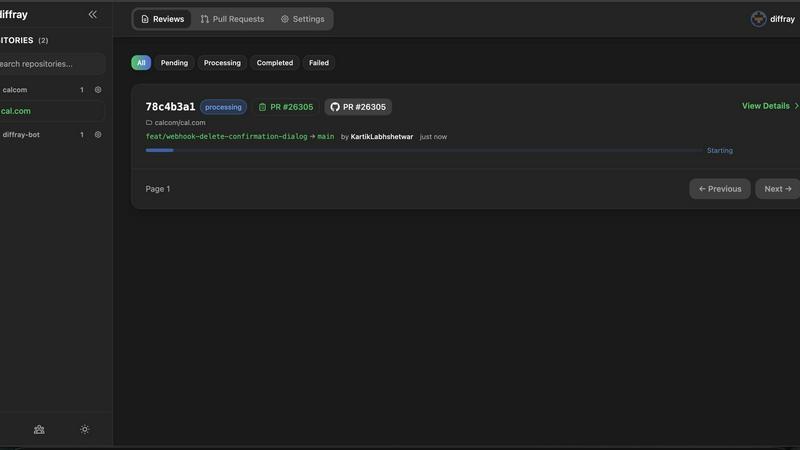
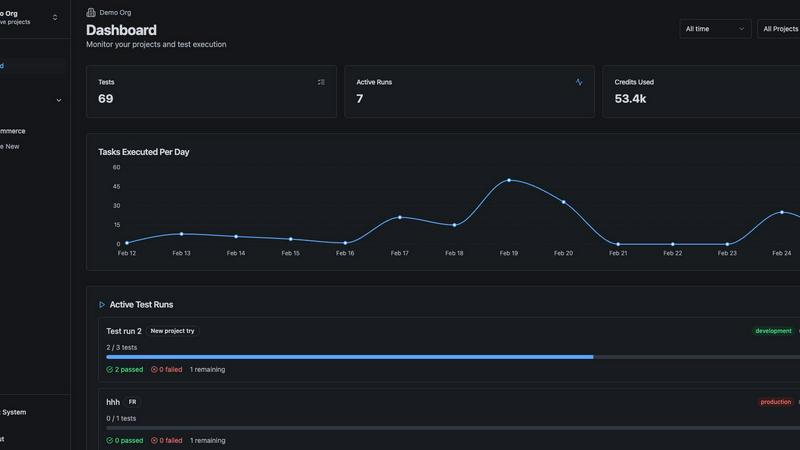
Visual Comparison
diffray
qtrl.ai
Feature Comparison
diffray
Multi-Agent Specialized Architecture
diffray's foundational feature is its team of over 30 specialized AI agents. Unlike a single AI that tries to be good at everything, each agent is an expert in one specific domain, such as security, performance, or code style. This specialization ensures that every aspect of your code is reviewed by an entity designed specifically to find those types of issues, leading to more accurate and relevant findings than a generalized tool can provide.
Full-Context Code Analysis
diffray moves beyond simple line-by-line diff review. It analyzes pull requests by understanding the full context of the codebase. This means it can identify how new changes interact with existing code, spot potential integration issues, and recognize patterns that only become apparent when viewing the system as a whole. This contextual awareness is fundamental to providing truly insightful and actionable feedback.
Actionable and Precise Feedback
The platform is engineered to reduce noise and focus on what matters. By leveraging its team of specialized agents, diffray filters out trivial suggestions and highlights critical, high-priority issues that require developer attention. The feedback is clear, precise, and directly tied to improving code security, performance, and maintainability, allowing developers to act on it with confidence.
Comprehensive Issue Coverage
diffray provides a complete review spectrum by deploying agents across all critical software quality domains. This includes dedicated analysis for security vulnerabilities, performance anti-patterns, common bug logic, adherence to language-specific best practices, and even considerations like SEO for relevant codebases. This comprehensive coverage ensures no critical aspect of code quality is overlooked.
qtrl.ai
Enterprise-Grade Test Management
This feature provides a structured foundation for all quality activities. It offers a centralized repository for test cases, plans, and runs, ensuring everything is organized and accessible. Full traceability links tests back to requirements, and detailed audit trails are maintained for compliance. It supports both manual and automated workflows, giving teams the flexibility to manage quality in a way that fits their current process while preparing for more advanced automation.
Progressive AI Automation
Instead of a sudden, all-or-nothing approach, qtrl.ai introduces automation progressively. Teams begin by writing high-level test instructions in plain English. When ready, they can leverage AI to generate detailed test scripts from those instructions. The AI also suggests new tests based on coverage gaps. Crucially, every AI-generated step is fully reviewable and approvable by a human, maintaining oversight and ensuring tests align with team expectations before execution.
Autonomous QA Agents
These are intelligent executors that operate within defined rules. They can run tests on demand or continuously across multiple real browsers and environments, such as development, staging, and production. The agents execute instructions precisely, providing real browser interaction rather than simulations. They operate with permissioned autonomy levels, meaning their actions are transparent and controllable, never making unpredictable "black-box" decisions.
Adaptive Memory & Multi-Environment Execution
The platform builds a living knowledge base of your application by learning from exploration, test execution, and discovered issues. This context makes test generation smarter over time. Coupled with robust multi-environment execution, teams can run tests across any stage of the development lifecycle. The system securely manages per-environment variables and encrypted secrets, which are never exposed to the AI agent, ensuring security and consistency.
Use Cases
diffray
Accelerating Pull Request Reviews
Development teams use diffray to dramatically reduce the time spent on manual code review cycles. By providing an immediate, expert-level first pass on every pull request, diffray surfaces critical issues early. This allows human reviewers to focus on higher-level architecture and logic discussions rather than basic bug-hunting, speeding up the merge process without sacrificing quality.
Enforcing Code Quality and Best Practices
Engineering leads and architects integrate diffray into their development workflow to consistently enforce coding standards and best practices across the entire team. The platform acts as an always-available, unbiased expert reviewer, ensuring that every piece of code meets organizational standards for security, performance, and style before it is even seen by a human reviewer.
Proactive Security and Performance Auditing
Organizations prioritize diffray for its deep, proactive analysis in critical areas. The specialized security agents continuously scan for vulnerabilities like injection flaws or insecure dependencies, while performance agents identify bottlenecks and inefficient patterns. This shifts security and performance left in the development lifecycle, preventing issues from reaching production.
Onboarding and Mentoring Junior Developers
diffray serves as an excellent educational tool for developers at the beginning of their careers. By providing instant, contextual feedback on code that explains not just the "what" but often the "why" behind best practices and potential pitfalls, it helps junior engineers learn and internalize high-quality coding patterns faster, accelerating their professional growth.
qtrl.ai
Scaling Beyond Manual Testing
For QA teams overwhelmed by repetitive manual test cycles, qtrl.ai provides a clear path forward. Teams can start by structuring their existing manual tests in the platform. Then, they can progressively automate the most tedious and high-value test cases using AI-generated scripts, freeing up human testers for more complex exploratory work and significantly increasing test coverage and execution speed.
Modernizing Legacy QA Workflows
Companies relying on outdated, siloed, or spreadsheet-based test management systems can consolidate their entire QA process into qtrl.ai. The platform brings test management, automation, and execution into a single, governed system. This modernization provides immediate benefits like real-time dashboards, audit trails, and traceability, while setting the stage for intelligent automation without a disruptive overhaul.
Governing Enterprise AI Testing
Enterprises with strict compliance, security, and governance requirements can safely adopt AI for testing with qtrl.ai. The platform's design ensures full visibility into all AI agent activities, maintains detailed audit trails, and keeps human oversight at the center. Teams can grant autonomy gradually, ensuring the AI operates within strict guardrails and corporate policies, making it a trustworthy solution for regulated industries.
Enhancing Product-Led Engineering
Product-led engineering teams that need to move fast without breaking things can integrate qtrl.ai into their CI/CD pipelines. The platform supports continuous quality feedback loops, allowing teams to run automated test suites against every build. AI agents can be tasked with verifying new features or conducting regression tests, providing rapid feedback and ensuring quality keeps pace with development velocity.
Overview
About diffray
diffray is a multi-agent AI code review platform designed to fundamentally improve the software development process. It addresses the core shortcomings of traditional, single-model AI review tools, which often generate excessive noise and miss critical issues. At its heart, diffray is built on a principle of specialization. Instead of relying on one general-purpose AI, it employs a team of over 30 distinct AI agents. Each agent is a dedicated expert in a specific domain, such as security vulnerabilities, performance bottlenecks, bug patterns, best practices, or SEO considerations. This targeted, back-to-basics approach allows diffray to conduct deep, investigative analysis of pull requests. It understands not just the diff but the full context of the codebase, leading to actionable, precise feedback that developers can trust and act upon immediately. The result is a dramatic reduction in manual review time and a significant increase in the quality and reliability of code merged into production. diffray is an essential tool for individual developers seeking to improve their craft, engineering leads responsible for team output, and organizations of all sizes committed to building secure, maintainable, and high-quality software.
About qtrl.ai
qtrl.ai is a modern QA platform designed to help software development teams scale their quality assurance efforts effectively. At its core, it addresses a fundamental challenge: the trade-off between speed and control. Many teams are caught between slow, unscalable manual testing and complex, brittle traditional automation tools. qtrl.ai provides a structured solution by combining enterprise-grade test management with intelligent, trustworthy AI automation. This creates a centralized hub where teams can organize test cases, plan test runs, trace requirements, and track quality metrics through real-time dashboards. The platform is built for progression, allowing teams to start with simple manual test management and gradually introduce AI-powered automation as they become comfortable. This makes it an ideal fit for product-led engineering teams, QA groups moving beyond manual processes, companies modernizing legacy workflows, and enterprises that require strict compliance and audit trails. Ultimately, qtrl.ai's mission is to bridge the gap, offering a controlled, transparent path to faster and more intelligent quality assurance without the risks associated with unpredictable "black-box" AI solutions.
Frequently Asked Questions
diffray FAQ
How is diffray different from other AI code review tools?
diffray is fundamentally different due to its multi-agent, specialized architecture. Most other tools use a single, general-purpose AI model to attempt all types of analysis, which can lead to generic, noisy, or incomplete feedback. diffray uses over 30 AI agents, each a domain expert, ensuring deep and precise analysis in areas like security, performance, and bugs. This results in more actionable, trustworthy, and context-aware reviews.
What programming languages and frameworks does diffray support?
diffray is designed to understand a wide array of modern programming languages and their associated frameworks. The specialized agent system allows for deep, language-specific analysis. For the most current and detailed list of supported languages and frameworks, please refer to the official diffray documentation, as this list is continually expanded based on the evolution of the software development landscape.
How does diffray handle the context of my entire codebase?
diffray does not just look at the changed lines in a pull request. It is engineered to ingest and understand the relevant context of your entire codebase. This allows its agents to analyze how new changes integrate with existing modules, identify broken dependencies, spot inconsistent patterns, and provide feedback that is meaningful within the full scope of your project, not just an isolated snippet.
Is my code secure when using diffray?
Code security is a foundational priority for diffray. The platform employs enterprise-grade security practices to protect your intellectual property. Your code is processed securely for the purpose of analysis, and diffray does not retain or use your code to train general AI models. You maintain full ownership and control of your code at all times.
qtrl.ai FAQ
How does qtrl.ai's AI differ from other "autonomous" testing tools?
qtrl.ai avoids a risky "black-box" approach. Its AI is designed for transparency and control. It does not make unpredictable decisions. Instead, it generates test steps from human instructions, which must be reviewed and approved before execution. You define the rules and level of autonomy. This progressive, governed model ensures the AI assists your team reliably and builds trust over time.
Can we use qtrl.ai if we are not ready for full AI automation?
Absolutely. qtrl.ai is built for progression. You can start by using it solely as a powerful test management platform to organize manual test cases, plans, and runs. When your team is ready, you can begin experimenting with AI-generated test creation for specific scenarios. The platform adapts to your pace, allowing you to increase automation gradually without any pressure to change your entire workflow overnight.
How does qtrl.ai handle security and sensitive data?
Security is a foundational principle. qtrl.ai offers enterprise-ready security measures. For automation, you can define environment-specific variables and encrypted secrets (like passwords or API keys). These secrets are never exposed to the AI agent during test execution. The platform provides full audit trails and is built to support compliance requirements, giving you control over your data and test assets.
Does qtrl.ai work with our existing development tools?
Yes, qtrl.ai is designed to integrate into real-world workflows. It offers requirements management integration, CI/CD pipeline support, and is built to work alongside your existing toolset. The goal is to enhance your current process, not replace it entirely. This allows teams to incorporate structured test management and intelligent automation without disrupting their established development lifecycle.
Alternatives
diffray Alternatives
diffray is a specialized AI code review platform in the software development category. It employs a multi-agent architecture to conduct deep, contextual analysis of code, focusing on catching real bugs and security issues rather than superficial style points. This approach sets it apart from more generalized tools. Users may explore alternatives for various practical reasons. These can include budget constraints, the need for integration with specific development platforms or CI/CD pipelines, or a desire for different feature sets, such as more granular control over review rules or team collaboration workflows. Every development team has unique requirements and constraints. When evaluating an alternative, focus on the core principles of effective code review automation. Look for tools that provide meaningful, actionable feedback to reduce developer noise. The ability to understand code in context, not just isolated changes, is crucial for catching architectural and logic errors. Ultimately, the goal is to find a solution that genuinely improves code quality and developer velocity.
qtrl.ai Alternatives
qtrl.ai is a modern quality assurance platform in the automation and developer tools category. It helps software teams scale their testing efforts by combining structured test management with intelligent AI agents. This approach allows teams to maintain full control and governance while gradually introducing automation. Users often explore alternatives for various reasons. Common considerations include budget constraints, the need for specific features not offered, or a requirement to integrate with a different set of existing development tools. The specific needs of a team's workflow and application stack are also key factors. When evaluating any alternative, it's wise to look at the core capabilities. Consider the balance between manual test organization and automated execution. Assess how the tool handles test maintenance and reporting. Finally, evaluate the level of control and transparency the platform offers, especially when it involves AI-driven features.