
iGPT
iGPT delivers secure, context-aware answers from email data, streamlining enterprise workflows with immediate.
Visit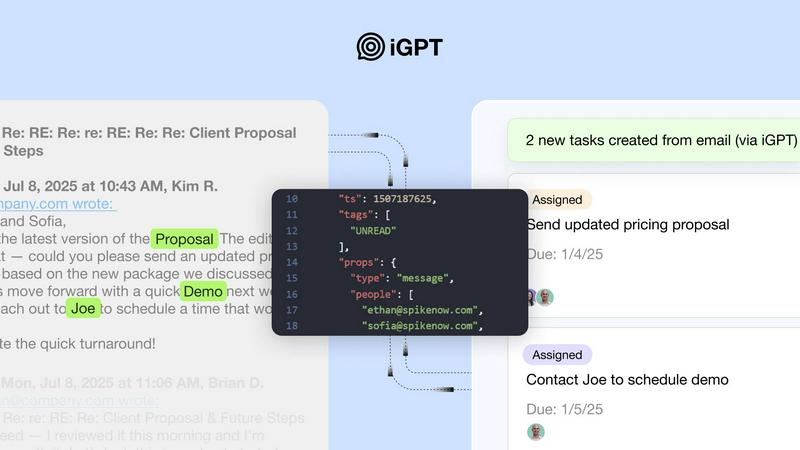
About iGPT
iGPT is an enterprise-grade API designed to empower businesses by providing a foundational intelligence layer for AI agents and workflows. It addresses a critical challenge in the modern workplace: the vast amounts of unstructured data found in emails and communications. While these channels are where real business transactions occur, they often confound traditional AI systems due to their conversational nature and heavy use of attachments. By transforming complex email threads, documents, and spreadsheets into context-aware, actionable insights, iGPT enables developers and enterprises to create intelligent systems that enhance sales, customer success, and compliance solutions. Its primary value proposition lies in its simplicity and security, as it streamlines the complex processes of data parsing and context extraction into a single, unified API call. This ensures that teams can deliver intelligent features rapidly, all while maintaining stringent security protocols and comprehensive audit trails, ensuring that sensitive data remains under the company's control and is not used for model training.
Features of iGPT
Immediate Integration
iGPT offers an easy integration experience with its SDK and live playground, allowing developers to test requests and responses quickly. This feature ensures that teams can get up and running with minimal hassle, enabling rapid deployment of AI solutions.
Contextual Responses
iGPT provides contextual responses that are ready for reasoning and automation. Each response includes citations to the source data, allowing users to trace back the information to its origin. This feature ensures that all insights are reliable and verifiable.
Hybrid Retrieval
The API employs a hybrid retrieval system that combines semantic, keyword, and filter-based searches. This approach allows for comprehensive data extraction and ensures that users receive the most relevant information in a single API call, enhancing efficiency and accuracy.
Continuous Data Indexing
iGPT continuously indexes new messages and attachments in real time. This feature ensures that the data and answers are always up-to-date, allowing users to rely on the most current information when making business decisions.
Use Cases of iGPT
Email Assistants
iGPT enables the creation of intelligent email assistants that can draft, prioritize, and act on emails with full context. This use case enhances productivity by automating routine tasks and ensuring important actions are not overlooked.
Workflow Automation
With iGPT, organizations can transform email threads into actionable tasks, deadlines, and approval requests. This streamlines workflows and helps teams keep track of progress, making it easier to manage projects and ensure nothing gets stuck.
Customer Support Copilots
Customer support teams can utilize iGPT to reconstruct the full customer story across long email chains and attachments. This capability allows support agents to understand the history and tone of conversations, improving the quality of customer interactions.
Compliance and Audit Trails
iGPT aids in compliance by providing a clear audit trail of feedback, approvals, and rationale linked back to original conversations. This feature is crucial for organizations that require transparency and accountability in their communication processes.
Frequently Asked Questions
What types of data can iGPT process?
iGPT can process various forms of unstructured data, including emails, documents, PDFs, and spreadsheets, turning them into actionable insights.
How does iGPT ensure data security?
iGPT employs enterprise-grade security measures, including role-based access control and zero data retention policies, ensuring that sensitive data remains under the company's control and is not used for model training.
Can iGPT integrate with existing systems?
Yes, iGPT is designed for immediate integration, with SDKs and a live playground that allows developers to test and connect email sources quickly.
What is the response time for iGPT?
iGPT typically delivers responses with around 200 milliseconds for retrieval and approximately 3 seconds to generate the first token, even when dealing with large, complex email data.
Similar to iGPT

Real-time App Store analytics with an AI copilot for portfolio owners.

Optilise is a Dutch Power BI consultancy helping SMEs get a grip on their numbers with clear BI software and solutions. We make companies self suffici

Omentir is an AI LinkedIn sales agent that finds qualified buyers, sends personalized outreach, follows up automatically, and organizes replies by int

AI Image Remover is a free browser tool for erasing people and objects from photos. Upload an image, brush a mask over the distraction

Managed remote build cache for Nx, Lerna, Turbo, Gradle, and Bazel. Reuse artifacts across CI and developer machines.

EchoLeads AI uses intelligent voice agents to automate cold calling, qualify leads, and schedule appointments across phone, SMS, and WhatsApp.

Fleetkeep pulls official MOT and tax data to show what every UK vehicle needs next, from compliance to maintenance.

Distro is an AI operator that maps buyer intent, drafts in your voice, and turns questions into content you approve.